
GDPR Secure Document Workflow: A Practical Use Case for Compliant AI Automation
This use case shows how to design a GDPR secure document workflow with AI, role-based access, audit logging, and compliant automation architecture.
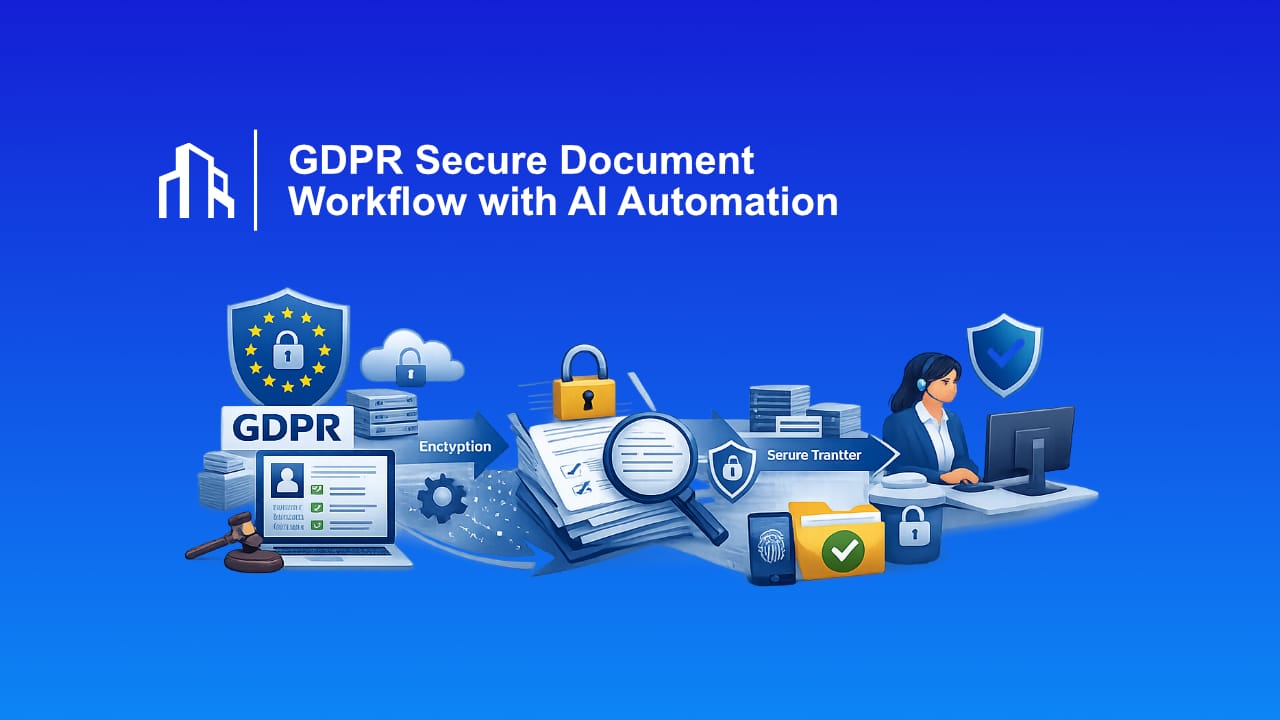
Why a GDPR Secure Document Workflow Is Now a Business Requirement
Many growing companies automate onboarding, contracts, HR files, and
compliance documentation. Few do it in a way that is actually GDPR-safe.
The result is predictable:
- Sensitive documents moving across email
- AI tools processing personal data without governance
- No audit trails
- No clear consent logging
- No role-based access enforcement
From a legal perspective, this is exposure. From an operational
perspective, it is chaos.
A GDPR secure document workflow is not just about encryption. It is
about architecture, access control, logging, and AI governance built
into the system from the start.
This article walks through a real-world use case and shows how to
implement it in a scalable way.
The Use Case: Automating Employee Contract Processing in the EU
The Situation
A mid-sized SaaS company operating in Germany and the Netherlands needed
to automate its employee contract workflow.
Their existing process looked like this:
- HR created contracts in Google Docs.
- Contracts were emailed as attachments.
- Signed versions were returned via email.
- Files were manually uploaded into shared folders.
- No structured consent logging.
- No centralized audit log.
They wanted:
- AI-assisted document validation
- Automated storage
- Role-based access control
- Full GDPR compliance
- A defensible audit trail
The Compliance Risks
Before redesigning the workflow, we identified the key GDPR risks:
- Personal data processed by AI without a Data Processing Agreement
- No defined data retention policy
- No logging of document access
- No structured consent records
- No separation between HR and management access
Under GDPR, this exposes the company to regulatory risk and reputational
damage.
A compliant solution requires privacy by design and privacy by default.
The GDPR Secure Document Workflow Architecture
The solution was built around four layers:
1. Controlled Data Intake
Contracts are generated inside a secure environment.
Data inputs are validated before document creation.
No raw personal data is sent to AI tools without:
- Anonymization where possible
- A compliant processing agreement
- Clearly defined purpose limitation
2. Secure Document Processing
AI is used to:
- Validate missing fields
- Check formatting consistency
- Flag legal clause inconsistencies
The AI system does not store documents permanently.
Processing happens within controlled sessions.
3. Automated Storage with Role-Based Access
Once signed:
- Documents are stored in a structured repository
- Access is granted based on department and role
- All access is logged automatically
No shared folders.
No manual uploads.
No uncontrolled duplication.
4. Full Audit Trail
Every action is logged:
- Document creation
- Edits
- AI validation
- Signature completion
- Access history
This creates a defensible compliance posture.
Technology Stack Example
Depending on scale, the workflow can be implemented using:
- Custom middleware for secure orchestration
- Encrypted storage environments
- Identity-based access control
- Audit logging infrastructure
- Automation tools like Make.com or n8n for smaller environments
For larger organizations, custom middleware is preferred to ensure
strict governance and control over AI processing flows.
Where AI Fits in a GDPR Secure Workflow
AI can safely be used for:
- Clause comparison
- Document summarization
- Data validation
- Risk flagging
- Internal compliance checks
AI should not:
- Store sensitive personal data unnecessarily
- Operate without logging
- Be integrated without legal review
AI enhances productivity.
Architecture protects compliance.
Measurable Business Impact
After implementation, the company achieved:
- 70 percent reduction in manual HR processing time
- 100 percent audit visibility
- Zero uncontrolled document transfers
- Clear data retention policies
- Reduced legal exposure
Compliance became operationally embedded, not reactive.
Key GDPR Controls Embedded in the Workflow
A properly designed GDPR secure document workflow includes:
- Purpose limitation mapping
- Data minimization logic
- Access control enforcement
- Consent capture and storage
- Encryption at rest and in transit
- Automated retention triggers
- Audit logs that cannot be altered
Without these, automation increases risk instead of reducing it.
Common Mistakes Companies Make
- Using AI tools without checking data processing terms
- Sending personal data through email attachments
- Storing documents in shared drives without access control
- Failing to log document access
- Mixing EU and non-EU processing environments
These shortcuts create long-term liability.
When You Need Custom Middleware Instead of No-Code Tools
For startups, tools like Make.com can work if configured carefully.
For scale-ups and enterprise environments, you need:
- Dedicated orchestration logic
- Strict API-level logging
- Centralized policy enforcement
- Separation of processing layers
- Full observability
This is where a secure architecture mindset becomes essential.
Final Thoughts
A GDPR secure document workflow is not about adding encryption to a
broken process.
It is about redesigning document handling with compliance embedded at
every layer.
AI and automation are powerful.
Without governance, they create exposure.
With proper architecture, they create leverage.
If you are automating contracts, onboarding, HR files, or legal
documents in the EU, compliance cannot be optional.
It must be engineered.
Frequently Asked Questions
What is a GDPR secure document workflow?
A GDPR secure document workflow is an automated document process
designed with privacy by design principles, including access control,
logging, encryption, and lawful data processing safeguards.
Can AI be used in GDPR-compliant document workflows?
Yes, if AI processing follows data minimization principles, has proper
legal agreements in place, and does not store personal data
unnecessarily.
Do small companies need this level of compliance?
If you process EU personal data, GDPR applies regardless of company
size. The architecture may be simpler, but compliance remains mandatory.
How can Scalevise help with this?
Scalevise helps businesses turn complex digital challenges into scalable
solutions. Whether you're facing compliance, automation, integration, or
innovation hurdles our team delivers custom strategies and
implementations that work.