
Google’s Gemini 4 Argon, Connected Apps and Custom Skills Reshape AI Workflows
Google is expanding Gemini with the Gemini 4 Argon model, connected-app integrations and custom skills that can bring more work into a single AI environment.
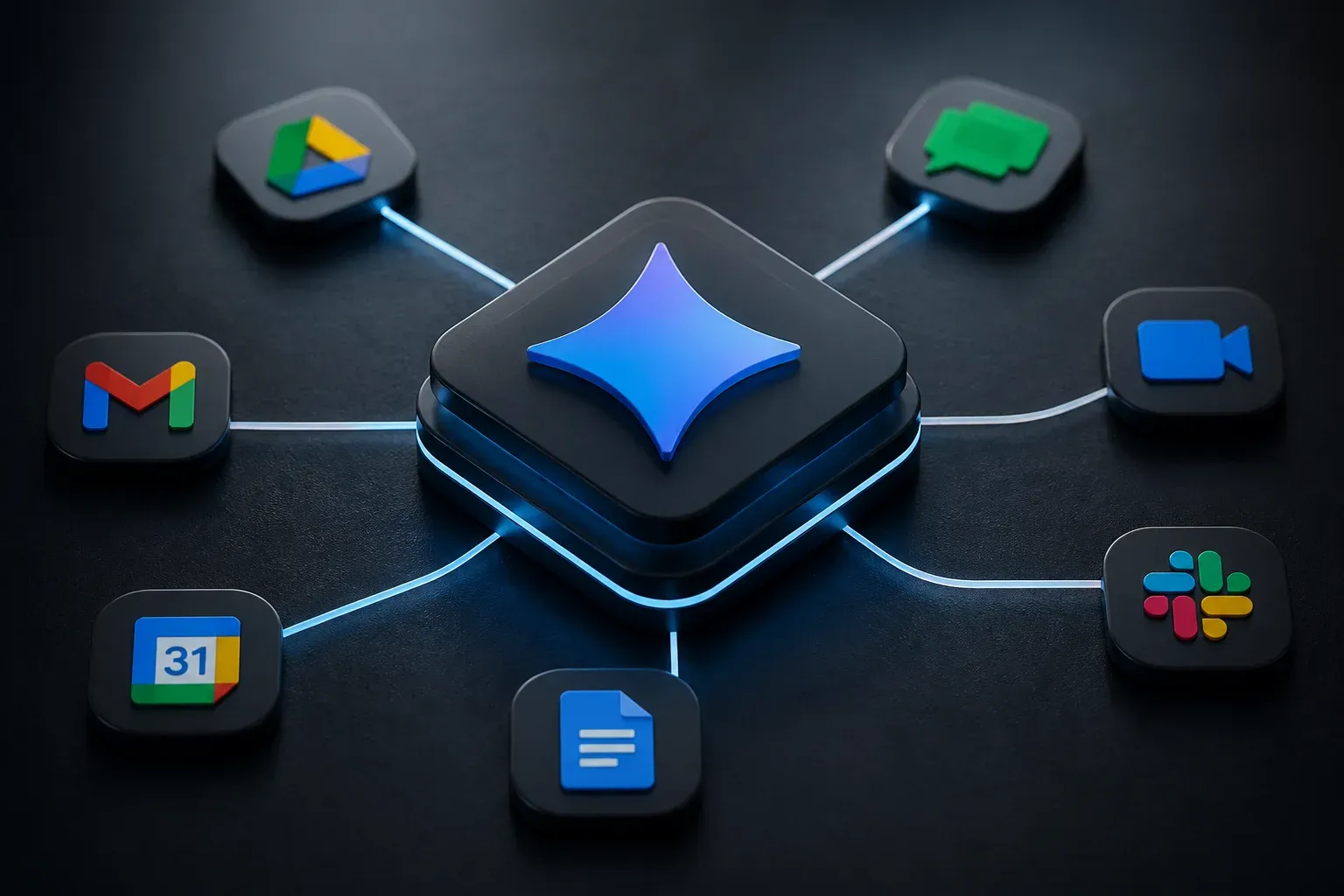
Google is expanding Gemini on several fronts at once: the global release of Gemini 4 Argon, a wider set of connected apps, and demonstrations of custom skills and reusable prompt commands. Together, the changes position Gemini as more than a standalone chat interface. For teams, the practical opportunity is to bring complex AI work, business tools and repeatable tasks closer together, while keeping a close eye on access, rollout details and usage-based API costs.
Google describes Argon as its flagship frontier model for deep, long-horizon work across fields including coding, finance, legal, cybersecurity and science. In its official Gemini 4 Argon announcement, Google says the model is globally available through the Gemini API and AI Studio for developers, the Gemini platform for enterprise customers, and selected consumer experiences. The release is therefore a product rollout across multiple Gemini surfaces, not a single feature update.
What the Gemini rollout brings
Gemini 4 Argon expands access to long-horizon AI work
Argon is intended for complex work that can require substantial context and multiple steps. Google highlights support for complex multi-agent workflows, as well as improvements to grounding and safety. For developers using the Gemini API, Google lists a 1,000,000 token unified input-output limit, giving applications room to handle large bodies of information and generate detailed outputs within the same limit.
That can matter where work is fragmented across documents, code, data and project materials. A development team, for example, may evaluate whether a large-context model can assist with a broader body of technical material rather than a short isolated prompt. But the model does not remove the need to validate important outputs, particularly in high-stakes domains that Google itself identifies, such as legal, financial and cybersecurity work.
Google’s consumer availability is also tiered by surface. Argon is available in Google Antigravity for Ultra subscribers, while the Gemini app and AI Mode in Search offer it for Ultra and Pro users. Organizations should therefore distinguish between an employee using a consumer Gemini surface and a team building a workflow through the API or Gemini platform. The access path affects both the available experience and how the work can be integrated.
Connected apps bring more tools into Gemini
A separate Google update published on September 23, 2026 outlined a broader rollout of connected apps in Gemini. These integrations can be enabled through settings or invoked through chat prompts, allowing Gemini to connect with a growing range of third-party services.
The named integrations span several common work categories:
- Productivity tools: Airtable, Linear, monday.com, PandaDoc, Wispr AI and Zoho.
- Creative and web tools: Adobe, Picsart, Squarespace and Webflow.
- Lifestyle services: apartments.com, Experian, Peloton and SeatGeek.
For businesses, the most relevant implication is less context switching. A user can potentially work with information and actions associated with familiar apps from within Gemini, rather than treating the AI tool as a separate destination. The real value will depend on which integrations are available to an account and whether they match an existing process. A connection is useful only when it reduces a genuine handoff, such as moving from project information to a draft, a plan or a follow-up task.
| Gemini workflow component | Confirmed role | Confirmed access or example |
|---|---|---|
| Gemini 4 Argon | Flagship model for deep, long-horizon tasks | Gemini API, AI Studio, Gemini platform and selected consumer surfaces |
| Connected apps | Connects Gemini with third-party services | Configured through settings or chat prompts, with apps including Airtable, Linear and Webflow |
| Custom skills and slash commands | Supports reusable instructions for repetitive work | Google demonstrated custom skills and commands such as /goal in Antigravity |
Custom skills can standardize repetitive prompts
Google also highlighted custom skills and slash-command prompts in Antigravity, including a /goal example. The important distinction is that these tools can make recurring instructions easier to reuse. Instead of repeatedly rebuilding the same prompt structure, a team can standardize a known pattern for a defined task.
That is potentially useful for recurring work such as creating a project brief, preparing a structured review, turning source material into a first draft or framing a coding task. The strongest starting point is a task that is already repetitive, has a clear expected format and still has a person responsible for reviewing the result. Custom instructions can improve consistency, but they should not be treated as proof that every task can be automated safely or without oversight.
API pricing makes workload design important
Google has introduced Argon API pricing at $2 per million input tokens and $10 per million output tokens. Cached input tokens receive a 95% discount. Google says the public Argon model is scheduled to move to $4 per million input tokens and $20 per million output tokens after November 30, 2026.
This pricing structure makes workflow design a commercial consideration, not just a technical one. Large-context tasks and lengthy generated outputs can be valuable, but they also consume more tokens. Teams considering the API can evaluate where Argon’s long-horizon capability delivers enough value to justify usage, and where a shorter prompt or a different workflow is sufficient. Reusing stable context through caching may be particularly relevant when an application repeatedly works from the same material.
The broader rollout does not answer every implementation question. Google’s announcements identify the model’s access routes, pricing path and named connected apps, but organizations still need to verify the services available in their own Gemini environment. They also need to test whether a proposed workflow produces reliable results with their actual documents, task definitions and review process.
For companies trying to turn Gemini’s expanding capabilities into measurable operational gains, Scalevise can help prioritize suitable use cases, map the workflow around the people and systems already in place, and avoid investing in impressive but low-value experiments. A practical AI implementation and workflow assessment can identify where connected tools, reusable prompts or API-based AI work can reduce manual effort while retaining the right human checks. Request an AI consultancy discussion.
Frequently Asked Questions
What is Gemini 4 Argon?
Gemini 4 Argon is Google’s flagship frontier model for deep, long-horizon tasks. Google says it is available globally through the Gemini API, AI Studio, the Gemini platform and selected consumer Gemini experiences.
What does Gemini 4 Argon cost through the API?
Google’s introductory API price is $2 per million input tokens and $10 per million output tokens. Cached input tokens receive a 95% discount. Google says public Argon pricing changes to $4 per million input tokens and $20 per million output tokens after November 30, 2026.
Which apps can connect to Gemini?
Google has named connected apps including Airtable, Linear, monday.com, PandaDoc, Wispr AI, Zoho, Adobe, Picsart, Squarespace and Webflow. Google says connections can be managed through settings or used through chat prompts.
How do custom skills fit into Gemini workflows?
Google demonstrated custom skills and slash-command prompts in Antigravity, including /goal. They can help users reuse a defined instruction pattern for repetitive tasks, but outputs should still be reviewed for accuracy and suitability.
Conclusion
Gemini 4 Argon, connected apps and custom skills form a coordinated expansion of Google’s AI workspace. Argon adds a large-context, long-horizon model with defined API pricing, while integrations and reusable instructions can make Gemini more useful inside everyday work. The practical test for businesses is whether these features simplify a specific process, preserve appropriate review and justify their ongoing usage cost.