
GPT-5.2 Shopping Research Assistant: How Buyers Search and Compare Products
How buyers use ChatGPT to research and compare products, and how businesses can become visible in AI-driven buying journeys.
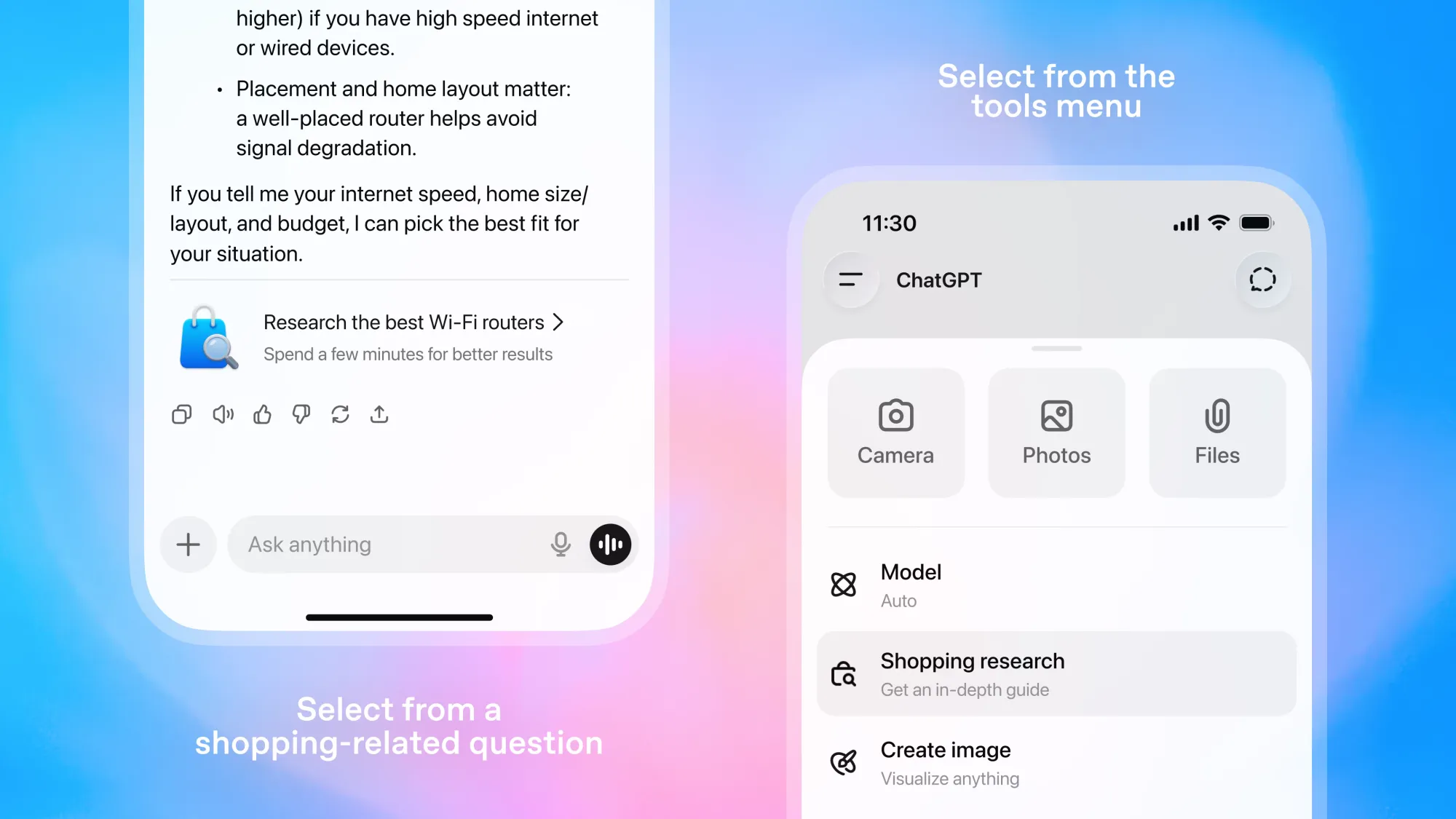
Modern buyers these days do not simply search, compare a few pages, and click through to an online store. Increasingly, they start with a conversation. They describe a problem, explore options, and seek guidance before even identifying the product they want.
The advent of GPT-5.2 has accelerated this shift, transforming tools like ChatGPT into a practical research assistant for shopping and purchasing decisions. Moving beyond a passive answer engine, the model now actively helps users think through choices, constraints, and trade-offs.
For businesses, this changes the rules of discovery. Visibility no longer hinges solely on search rankings. It depends on whether an AI system can clearly understand:
- What you offer.
- Who your target audience is.
- How your solution compares to alternatives.
From Search Results to Active Decision Support
Traditional search assumes the user knows what they are looking for. AI-driven research, utilizing GPT-5.2, does not make that assumption.
When a buying intent is expressed, ChatGPT’s initial focus is on understanding the situation rather than immediately pushing suggestions.
- A conversation often starts vague or incomplete.
- The assistant treats this uncertainty as a signal, not a problem.
- It clarifies intent and context before moving toward concrete options.
This behavior mimics a human advisor. The core goal is relevance and confidence, not speed.
Common Starting Points for AI Product Research
Most users engage AI with a question or a challenge, such as choosing software, evaluating services, or deciding between competing solutions.
Typical prompts include:
- "I’m looking for a tool to manage X, what are the key considerations?"
- "Can you help me compare options for my business needs?"
- "What would you recommend given these specific constraints?"
At this stage, GPT-5.2 avoids premature product naming and focuses on building a precise mental model of the user's requirements.
The Critical Role of Follow-Up Questions
A defining characteristic of GPT-5.2 in shopping scenarios is its use of targeted follow-up questions. These are precise clarifications that shape the recommendation logic.
ChatGPT typically explores areas such as:
- Intended use and budget sensitivity.
- Operational constraints and integration needs.
- Scalability, compliance, and risk tolerance (especially in B2B contexts).
These questions serve to reduce the chance of a poor recommendation and strategically narrow the decision space to viable options. The final output is consequently more deliberate and trustworthy.
How AI Recommendations Are Formed
Once sufficient context is gathered, the AI moves into evaluation. It doesn't present a long list. Instead, it reasons through a small set of fitting options and explains the rationale behind them.
The assistant highlights strengths and weaknesses in plain language, detailing:
- Where a solution excels.
- Where it compromises.
- Under which specific circumstances it is the optimal choice.
Key Takeaway: The clear explanation of why something fits the user’s situation often provides more value than the recommendation itself, significantly increasing user trust and reducing decision anxiety.
Implications for Business: Achieving AI Visibility
The shift is clear: being discoverable in AI-driven research is about precision and clarity, not manipulating prompts.
If an AI cannot confidently infer your product's core value, target audience, and competitive differentiation, it cannot recommend it. Ambiguous positioning and inconsistent messaging actively work against AI-powered discovery.
Companies must think beyond traditional SEO pages and landing funnels. They need to prioritize machine-readable understanding and comparison readiness.
Common Visibility Blockers in AI Research
The assumption that general web visibility automatically translates to AI recommendations is often incorrect.
Common reasons why businesses fail to surface include:
- Unclear Value Proposition: The unique benefit is not immediately explicit.
- Missing Use-Case Descriptions: Failure to explicitly state when the product performs best.
- Fragmented Information: Essential details are scattered across multiple pages.
- Lack of Explicit Comparison Context: Not defining how the product stacks up against generic alternatives.
Visibility in conversational research is earned through precision, not sheer volume.
How Scalevise Optimizes AI Discoverability
At Scalevise, we help businesses adapt to this new reality. Our focus is on making products and services understandable and highly relevant for AI-driven research and decision flows, without resorting to artificial optimization.
We partner with companies to:
- Clarify positioning specifically for AI consumption.
- Structure offerings and content to align with how modern AI systems reason through choices.
- Ensure your content is optimized for machine-readable context.
The goal is straightforward: When potential buyers use ChatGPT to research solutions, your business should be presented as a credible, explainable, and confident option.