
OpenAI GPT-5.3-Codex Strengthens the Case for Auditable COBOL Modernization
OpenAI's latest Codex release and its documented COBOL workflow point to a more structured approach to understanding, translating, and validating legacy software.
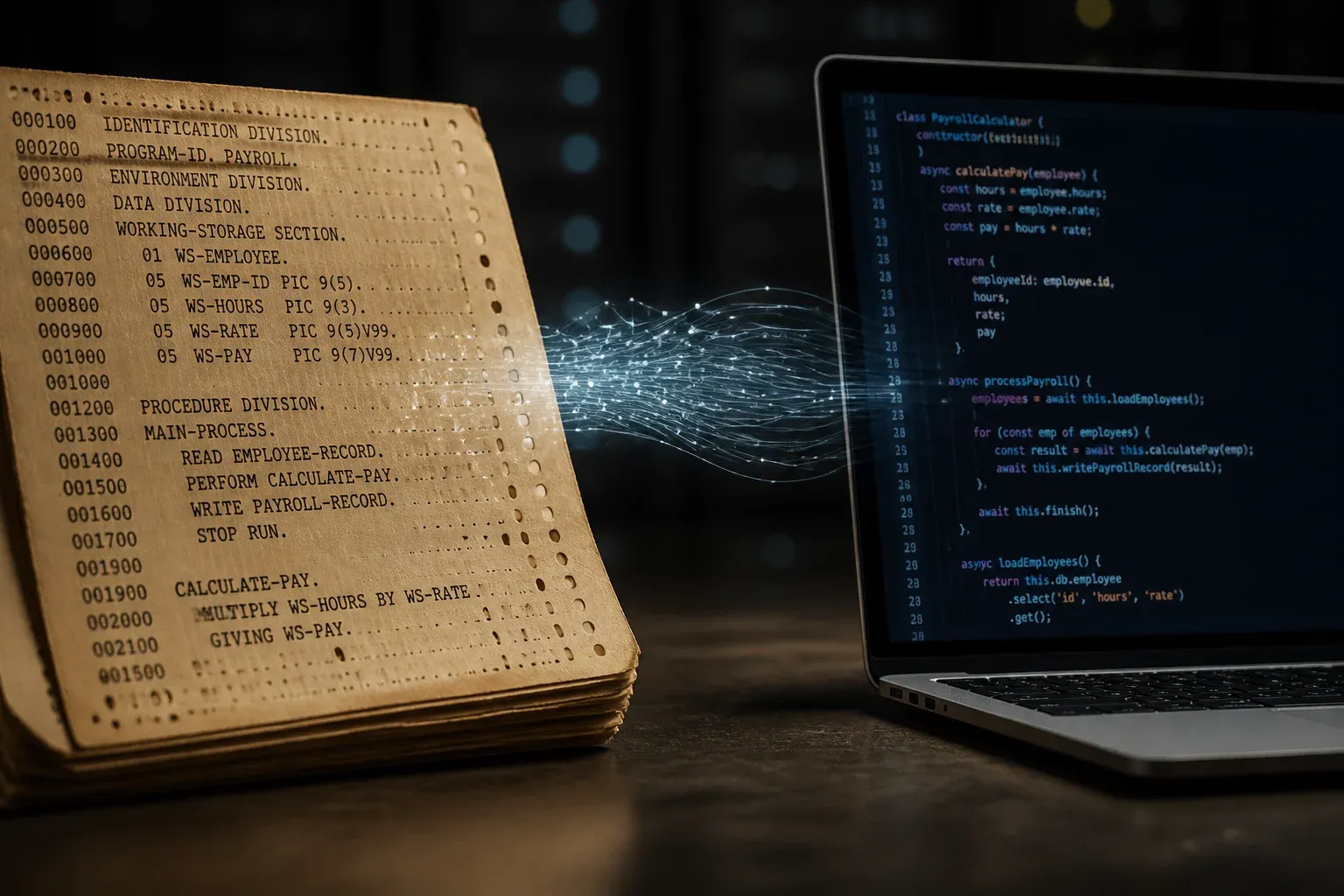
OpenAI is positioning GPT-5.3-Codex for more capable coding, debugging, and end-to-end software work, a development that has particular relevance for organizations maintaining difficult legacy applications. The strongest first-party evidence concerns COBOL: OpenAI has published a Codex workflow for modernizing COBOL codebases that emphasizes discovery, business-rule extraction, translation, and testing rather than a one-step code conversion.
In its February 2026 official GPT-5.3-Codex announcement, OpenAI said the model improves coding and agentic software workflows across the Codex app, CLI, and IDE integrations. That broader capability matters for legacy modernization because old systems rarely consist of one language file. They commonly involve application code, batch jobs, shared definitions, data sources, and operational behavior that must continue to work after a migration.
For businesses, the practical opportunity is not simply to replace old syntax with a newer language. It is to use AI-assisted workflows to make a poorly understood codebase more legible, identify dependencies, produce migration artifacts, and verify whether the replacement preserves critical behavior. The documented process also makes clear that AI output needs disciplined review and parity testing before it can support production change.
What OpenAI has documented for legacy modernization
OpenAI's Codex Cookbook, published in November 2025, uses COBOL as its running example for a five-phase modernization pipeline. The workflow covers the components that often make legacy work risky: COBOL programs, JCL, copybooks, data sources, and parity testing. It is designed to create a auditable migration process, rather than treating modernization as a black-box generation task.
The five phases provide a useful operating model:
- Inventory and understand the estate, including the programs and supporting assets involved.
- Extract business rules from existing code and related artifacts.
- Create modernization artifacts that document the intended target behavior and structure.
- Generate or refactor implementation work with Codex as part of the software workflow.
- Test for behavioral parity so teams can compare the modernized system with the legacy application.
This sequencing is significant. A COBOL program may encode rules developed over many years, including exceptional cases that are not represented in a separate specification. Translation without investigation can preserve syntax while losing the operational logic that users and downstream systems depend on. The cookbook's focus on source analysis and parity testing addresses that core problem.
Stronger model capability does not remove migration discipline
GPT-5.3-Codex is presented as a stronger model for software tasks, including debugging and agentic workflows. That can improve the quality and speed of work performed across a modernization project, such as analyzing modules, preparing documentation, generating tests, and iterating on implementation changes.
But the available materials do not establish that Codex can autonomously complete a production migration without human oversight. The formal COBOL workflow points in the opposite direction: modernization is a multi-stage engineering effort in which teams inspect outputs, retain traceability, and test for equivalent behavior. For a business application tied to payments, public services, or other essential operations, that distinction is more important than the speed of initial code generation.
| Area | What the verified material supports | What remains less directly documented |
|---|---|---|
| COBOL modernization | OpenAI's Codex Cookbook provides a five-phase workflow using COBOL, JCL, copybooks, data sources, and parity testing. | Project-specific outcomes still depend on the codebase, target architecture, validation, and engineering review. |
| Fortran | Fortran appears in partner and ecosystem discussions about broader legacy modernization. | The supplied OpenAI first-party material does not provide an equivalent formal Fortran workflow. |
| Visual Basic | The wider claim concerns legacy-language migration work. | OpenAI's first-party materials supplied here do not consistently document Visual Basic as a specifically targeted modernization language. |
Where Codex can fit into an existing delivery process
The release's support across the Codex app, command-line interface, and IDE integrations gives development teams several ways to place the model alongside existing practices. Rather than replacing source control, issue tracking, test suites, or release controls, Codex can be used within the work developers already perform.
A practical implementation can begin with a bounded application area and a clear success criterion. For example, a team might first use Codex to inventory dependencies and explain business rules in a selected COBOL module. It can then create tests around the existing behavior before any translation is attempted. This produces evidence that can guide later refactoring and gives reviewers something more concrete than generated code alone.
That approach is especially relevant when a company has limited internal familiarity with its oldest applications. The near-term value may be improved documentation and test coverage, not an immediate full-platform replacement. Those artifacts can reduce discovery time, make supplier conversations more informed, and help teams decide which parts of an estate are realistic modernization candidates.
OpenAI's materials should not be read as a fixed return-on-investment promise. Migration cost and value depend on factors such as application complexity, the availability of knowledgeable reviewers, data dependencies, testing quality, and the intended target system. However, the documented workflow identifies where AI assistance can contribute: repetitive analysis, artifact creation, code transformation support, and test-oriented validation.
For companies considering this route, the key question is not whether an AI model can produce modern code from a legacy file. It is whether the organization can establish a repeatable process that preserves business rules, creates reviewable evidence, and detects behavior changes before release.
Modernizing a legacy estate with AI requires more than access to a capable coding model. Scalevise can help teams assess suitable use cases, map a controlled adoption plan, and connect AI-assisted development to real engineering workflows through practical AI implementation consulting. The goal is to reduce manual discovery work without turning critical software change into an uncontrolled experiment. Request an AI consultancy discussion to define a testable modernization path.
Frequently Asked Questions
What is GPT-5.3-Codex?
GPT-5.3-Codex is an OpenAI model release described as improving coding, debugging, end-to-end software work, and agentic workflows across the Codex app, CLI, and IDE integrations.
Does OpenAI provide a documented COBOL modernization workflow?
Yes. OpenAI's Codex Cookbook presents a five-phase COBOL modernization pipeline covering code and asset discovery, business-rule extraction, modernization artifacts, implementation work, and parity testing.
Can Codex modernize Fortran and Visual Basic applications?
The supplied research supports broader legacy modernization discussions involving Fortran, but it does not provide an equivalent OpenAI first-party workflow. Visual Basic is not consistently documented in the supplied OpenAI materials as a specifically targeted modernization language.
Why is parity testing important in legacy migration?
Parity testing helps teams compare a modernized application with the legacy system to identify behavior changes. It is a central part of OpenAI's documented COBOL workflow because generated or refactored code still needs validation.
Conclusion
GPT-5.3-Codex adds stronger coding and software-workflow capabilities, while OpenAI's COBOL cookbook supplies the more important practical lesson for legacy migration: successful modernization depends on structured discovery, traceable artifacts, and behavioral testing. For organizations with hard-to-maintain software, Codex may help accelerate the work, but careful engineering validation remains the foundation of a credible migration.