
OpenAI Codex App: The Next Evolution in AI Coding and Automation
OpenAI’s Codex app introduces a powerful agentic coding environment driven by GPT-5.3-Codex, enabling autonomous feature development, debugging, testing, and parallel workflows
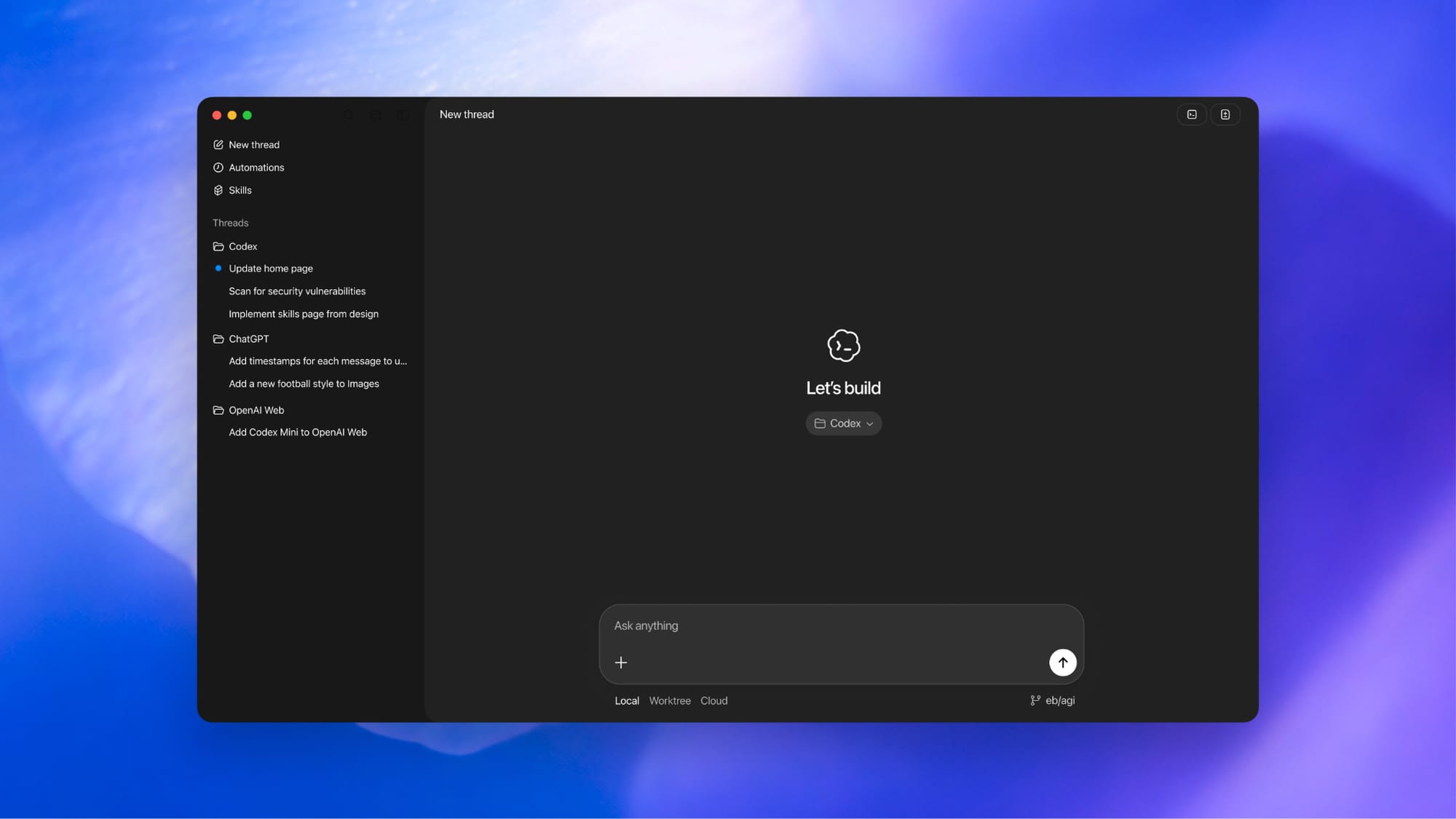
OpenAI has introduced the Codex app, a dedicated AI-driven coding environment designed to fundamentally change how developers build and manage software. Unlike traditional coding assistants that operate inside an IDE and react to prompts, the Codex app functions as an execution layer for autonomous development tasks.
It represents a structural shift toward agent-based software engineering, where AI systems do not merely suggest code but actively execute scoped development work under supervision.
What the Codex App Actually Is
The Codex app is a standalone AI coding environment built around autonomous agents. Instead of generating isolated snippets, it allows users to define structured objectives across repositories and workflows.
An agent can:
- Analyze an entire codebase
- Break down objectives into executable steps
- Write or refactor code
- Run validations and test suites
- Propose structured updates
- Adjust behavior based on feedback
The interaction model changes from command-response to task delegation and review. Developers define direction. The agent executes. Humans supervise and approve.
From Reactive Assistance to Autonomous Execution
Most AI coding tools today are reactive. You type a request, and they return a response. The context is limited to the immediate interaction.
The Codex app introduces continuity. Once assigned a task, the agent maintains context across execution stages. It plans, implements, tests, and reports without requiring constant prompting.
Instead of asking for a function or a refactor in isolation, you can assign broader objectives such as implementing authentication logic across a project, migrating a legacy module, or improving test coverage throughout a repository.
Multi-Agent Orchestration
One of the defining characteristics of the Codex app is the ability to coordinate multiple agents in parallel.
Different agents can handle different workstreams, such as:
- Feature implementation
- Bug resolution
- Documentation updates
- Test generation
- Refactoring tasks
Each operates within an isolated environment, allowing teams to explore parallel development paths without destabilizing the main codebase.
This parallelism introduces a new layer of productivity. Instead of sequential work handled by one developer at a time, structured tasks can be executed simultaneously under review control.
Context Preservation Across Projects
A major limitation of traditional AI coding tools is context fragmentation. Each prompt starts almost from scratch.
Codex agents are designed to preserve context across extended sessions and repositories. They understand project structure, dependencies, conventions, and architectural patterns.
This allows them to operate at a higher abstraction level. Rather than responding line by line, they operate at the level of modules, services, or system layers.
That distinction enables more strategic development support.
Core Capabilities
The Codex app focuses on execution rather than suggestion. Core capabilities include:
Autonomous Code Generation
Agents can implement structured features spanning multiple files and directories while respecting project conventions.
Intelligent Refactoring
Large code sections can be restructured for performance, readability, or modernization without manual rewriting.
Automated Testing
Agents can generate and expand test coverage, run validation suites, and flag inconsistencies.
Bug Detection and Resolution
Pattern recognition across repositories allows the agent to identify probable defects and propose fixes.
Workflow Reporting
Execution progress is communicated in structured summaries, making oversight manageable.
The emphasis is not on replacing developers but on amplifying throughput.
Who Benefits Most
The Codex app is particularly relevant for:
Software Developers
Reduce repetitive implementation tasks and accelerate delivery timelines.
Engineering Teams
Coordinate complex workstreams without increasing manual coordination overhead.
Technical Leads
Delegate defined objectives while retaining architectural control.
Product Teams
Prototype faster and validate ideas without extensive engineering bottlenecks.
The greatest gains occur when the tool is integrated into structured development workflows rather than used casually.
Real Business Use Cases
Autonomous Feature Development
A high-level feature specification can be assigned to an agent, which then implements the required logic, integrates dependencies, and prepares code for review.
Large-Scale Refactoring
Legacy systems often require modernization. Agents can refactor outdated modules systematically while preserving functionality.
Continuous Integration Support
Agents can monitor failing tests, suggest fixes, and expand coverage automatically, supporting CI/CD pipelines.
Multi-Repository Management
For organizations managing multiple services, agents can operate across repositories simultaneously, aligning updates and ensuring consistency.
Architectural Considerations
Despite its capabilities, adoption requires discipline.
Organizations should:
- Define clear authority boundaries for agents
- Enforce review processes before merges
- Log and monitor changes systematically
- Begin with non-critical repositories
- Standardize interaction frameworks
Autonomy without governance introduces risk. Structured integration mitigates it.
What This Signals About AI Development
The Codex app reflects a broader transition in AI tooling. We are moving from tools that assist humans toward systems that execute defined objectives under supervision.
This changes the role of developers. Instead of writing every implementation detail, they increasingly define direction, architecture, and quality thresholds.
Software engineering shifts from manual construction toward supervised orchestration.
Conclusion
The OpenAI Codex app is not just another coding assistant. It is an autonomous development environment built around agent-driven execution.
By combining contextual awareness, parallel workflows, structured reporting, and adaptive reasoning, it introduces a new model for building software at scale.
Developers remain in control, but execution becomes faster, more parallel, and more structured.
The evolution from assistant to autonomous agent has begun.