
Why OpenAI Is Choosing an Ad Free ChatGPT and How That Decision Reshapes Online Visibility
OpenAI avoids advertising by choice. This protects trust but removes corporate control over how content is interpreted and shown inside ChatGPT. The shift demands a new approach to visibility.
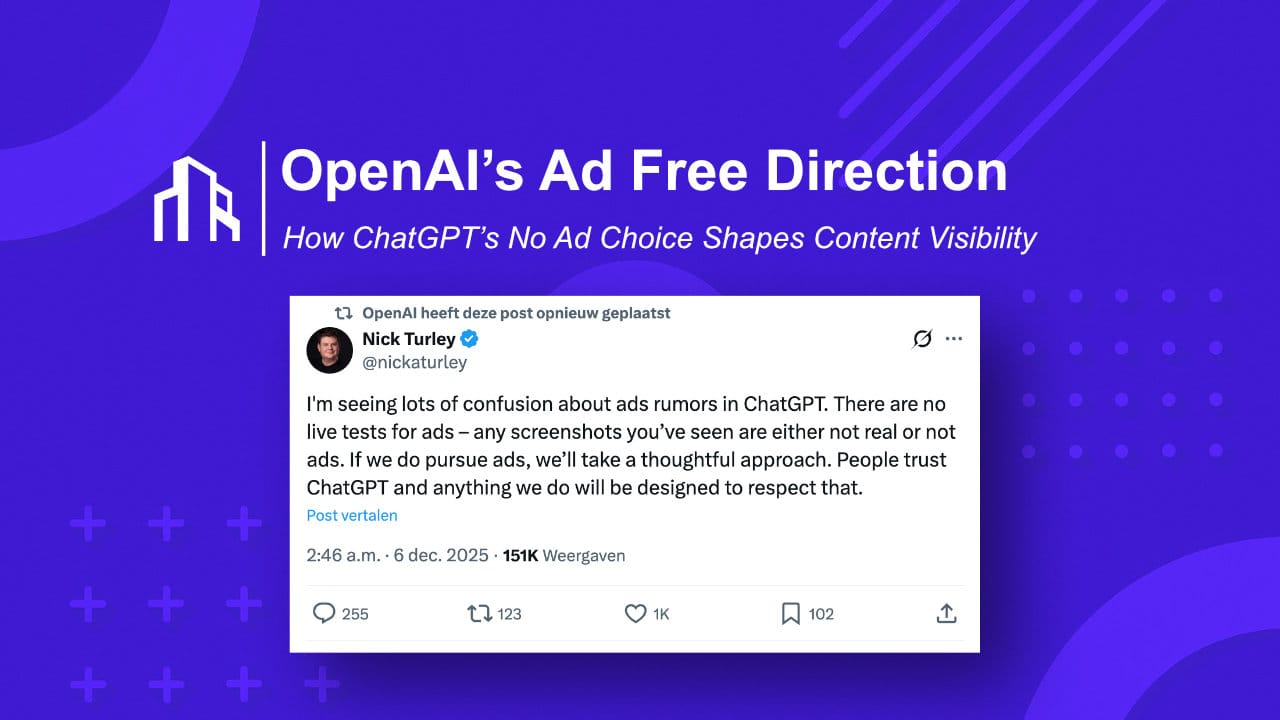
UPDATE: ChatGPT Go Now Has Ads
The recent clarification from Nick Turley that ChatGPT is not testing ads was more than a denial of a rumor. It highlighted an intentional strategic choice by OpenAI. The platform is not avoiding ads because it cannot support them or because the model would struggle with monetisation. It is simply not interested in building an advertising driven ecosystem. OpenAI is choosing to keep ChatGPT free of paid placements to preserve trust, maintain neutrality and scale through a product based revenue model rather than an attention based one.
This decision reshapes how businesses must think about visibility in an AI first world. ChatGPT has become a dominant discovery interface where answers appear instantly without redirecting users to external sites. Yet companies have no direct influence on how their content is summarised, positioned or attributed within the model. The lack of advertising eliminates manipulation but also eliminates control.
Why OpenAI deliberately avoids an advertising model
The absence of ads reflects a clear strategic stance. Three principles drive this choice.
User trust remains the core product asset
Generative AI is used for decisions, planning, research and analysis. Any presence of paid placements could introduce doubt about the neutrality of outputs. For OpenAI, credibility is not a feature but the foundation of its business. Ads would weaken that foundation.
Product revenue aligns with long term scale
OpenAI’s business model is already built on subscriptions, enterprise licensing and API usage.
These models scale predictably and do not require user attention extraction. A clean interface with no commercial noise strengthens the value proposition of paid tiers.
Regulatory and operational complexity increases with ads
Advertising introduces obligations around targeting, disclosures, moderation and compliance across multiple jurisdictions. Generative AI already faces intense governance scrutiny. Introducing ads would exponentially increase that burden.
By choosing not to pursue an ad driven model, OpenAI keeps ChatGPT positioned as a trusted reasoning engine rather than a monetised content surface.
The impact on businesses in an AI mediated ecosystem
For companies, the ad free model solves one problem but creates another.
Total loss of visibility control
Unlike search engines, ChatGPT does not provide consoles, previews, markup guidelines or structured ways to influence how content is displayed. The model decides what to summarise, how to summarise it and when to reference a source.
No direct path to guaranteed placement
There is no bidding, ranking or optimisation framework. Expertise alone determines relevance. For brands that rely on audience reach through SEO or paid visibility, this is a major shift in influence.
Traffic is replaced by inference
ChatGPT consumes and processes information internally. Users often receive complete answers without visiting the source. Businesses benefit from authority recognition but lose measurable traffic, conversions and attribution metrics.
Dependence on model interpretation
Even high quality content can be compressed, reframed or partially interpreted by the model. Companies cannot control nuance, positioning or attached context, which introduces risk for regulated sectors.
The strategic tension companies must navigate
The industry is moving from an internet where companies controlled distribution to an environment where AI systems intermediate virtually every interaction. ChatGPT’s ad free position reinforces this shift. With no ads and no influence mechanisms, companies must adapt through substance rather than placement.
This creates several long term challenges.
Content must be structured for model understanding, not human scanning
AI systems prioritise clarity, factual density and conceptual relevance. Traditional content marketing techniques lose impact.
Authority becomes the primary ranking signal
If there is no bidding or optimisation, the only path to visibility is genuine expertise. Brands must invest in depth rather than volume.
Attribution becomes secondary to utility
AI interfaces favour delivering outcomes rather than transferring users. Companies must reconsider how they measure value when impressions cannot be tracked.
A new paradigm for corporate communication
OpenAI’s refusal to launch ads is not an anti business statement. It is a commitment to an ecosystem where utility and trust sit above monetisation. Yet the consequence is clear. Organisations must accept that they operate in a landscape where they do not control the interface. AI systems choose what matters. AI systems decide how it appears. And AI systems determine when users ever reach a website.
ChatGPT remaining ad free is a deliberate strategic bet. And every organisation now needs to understand what that means for their future visibility.