
The Architecture Behind Scalable AI Automation for Production Systems
Scalable AI automation is not about smarter models, but about architecture. This article explains how production-ready AI systems are designed to stay reliable, explainable, and controllable as complexity grows.
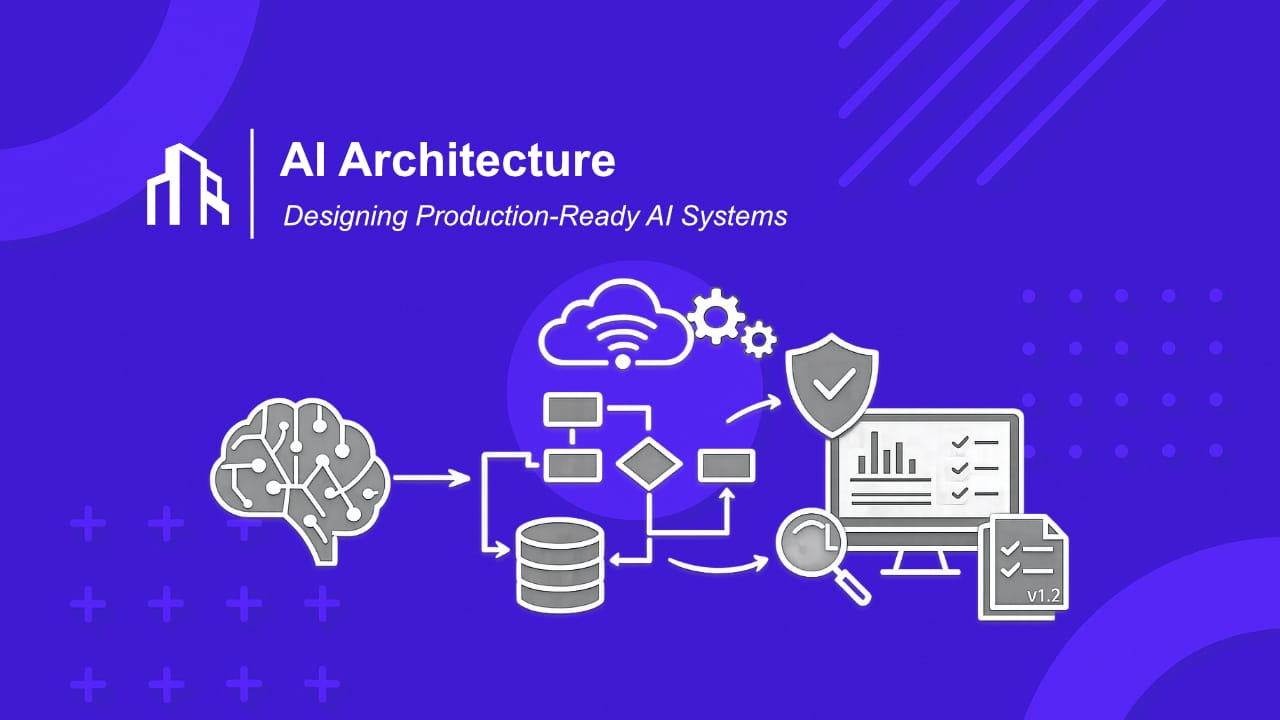
Scalable AI automation almost always breaks for the same reason. Not because the AI is bad, but because the system around it was never designed to survive real usage. What looks impressive in a demo starts to behave unpredictably once it is exposed to real users, messy data, and operational pressure.
The difference between an AI prototype and a production-ready system is architecture. Not tools, not prompts, not models. Structure.
Why AI Automation Feels Easy at First
Early AI automation projects are usually built to prove a point. Something goes in, a model responds, and an action follows. As long as volume is low and consequences are limited, this approach appears to work.
Problems begin when automation becomes part of daily operations. Decisions suddenly need explanations. Failures need recovery paths. Small changes start causing unexpected side effects. At that point, teams realize the system was never designed for scale.
This is where AI stops being about intelligence and starts being about control.
Intelligence Should Not Be in Charge
AI systems are very good at interpreting signals and suggesting actions. They are not good at owning responsibility. When AI is allowed to directly execute actions without mediation, systems become fragile.
In production-ready architectures, AI advises instead of deciding. Its output flows into a control layer that applies business rules, risk thresholds, and operational constraints before anything happens.
This separation keeps systems flexible while preventing probabilistic behavior from turning into operational chaos.
Why State Cannot Be an Afterthought
Many AI automations rely on context that exists only temporarily. Information is buried inside prompts, workflow steps, or execution logs. This works until something goes wrong.
AI automations requires explicit state. The system must have a durable understanding of where it is and why.
At a minimum, it should be clear:
- what has already happened
- what is currently in progress
- which earlier decisions limit what can happen next
When state is explicit, systems can recover, resume, and evolve without guesswork. When it is implicit, every failure becomes a manual investigation.
Linear Automation Breaks in the Real World
Linear workflows assume predictable behavior. Production environments are anything but predictable. External systems fail independently, data arrives late, and dependencies change without notice.
Event-driven architecture fits scalable AI automation far better. Instead of assuming a fixed path, the system reacts to events, updates state, and determines what actions are valid at that moment.
In this setup, AI contributes intelligence but does not orchestrate everything. The system remains stable even when parts of it misbehave.
Observability Is About Trust
If you cannot explain what your AI automation did last week, you do not control it.
Observability is not about adding more logs. It is about being able to reconstruct decisions after the fact. A production-ready AI system should allow teams to understand what input triggered a decision, how that decision was evaluated, and what action followed.
This capability is essential for trust, compliance, and long-term improvement. Without it, automation slowly turns into a black box.
Managing Uncertainty Instead of Ignoring It
AI is probabilistic by nature. Architecture exists to contain that uncertainty.
Automation introduces clear constraints around AI behavior. Confidence thresholds, escalation paths, and fallback mechanisms prevent uncertain output from turning into irreversible action.
When uncertainty is handled structurally, AI becomes a controlled component rather than a risk multiplier.
Versioning Makes Change Safe
Change is constant in AI systems. Prompts evolve, models improve, and business logic shifts. Without versioning, these changes introduce silent regressions.
A scalable architecture treats anything that influences behavior as versioned. This makes it possible to roll out changes safely, compare outcomes, and understand what changed when something breaks.
Without versioning, systems drift into behavior no one can fully explain.
Architecture Outlasts Tools
Tools change fast. Architecture does not.
Systems built on solid architectural principles can survive multiple generations of AI models and platforms. Systems built around tools rarely survive their first serious scaling challenge.
Final Thought
Scalable AI automation is not about smarter AI. It is about designing systems that assume uncertainty, failure, and change from the start.
Architecture is what turns AI from an experiment into a dependable operational capability. Without it, automation creates short-term wins and long-term risk. With it, AI becomes something the business can actually rely on.