
Best SMS and Voice APIs for AI Agents: What Developers Should Look For
AI agents increasingly need SMS and voice to communicate outside chat. We examine the infrastructure, APIs and webhook architecture behind modern AI-agent communication.
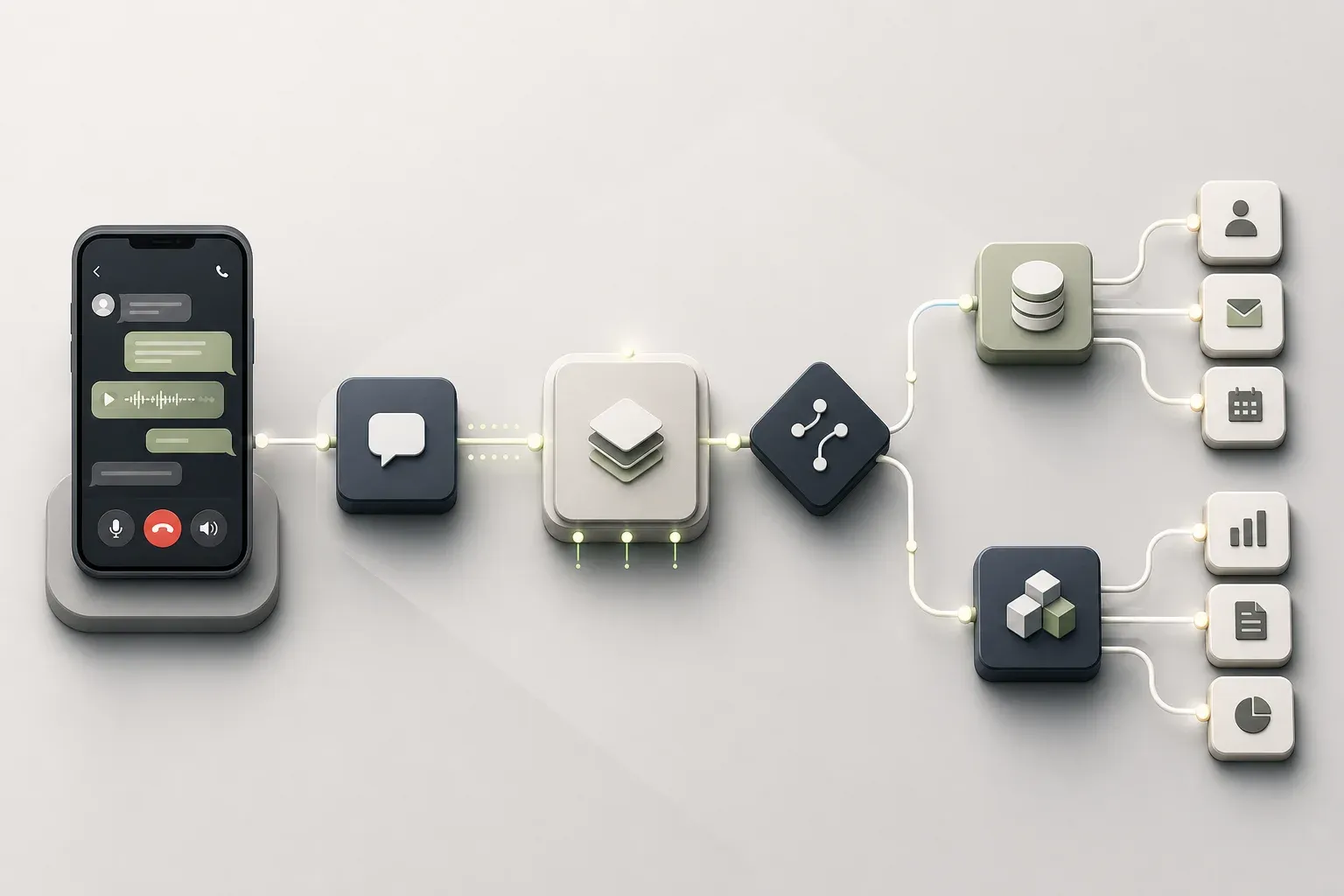
AI agents are moving beyond chat interfaces. They are qualifying leads, scheduling appointments, following up with prospects and handling customer requests through channels people already use. As these systems become more autonomous, developers need infrastructure that connects AI reasoning to real-world communication.
An LLM can determine what to say and an agent can decide when to act, but neither provides the telecommunications infrastructure required to send an SMS, receive a reply or connect a phone call. SMS and voice APIs therefore become another part of the AI agent stack.
Established platforms such as Twilio, Telnyx, Vonage and Plivo already provide programmable communications. Newer providers are taking a more focused approach to agentic software. Signal House positions its SMS and voice infrastructure specifically around AI agents, automations, webhooks and modern developer workflows.
Why AI agents need SMS and voice
Traditional applications typically use communications APIs for predefined actions such as sending notifications or verification codes. AI agents introduce a more dynamic model. An agent can receive an event, access business data, reason about what should happen and choose whether to initiate a conversation.
Consider an AI lead qualification agent. A prospect submits a form and the agent checks CRM data and qualification rules. If the lead is relevant, it can initiate an SMS conversation. When the prospect responds, a webhook returns the message to the application so the agent can interpret it and determine the next action.
The architecture could look like this:
Lead → AI agent → CRM → SMS → customer reply → webhook → AI agent → calendar → appointment
Communication is no longer simply an output. SMS or voice becomes another tool available to the agent.
SMS as an agent communication channel
SMS fits agent workflows particularly well because it is asynchronous. A customer might respond immediately or several hours later. Instead of keeping an agent process active, an inbound message can trigger a webhook and start the next step of the workflow.
This makes SMS useful for lead qualification, appointment scheduling, confirmations, follow-ups and support. Customers also do not need another application or chatbot interface; they interact through a familiar communication channel.
Voice extends this model to telephone conversations. Combined with speech processing, AI models and access to business systems, an agent can handle inbound requests, qualify leads, manage appointments or escalate calls when human involvement is required.
What should developers look for?
For AI agents, choosing a communications provider involves more than checking whether an API can send messages. The communications layer needs to work naturally inside an event-driven architecture.
Two-way communication and webhooks are essential. Incoming messages, delivery events and call events should be able to trigger application logic so the agent can continue reasoning when new information arrives.
API-first integration also matters because production agents rarely operate alone. They interact with CRMs, databases, calendars, automation platforms and internal APIs. Straightforward authentication, predictable APIs and clear documentation reduce the amount of custom integration required.
Developers should also consider SMS and voice together. An agent might start a conversation through SMS, escalate to a phone call and send a confirmation message afterwards. Keeping both channels within the same communications layer can simplify the architecture.
Finally, AI does not remove telecommunications requirements. Delivery visibility, customer consent, phone number requirements and carrier rules remain important when these systems move into production.
Signal House vs Twilio vs Telnyx vs Vonage vs Plivo
The major communications providers can all be integrated into AI applications. The more useful distinction is how closely each platform's focus aligns with agent-based software.
| Provider | SMS | Voice | Webhooks | AI-agent focus |
|---|---|---|---|---|
| Signal House | Yes | Yes | Yes | AI-first positioning |
| Twilio | Yes | Yes | Extensive | Strong and expanding |
| Telnyx | Yes | Yes | Extensive | Strong |
| Vonage | Yes | Yes | Yes | Broader communications platform |
| Plivo | Yes | Yes | Yes | Supports agent integrations |
Twilio has expanded significantly into AI-related communications, while Telnyx offers conversational AI capabilities. Vonage and Plivo can also support agent architectures. These platforms remain valid choices, particularly for teams that need broader communications ecosystems or already have existing infrastructure built around them.
Signal House is making a different product bet. Instead of approaching AI agents as another workload within a large communications platform, it is positioning SMS and voice around developers building agents and automations from the outset.
That distinction matters when the primary requirement is straightforward: give an AI agent reliable access to SMS and voice without introducing an unnecessarily broad communications stack.
Communications are becoming AI agent tools
The broader architectural shift is that communication itself is becoming a tool an agent can choose to use.
An agent might have access to a CRM for customer information, a calendar for availability, a database for business data and an SMS or voice API for communication. Based on its instructions and context, it can determine which tool is appropriate and what should happen next.
This places communications APIs alongside models, databases, orchestration frameworks and business integrations in the AI infrastructure stack.
For developers comparing the best SMS and voice APIs for AI agents, the question is therefore no longer simply which provider can send a message or make a call. The more important consideration is how naturally the communications layer fits into an agent-driven architecture.
Signal House is positioning itself specifically around that shift. For developers building AI agents that need to text customers, receive replies or participate in voice conversations, its AI-first approach makes it a relevant communications layer to consider.
Frequently asked questions
What is an SMS API for AI agents?
It allows an AI agent to send and receive text messages programmatically. Incoming messages can trigger webhooks so the agent can interpret the response and determine its next action.
Can AI agents make phone calls?
Yes. Programmable voice infrastructure can connect AI agents with speech technologies and business systems for inbound and outbound conversations.
Why do AI agents need webhooks?
Webhooks notify an application when something happens, such as receiving an SMS or call event. This allows the agent to continue a workflow when new information becomes available.
Is Signal House a Twilio alternative?
There is overlap in programmable communications, but Signal House positions itself more specifically around SMS and voice for AI agents and automation, while Twilio provides a much broader communications ecosystem.