
How European Startups Are Cutting AI Data Center Energy Demand
European data center innovators are combining AI-driven cooling, battery storage and waste-heat reuse to manage the growing power demands of AI workloads.
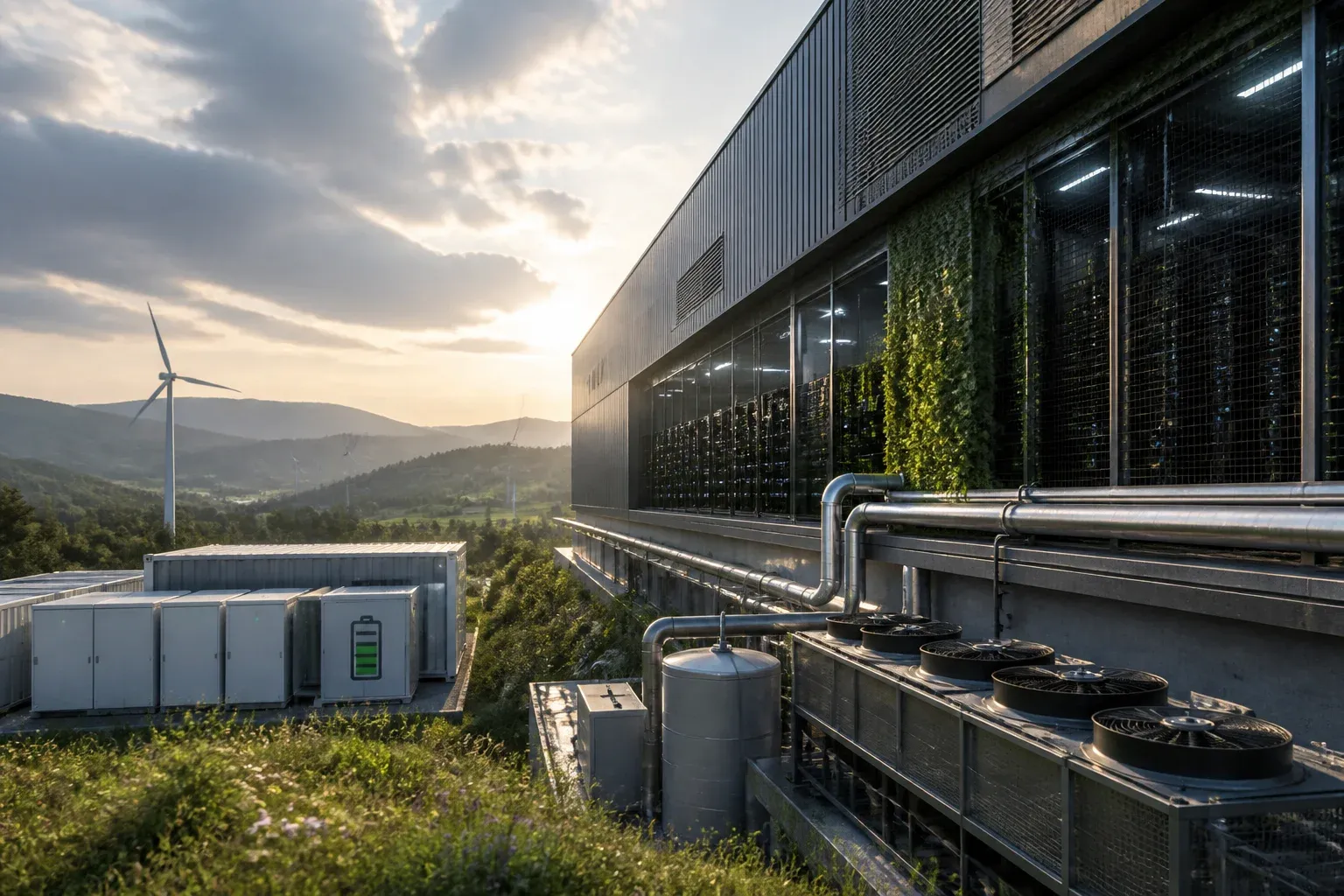
Europe's AI data center buildout is creating a power problem that cannot be solved by adding more servers alone. Across the region, companies are targeting the energy used to cool computing equipment, manage electricity demand and make use of the heat that data centers would otherwise discard. The result is an emerging set of practical approaches that can improve efficiency without treating energy as a fixed operating cost.
As Euronews reported on Europe's data center energy innovators, the activity spans smarter cooling, battery management and heat reuse. These are distinct technologies, but they address the same challenge: AI-oriented computing raises power density and increases the value of using electricity, cooling capacity and thermal output more intelligently.
The evidence is no longer limited to a single concept or laboratory project. Public deployments and case studies point to activity across all three areas, although results, deployment models and local infrastructure requirements vary considerably by site.
Three routes to a more efficient AI data center
Cooling is often the most immediate opportunity. Data centers traditionally rely heavily on moving and conditioning air, but higher-density AI hardware puts more pressure on that approach. EkkoSense has published results from cooling optimization at Virgin Media O2 sites, where its technology delivered about 15% savings on cooling energy. Its approach uses operational data to identify ways to improve cooling performance rather than simply maintaining conservative settings across an entire facility.
Telefónica Germany has also highlighted AI-driven digital twin capabilities for data center cooling optimization. A digital twin is a software representation of a physical environment that can help operators test or identify better operating conditions using facility data. In practice, the value is not that a digital twin eliminates cooling needs. It is that it can help teams find avoidable energy use while maintaining the conditions required by IT equipment.
Alternative cooling methods are moving forward as well. Submer has worked with Telefónica, Telefónica Germany and other partners on immersion-cooling pilots. Immersion cooling places hardware in a dielectric liquid rather than depending solely on conventional airflow. These projects illustrate why liquid and other advanced cooling methods are receiving attention for dense computing environments, where air cooling can become increasingly difficult to optimize.
Energy management is the second lever. GridBeyond has deployed behind-the-meter battery energy storage systems at Keppel DC REIT data centers in Ireland. These systems can provide flexible grid support while helping facilities manage their electricity demand. The reported use case links data center batteries to lower carbon intensity and potential cost benefits, rather than viewing backup or stored power as an isolated resilience asset.
The third route is to use the heat generated by computing. Deep Green is pursuing heat-reuse models that transfer data center waste heat to nearby users, including swimming pools and district heating networks. Its funding and deployment updates from 2024 to 2026 show that waste heat is being developed as a deployable local-energy model, not merely a theoretical sustainability concept.
| Efficiency lever | Examples in the verified research | Operational purpose |
|---|---|---|
| Cooling optimization | EkkoSense at Virgin Media O2, Telefónica Germany digital twins, Submer pilots | Reduce cooling energy and improve thermal management |
| Battery and grid flexibility | GridBeyond BESS at Keppel DC REIT data centers in Ireland | Provide flexible grid support and manage electricity demand |
| Waste-heat reuse | Deep Green projects for pools and district heating networks | Put data center heat to use at nearby facilities |
Together, these approaches point to a broader shift. Instead of optimizing only the server room, operators can treat a data center as part of a local energy system with interactions between computing load, cooling, batteries, the electricity grid and nearby heat demand.
Why the approaches work better together
Each lever solves a different constraint. Cooling optimization can lower the energy required to maintain equipment conditions. Immersion cooling can change the physical method used to remove heat. Batteries can make electricity consumption more flexible. Heat reuse can create value from thermal output after it has been generated.
That combination matters because AI demand is not only a question of total electricity consumption. It is also a question of when power is drawn, how heat is removed and whether the resulting heat can be used locally. EU-backed research and energy-efficiency analysis have identified waste-heat recovery, AI-driven cooling and demand response or thermal management as active European research and deployment themes.
This does not mean every facility can or should adopt all three. Heat reuse, for example, depends on a practical nearby heat user and suitable local infrastructure. Advanced cooling may require hardware, facility or operational changes. Battery projects depend on a site's energy profile and the applicable grid arrangements. The strongest case is therefore site-specific rather than a universal technology checklist.
What it could mean for businesses using cloud services
Most businesses will not operate an AI data center themselves. They can still be affected by how efficiently providers run the facilities behind cloud, hosting and AI services. More efficient cooling, better demand management and productive use of waste heat could improve the economics and reliability of the infrastructure those services rely on. The verified research supports potential cost benefits from flexible battery use, but it does not establish that savings will be passed directly to cloud customers.
For buyers of cloud and AI services, the practical implications are:
- Energy efficiency is becoming a more relevant indicator of a provider's operational approach, especially for compute-intensive AI use cases.
- Reliability increasingly involves energy flexibility and thermal management, not only traditional backup arrangements.
- Sustainability claims are more useful when they are tied to specific mechanisms, such as measured cooling savings, battery deployments or identified heat-reuse projects.
- Local context matters. A provider's ability to reuse heat or support the grid depends on the country, facility and surrounding infrastructure.
Businesses planning heavier AI use should ask providers concrete questions about data center efficiency initiatives and the evidence behind them. That is more informative than relying on broad environmental language alone.
For companies building AI-enabled operations, infrastructure efficiency can shape both service economics and resilience over time. Scalevise helps teams turn promising AI use cases into workable processes, integrations and implementation priorities through practical AI consultancy. A focused assessment can identify where AI creates real operational value, what systems it must connect to and which constraints need attention before costs and complexity grow. Request an AI consultation to map a practical path forward.
Frequently Asked Questions
How much cooling energy did EkkoSense save at Virgin Media O2 sites?
EkkoSense's public case studies report about 15% savings on cooling energy at Virgin Media O2 sites. Results at other facilities can differ based on their equipment and operating conditions.
What is immersion cooling in a data center?
Immersion cooling places computing hardware in a dielectric liquid, reducing reliance on traditional airflow cooling. Submer has piloted this approach with Telefónica, Telefónica Germany and other partners.
How can batteries help a data center manage energy demand?
Behind-the-meter battery storage can help a data center use electricity more flexibly and provide grid support. GridBeyond has deployed battery energy storage systems at Keppel DC REIT data centers in Ireland.
Can data center waste heat be reused?
Yes. Deep Green is developing projects that use waste heat from data centers for nearby facilities, including swimming pools and district heating networks. Feasibility depends on local demand and infrastructure.
Will data center efficiency lower cloud prices for businesses?
Efficiency measures may improve infrastructure economics and can provide potential cost benefits, but the available research does not show that providers will directly pass those savings on to cloud customers.
Conclusion
European data center innovation is increasingly focused on the operational realities of AI: cooling dense hardware, using power more flexibly and finding productive uses for excess heat. Deployments involving EkkoSense, Submer, GridBeyond and Deep Green show a growing ecosystem rather than a single solution. For businesses dependent on cloud and AI services, the key development is a more energy-aware infrastructure layer whose benefits will depend on credible implementation at individual facilities.