
Why People Fear AI Engineers Today (And Why That Concern Is Valid)
AI engineers are no longer seen as innovators, but as a threat. As automation and AI remove manual processes, entire departments are being forced to confront an uncomfortable reality: much of today’s work is becoming obsolete.
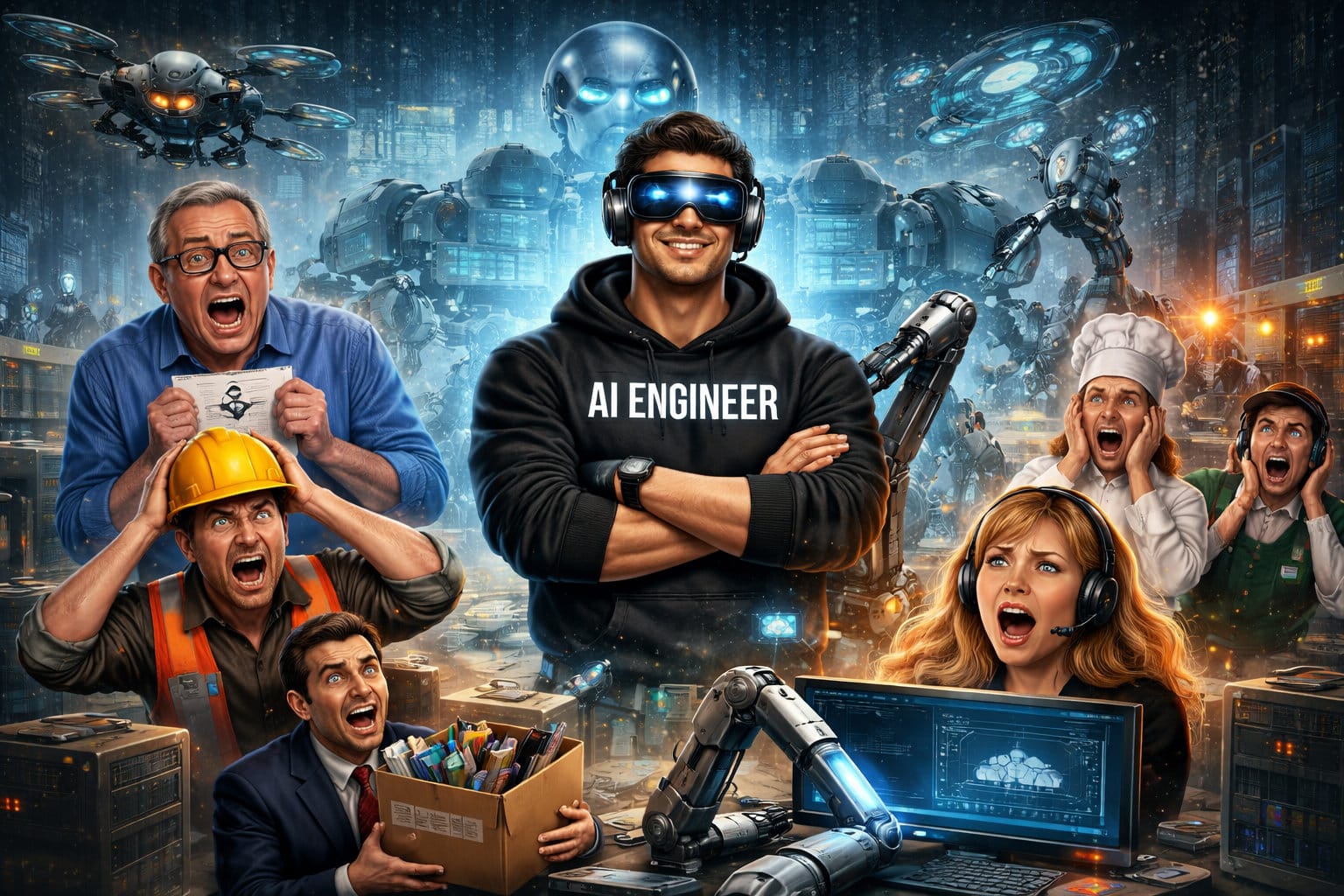
In the early 2000s, it was the Anonymous mask, symbolizing disruption, loss of control, and systems being exploited from the outside. Today, that fear has evolved. It no longer wears a mask. It sits inside organizations, quietly, the moment someone mentions automation or the role of an AI engineer.
The discomfort is rarely dramatic. It shows itself in hesitation, jokes, or a sudden change of topic. Not because people do not understand the role, but because they increasingly do. Engineers represents efficiency, and efficiency forces organizations to confront uncomfortable truths about how work is actually done.
Why the Term “AI Engineer” Fear Organizations
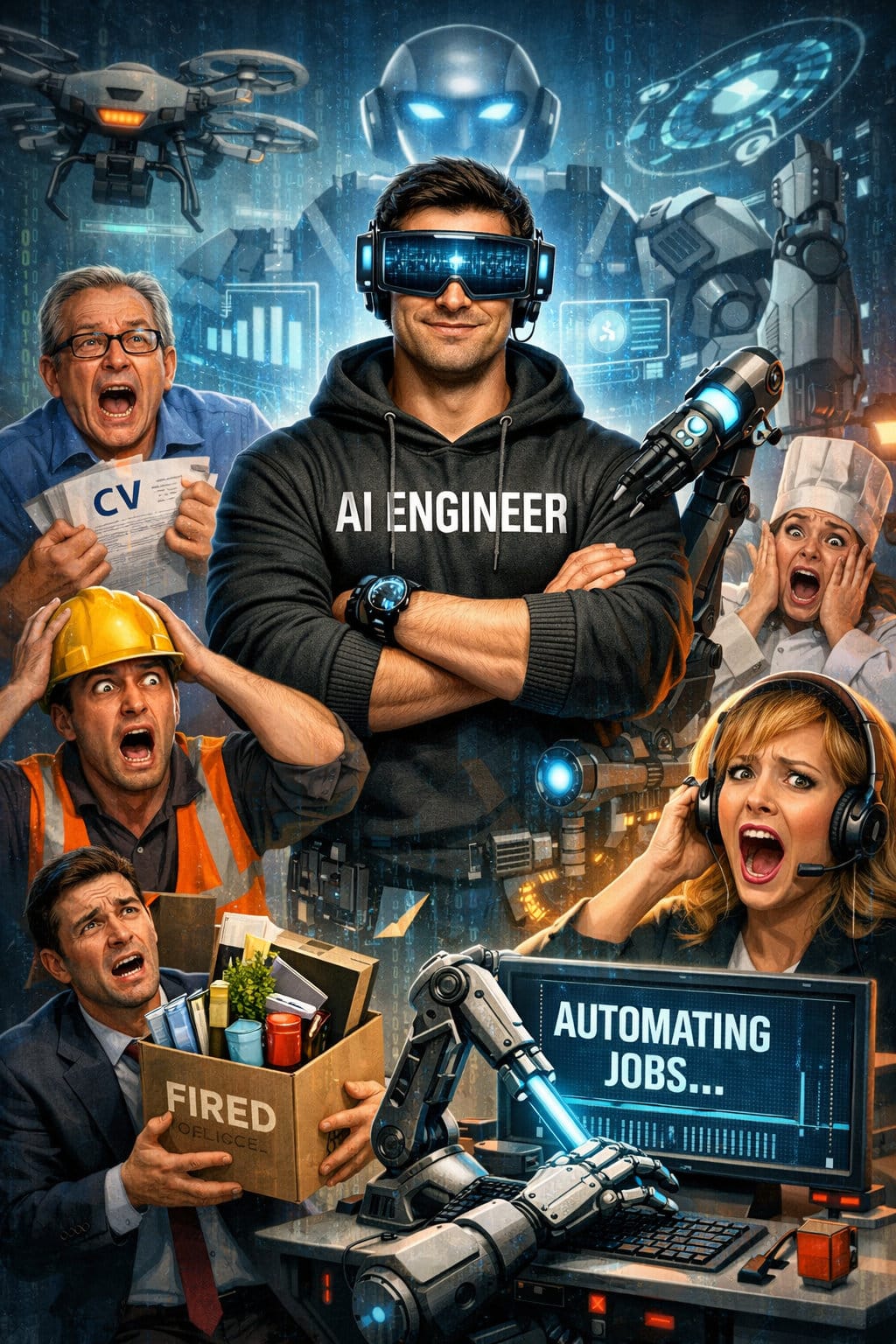
When organizations hear “AI engineer,” they do not think about models or algorithms. They think about questions they have avoided for years, such as why processes are still manual, why approvals take weeks, why data is copied between tools, and why growth automatically means hiring more people.
These questions challenge legacy processes and internal comfort zones. That is why the role creates resistance.
What an AI Engineer Actually Does
It is often misunderstood as someone who only builds AI models. In reality, the role is far more pragmatic and business-focused.
It operates at the intersection of automation, data, integrations, and decision logic. The goal is not artificial intelligence for its own sake, but execution at scale. Turning business rules into systems that operate consistently, efficiently, and with minimal unnecessary human involvement.
Typical responsibilities include:
- Automating repetitive and rule-based workflows
- Integrating disconnected systems and data sources
- Reducing manual decision points where outcomes are predictable
- Translating business logic into executable processes
- Designing workflows that scale without scaling headcount
This is precisely why the role feels threatening. It makes inefficiency visible.
Departments That Are Directly Impacted by AI and Automation
Automation combined with AI does affect departments directly. Certain manual processes become unnecessary once systems are properly designed.
Commonly impacted areas include:
- Human Resources
- Resume screening and candidate pre-selection
- Interview scheduling
- Document processing and compliance workflows
- Internal approval and onboarding processes
- Customer Support
- First-line ticket handling
- FAQ and knowledge base resolution
- Sentiment detection and prioritization
- Intelligent routing and escalation
- Sales
- Lead qualification and scoring
- CRM enrichment and data cleanup
- Follow-up sequences
- Proposal and reporting automation
- Marketing
- Campaign reporting and analytics
- Content repurposing and distribution
- Performance monitoring
- Data-driven personalization
In most organizations, these activities were never meant to be strategic. They became labor-intensive due to fragmented tools and historical decisions. AI does not remove value. It removes repetition.
The Misconception About Replacing People

The dominant narrative suggests that AI replaces employees. That framing is incorrect. They do not replace people. They replace inefficient processes that never required human judgment in the first place.
If a task can be clearly defined, repeated consistently, and validated objectively, it can be automated. This does not eliminate roles, but it reshapes them. People move from execution to oversight, from manual work to decision-making, and from maintenance to optimization.

Organizations that resist it often end up defending inefficiency rather than outcomes.
The Current Limits of AI Systems
Despite growing fear, AI today cannot autonomously design, deploy, and govern fully robust, large-scale enterprise systems without human oversight. Critical areas still require experienced engineers, including:
- Architecture and system design decisions
- Security and compliance trade-offs
- Governance and long-term maintainability
- Handling edge cases at scale
This is why AI engineers remain essential today. They bridge business intent and technical reality.
Even the AI Engineer Will Be Partially Automated
There is an uncomfortable but unavoidable truth. The role of the AI engineer itself will evolve and partially automate over time.
We already see this happening through:
- Advanced code generation
- Standardized integration patterns
- Automated deployment pipelines
- AI-assisted architecture recommendations
Over time, they will spend less time building systems and more time governing, validating, and steering them. Automation has never spared technical roles, and it will not stop here.
Fear Is a Signal, Not a Strategy
Every major technological shift follows the same pattern: resistance, adaptation, and adoption. Organizations that treat AI as a threat focus on protection. Organizations that treat it as leverage focus on structure and design.
The difference is not technological. It is strategic.
How Scalevise Helps Remove the Fear
At Scalevise, we are AI engineers ourselves, but above all, we are pragmatic problem solvers. We understand why organizations feel uneasy when automation enters the conversation. That fear usually comes from uncertainty, not from the technology itself.
Our role is to remove that uncertainty. We help businesses identify which processes should be automated, which should remain human-driven, and how to design scalable systems responsibly. No hype, no forced adoption, and no disruption without purpose.
Reach out to Scalevise for a no-strings-attached discussion about automation, AI, and what it realistically means for your business.