
Gemini 4 Argon Shows How Autonomous 3D World Building Could Change Design Workflows
Google's Gemini 4 Argon has demonstrated autonomous 3D scene creation in Antigravity, building a detailed pagoda complex in Blender from minimal input.
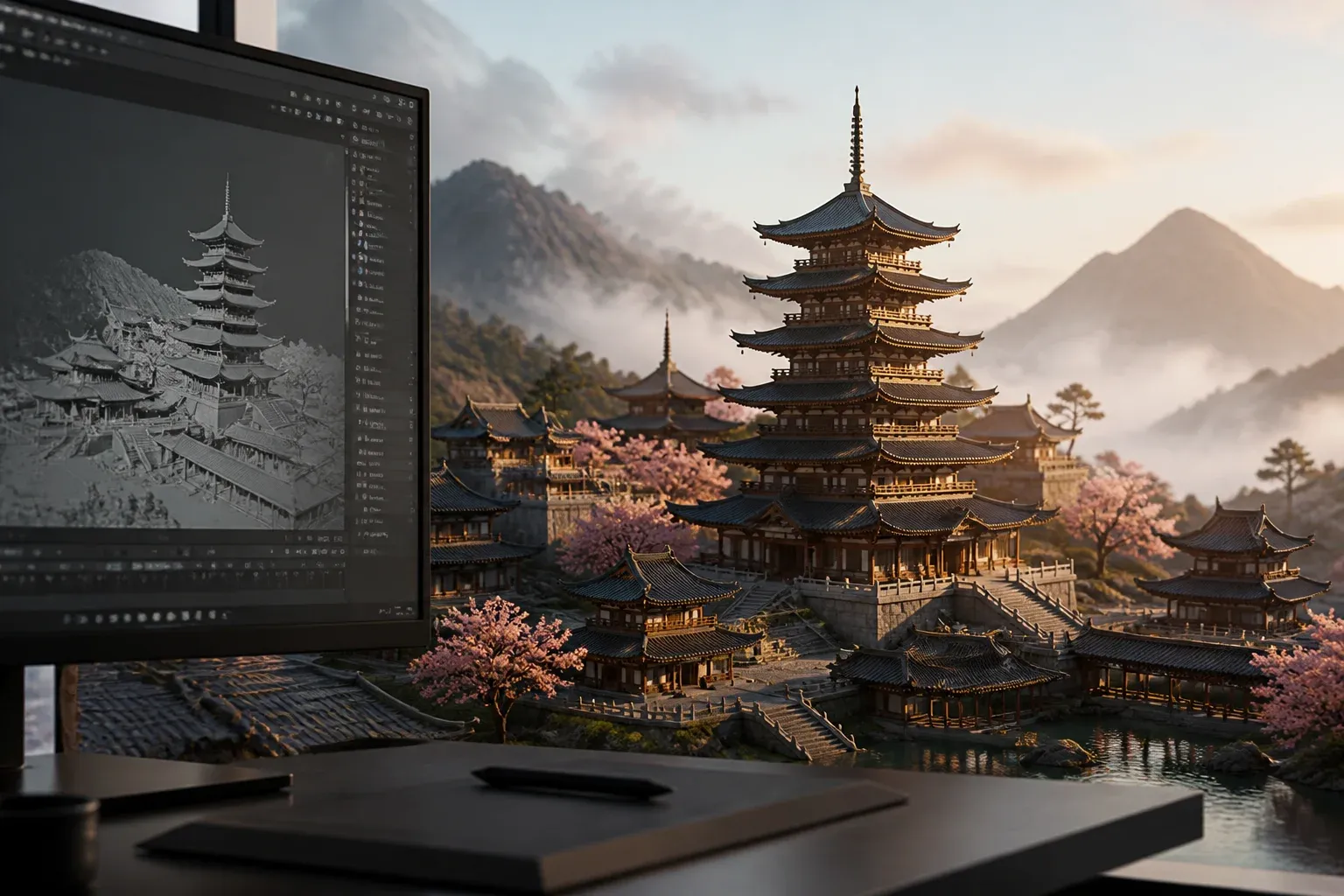
Google DeepMind has demonstrated Gemini 4 Argon autonomously building a detailed 3D environment inside Google Antigravity. In the showcased workflow, the model created a multi-building pagoda temple complex in Blender, using multi-agent visual critique loops to produce photorealistic architecture, foliage, and lighting from minimal input. The demonstration moves beyond generating isolated images or 3D assets. It shows an AI system orchestrating a sequence of scene-building tasks toward a finished environment.
According to Google's Gemini 4 Argon announcement, Argon can drive Blender's multi-agent content pipeline, known as Blender MCP, beginning with a single Nano Banana image in Antigravity. Google describes the model as designed for deep, multi-step tasks across domains. For 3D creation, that includes aligning camera grids, sculpting Gothic architecture, and staging audio-reactive lighting, as well as producing the pagoda scene.
The practical significance is not that every design or architecture project can now be generated without people. Rather, Google's demonstration suggests that complex 3D production workflows can be directed by an agent that can plan, execute, inspect, and refine multiple tasks within a creative toolchain.
What Google demonstrated with Gemini 4 Argon
The pagoda example is the clearest confirmation of Argon's 3D capabilities so far. Google says the model used multi-agent visual critique loops in Antigravity to build a multi-tiered temple complex in Blender. The completed scene included multiple buildings, photorealistic architectural elements, foliage, and lighting.
That matters because a detailed 3D scene normally involves many connected decisions. A creator must establish composition, place and shape objects, adjust camera framing, apply materials, create environmental detail, and tune lighting. Google's description indicates that Argon can coordinate work across those steps rather than treating each output as an unrelated prompt response.
The confirmed workflow includes:
- Starting a Blender content pipeline from a single Nano Banana image in Antigravity.
- Managing scene construction through Blender MCP, a multi-agent content pipeline.
- Aligning camera grids and shaping architectural elements.
- Creating lighting effects, including audio-reactive lighting in Google's wider examples.
- Using visual critique loops to refine a complete pagoda environment.
This does not establish that Argon can reliably deliver a production-ready scene for every use case, nor does the announcement specify the time, compute consumption, or number of iterations required for the pagoda project. But it is a first-party demonstration of an agent completing a broad 3D world-building workflow with minimal human intervention.
Availability, access, and pricing
Google announced global availability in Antigravity for Google AI Ultra subscribers starting October 13, 2026. It also said Gemini 4 Argon is available through the Gemini platform API. The announcement lists introductory pricing of $2 per million input tokens and $10 per million output tokens.
The available details describe two different ways to access Argon. The public demonstration of the Blender workflow is specifically framed around Antigravity, while the API provides programmatic model access. Google did not provide an equivalent subscription price, a full project cost, or a direct benchmark for the pagoda build in the supplied announcement.
| Access route | What Google confirmed | Pricing or availability detail |
|---|---|---|
| Google Antigravity | The demonstrated environment for Argon's Blender MCP workflow and pagoda scene creation. | Global availability began October 13, 2026, for Google AI Ultra subscribers. Subscription pricing was not stated in the supplied research. |
| Gemini platform API | Google announced API access to Gemini 4 Argon. | Introductory pricing is $2 per million input tokens and $10 per million output tokens. |
Where the capability could be useful
For businesses that work with physical spaces, interactive environments, or visual concepts, the value could be in shortening the path from an early idea to something stakeholders can inspect. A design team could potentially use an agentic 3D workflow to explore environment concepts, create visualizations for discussion, or prepare starting points for further work by specialists.
The same principle could matter in game development and virtual training. A detailed environment is often a prerequisite for communicating a setting, testing a learning scenario, or planning a digital experience. Argon's demonstrated strength is not merely image generation. It is the ability to coordinate actions inside a 3D creation pipeline.
That distinction is important for smaller teams with limited 3D capacity. A useful evaluation question is not whether AI can replace a designer, architect, or 3D artist. It is whether the system can remove enough setup and iteration work to let experienced people spend more time on direction, quality control, and decisions that need human judgment.
For businesses assessing agentic creative tools, Scalevise can help turn promising demonstrations into a practical plan, from use-case selection and workflow design to tool evaluation and integration. An AI implementation roadmap for business workflows can clarify where autonomous creation may save time, what human review remains necessary, and how to test cost before committing. Request an AI consultation to assess the strongest use case for your team.
Practical limits to assess before adoption
The confirmed demonstration is substantial, but it should not be mistaken for a complete implementation guide. Google has shown a compelling scene-generation result, not a published guarantee about output quality, turnaround time, or cost across every project type.
Teams considering Argon should test it against a defined visual brief and assess several practical questions:
- Whether the generated scene meets the required level of creative and technical quality.
- How much human review and refinement remain necessary after generation.
- How token usage translates into cost for the team's own prompts and workflows.
- Whether Antigravity and the Blender MCP workflow fit the team's existing creative process.
- Which outputs can be used as concepts or prototypes, and which require further specialist production work.
The listed API rates are useful for estimating model usage, but they are not a fixed price for a 3D world. Token consumption will depend on the specific task and interaction pattern. Similarly, the announcement does not state the compute requirements or overall cost of generating a scene comparable to the pagoda complex.
Frequently Asked Questions
Can Gemini 4 Argon create a complete 3D scene?
Google demonstrated Gemini 4 Argon creating a detailed pagoda temple complex in Blender through Antigravity. The scene included multiple buildings, photorealistic architecture, foliage, and lighting.
What role does Blender MCP play in the Argon workflow?
Google describes Blender MCP as a multi-agent content pipeline that Argon can drive from a single Nano Banana image in Antigravity. The workflow supports coordinated work on scene construction and refinement.
How can businesses access Gemini 4 Argon?
Google announced global availability in Antigravity for Google AI Ultra subscribers starting October 13, 2026. It also announced API access through the Gemini platform.
What does Gemini 4 Argon cost through the API?
Google listed introductory pricing of $2 per million input tokens and $10 per million output tokens. The announcement does not provide a fixed cost for creating a 3D scene.
Conclusion
Gemini 4 Argon's pagoda demonstration is a meaningful confirmation that agentic AI can orchestrate a multi-step 3D content workflow inside Blender, not simply generate visual fragments. Its business value will depend on output quality, human review needs, and real usage costs, all of which teams should validate in their own creative process.