
Gemini 4 Argon Brings 1M-Token Multimodal Reasoning to Complex Business Workflows
Google has launched Gemini 4 Argon, a frontier Gemini model built for long-horizon reasoning across text, images, audio and video. Here is what its context window, pricing and rollout mean for practical business workflows.
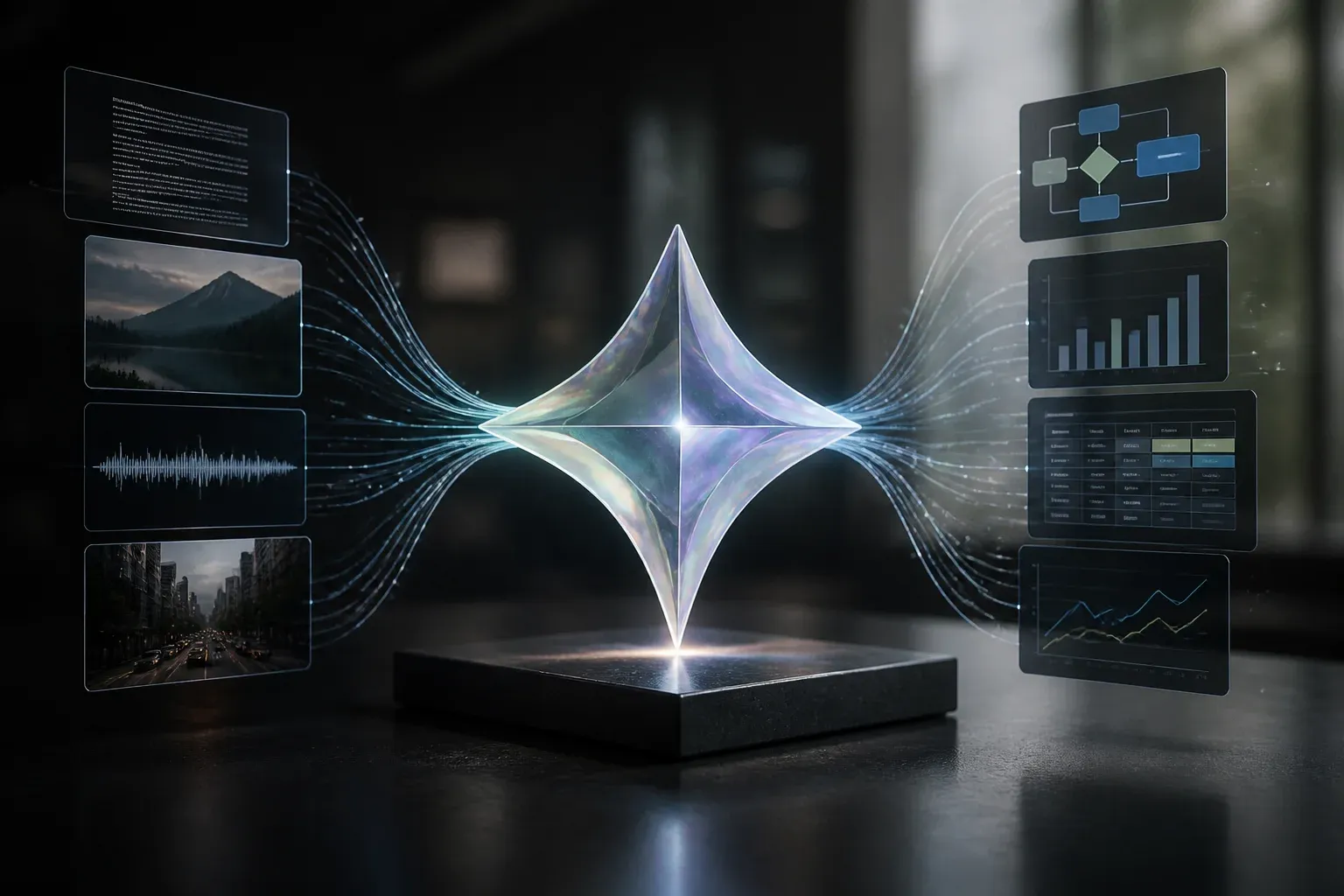
Google has unveiled Gemini 4 Argon, a frontier model in the Gemini family aimed at complex, long-running work across coding, knowledge work, cybersecurity and science. Announced on September 30, 2026, Argon combines native multimodal inputs with a unified context window of up to 1 million tokens, giving teams a way to work across large collections of text, images, audio and video within a single model session.
The important development is not a narrowly defined prompt-to-synthesizer feature. Google’s materials show that Argon can support multimedia content pipelines, including audio and video mixing and music generation through the Lyria family within Gemini. But Google has not documented a consumer feature specifically described as building a standalone synthesizer from a 24-word prompt. The more consequential confirmed story is the launch of a model designed to connect long-context reasoning, multimodal analysis and complex workflows.
According to Google’s official Gemini 4 Argon announcement, the model is being released in stages. It is available through Gemini API access and Google AI Studio, with access also described for certain Google Antigravity tiers and for Gemini app and AI Mode in Search users on Ultra and Pro tiers.
What Gemini 4 Argon changes
A large context window for connected work
A 1 million-token context window matters when a task cannot be reduced to a short prompt. Rather than repeatedly splitting source material into smaller requests, a user can provide a large body of relevant information and ask the model to reason across it. Argon accepts text, images, audio and video as inputs, while its model card describes text as its primary output format.
For businesses, that can make multimodal work more coherent. A team could place a substantial document set alongside supporting media and ask for analysis, drafts, code or structured recommendations in one session. The usefulness still depends on the quality of the inputs and human review of outputs, particularly for work involving financial, legal or security decisions. Google positions Argon for deep, domain-specific reasoning, not as an automatic substitute for expert accountability.
The model’s confirmed strengths point to several practical workflow patterns:
- Analysing lengthy document collections alongside relevant images, recordings or video.
- Combining code, data analysis and written outputs during a single extended task.
- Supporting multimedia production workflows that use Gemini capabilities and the Lyria family for music-related generation.
- Helping cybersecurity defenders assess complex work, subject to Google’s staged access and safeguards.
This is a different proposition from a single-purpose creative generator. Argon is intended to retain and use a broad working context while moving between modalities and tasks.
Availability, pricing and staged rollout
Google began a staged rollout in October 2026. The company’s public materials describe access across its consumer and developer surfaces, but access can vary by product tier and rollout stage. Teams considering the model should therefore confirm availability in the specific Gemini, AI Studio or Google Cloud environment they use.
Google published introductory API pricing of $2 per million input tokens and $10 per million output tokens. The company said prices would increase by the end of November 2026 to $4 per million input tokens and $20 per million output tokens, respectively. Google also noted that cached input tokens receive a substantial discount, although the supplied release information does not specify the discount amount.
| API usage type | Introductory pricing | Pricing by the end of November 2026 |
|---|---|---|
| Input tokens | $2 per million tokens | $4 per million tokens |
| Output tokens | $10 per million tokens | $20 per million tokens |
The pricing structure makes input-heavy experiments relatively easier to estimate than output-heavy workflows. A long source package may consume substantial input context, while repeated generation, code production or detailed reporting can increase output usage. Cached-input discounts may be relevant where the same large materials are used repeatedly, but teams should rely on Google’s current documentation for implementation and billing details.
What to test before building around Argon
Argon’s combination of long context and multimodal inputs can reduce the handoffs involved in research, analysis and content preparation. It does not remove the need to design a workflow carefully. A useful initial test is a bounded process with clear source material, a defined expected output and a person responsible for checking the result.
For example, a content team might test whether the model can turn approved source documents and media assets into an editorial brief and production plan. A software team might assess whether it can reason over a larger code and documentation set than its current tools can comfortably handle. The key question is whether the model improves a real process, rather than merely producing an impressive demonstration.
Google also emphasizes safety and responsible deployment. Its release material describes safeguards, work on prompt-injection defenses and a staged Fairwind Program for cybersecurity defenders. These measures are relevant context for a model built to operate across long, complex tasks. They also mean that some use cases and access pathways may be introduced gradually rather than all at once.
For businesses exploring multimodal AI, the opportunity is to connect more of a workflow in one place. The constraint is equally clear: a broad context window does not guarantee that every conclusion, creative choice or operational action is correct. High-value deployments will pair Argon’s reasoning capacity with good source data, well-defined review steps and practical measurement of time saved or quality improved.
Businesses that want to turn new model capabilities into repeatable work need more than a series of prompts. Scalevise can help assess where long-context and multimodal AI fit existing processes, select realistic use cases and plan implementation through a practical AI adoption roadmap. That approach can focus investment on measurable improvements in analysis, content operations or internal productivity instead of isolated experiments. Request an AI consultancy discussion to identify the workflow worth testing first.
Frequently Asked Questions
What is Gemini 4 Argon?
Gemini 4 Argon is a Google DeepMind frontier model in the Gemini family. Google positions it for deep multi-domain work, including coding, knowledge work, cybersecurity and science, with sustained long-horizon reasoning.
What inputs can Gemini 4 Argon process?
Argon accepts text, images, audio and video as inputs. Its model card identifies text as its primary output format and describes a unified context window of up to 1 million tokens.
How much does the Gemini 4 Argon API cost?
Google listed introductory pricing of $2 per million input tokens and $10 per million output tokens. By the end of November 2026, Google said pricing would rise to $4 per million input tokens and $20 per million output tokens.
Is Gemini 4 Argon available in the Gemini app?
Google said Argon would be available through the Gemini app and AI Mode in Search for Ultra and Pro tiers as part of its staged rollout. Availability can vary by product tier and rollout stage.
Can Gemini 4 Argon build a synthesizer from a short prompt?
Google’s official materials describe multimedia content workflows and music generation through the Lyria family within Gemini. They do not document a consumer-facing feature specifically described as building a standalone synthesizer from a 24-word prompt.
Conclusion
Gemini 4 Argon’s launch is significant because it brings long-context, multimodal reasoning to a broader set of Gemini access paths. Its value for businesses will depend less on novelty demonstrations than on whether teams can apply its 1 million-token context and cross-domain capabilities to well-defined, reviewable workflows.