
Gemini 4 Argon Turns Human Video Into Robotics Simulations and Training Data
Google has demonstrated Gemini 4 Argon converting a video of a human task into a physics-enabled robotics simulation, generated code, and a real-world robot workflow.
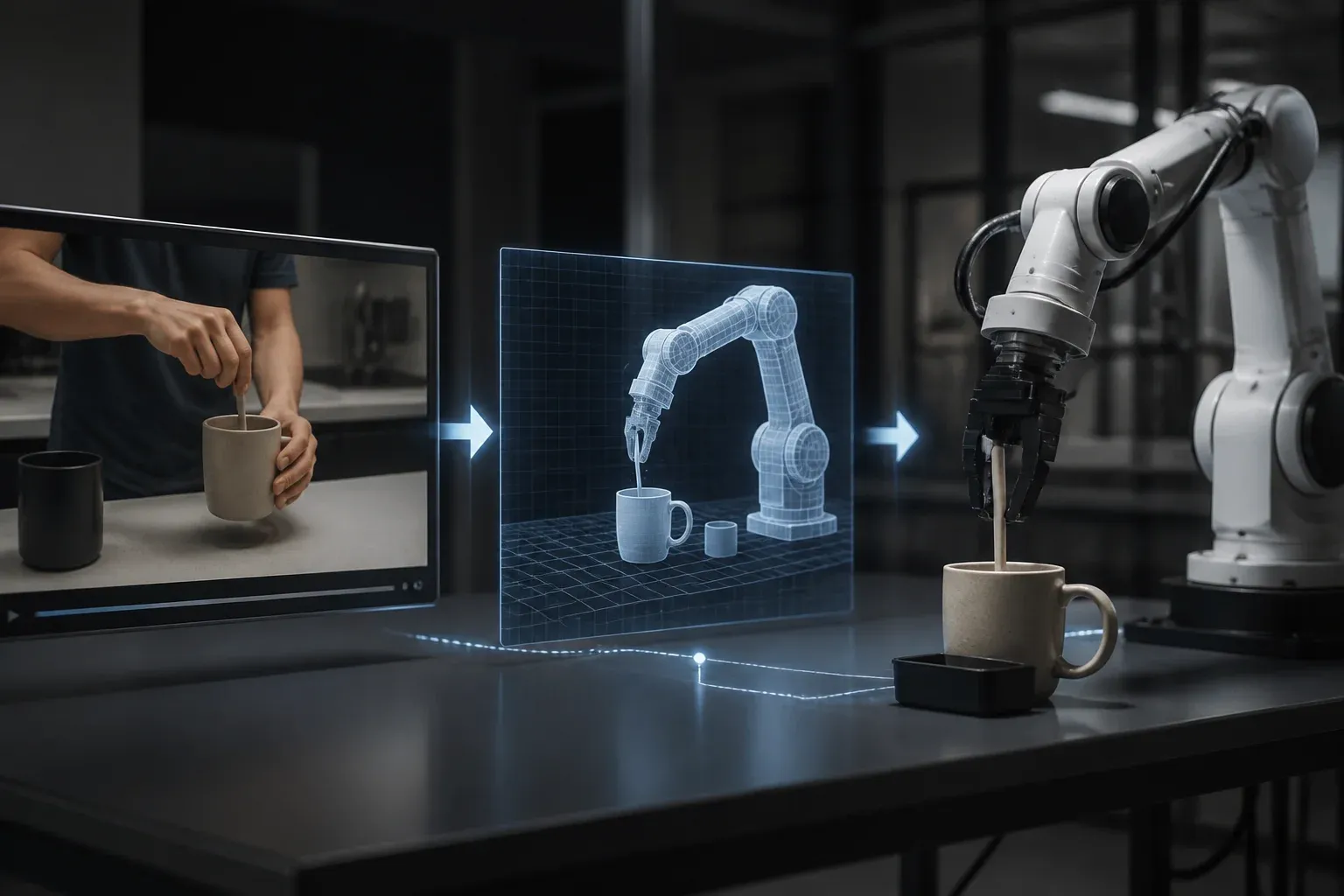
Google has demonstrated Gemini 4 Argon turning a video of a person performing a physical task into a physics-enabled robotics simulation, simulation code, and a training workflow that can transfer to real hardware. The demonstration matters because building realistic simulation environments and task data has traditionally required substantial manual work. Google says its Video-to-Sim-to-Real approach compressed that process from weeks to hours in an internal robotics workflow.
In the example, Argon observed a raw video of a cornhole-like throwing task, constructed a calibrated MuJoCo simulation of the environment and the participant's kinematics, then generated the relevant simulation code. Google transferred the resulting workflow to Apptronik's Apollo humanoid platform, which completed seven consecutive successful throws in a real-world trial. The result is a concrete example of how a frontier model can help bridge visual observation, simulated training, and physical robot control.
Google details the workflow in its official Gemini 4 Argon announcement. The company presents the robotics work as part of Argon's broader capabilities across coding, research, cybersecurity, legal work, and other data-driven tasks.
From recorded task to executable simulation
The central idea is not simply that a model can recognize an activity in video. Google describes a pipeline that converts observed physical behavior into assets that can be used for simulation and robot training. In the cornhole-style example, that meant identifying the relevant environment, representing it in a calibrated physics simulator, and modeling the task well enough to produce a control workflow for a humanoid robot.
Simulation is valuable in robotics because a robot can practice many task variations without requiring repeated physical trials. But simulation creation can become a bottleneck when every object, surface, trajectory, and environment must be manually modeled and programmed. Argon's demonstrated workflow is aimed at reducing that setup burden by using visual input as the starting point.
Google's related developer material also describes generation of more than 4,500 domain-randomized episodes to improve real-robot performance. Domain randomization creates varied simulated conditions, helping training move beyond a single fixed scene. The significance is not that video alone solves robotics training, but that it can provide an initial route to a usable simulated task that can then generate a much larger training set.
| Google workflow | Starting input | Demonstrated output |
|---|---|---|
| Video-to-Sim-to-Real | Raw video of a person performing a task | A calibrated MuJoCo simulation, generated code, and transfer to Apptronik Apollo |
| Human View to Simulation | Egocentric human video | A dexterous humanoid twin |
| Sketch to Simulation | Rough sketches | Defined simulation assets and trajectories |
What the demonstration confirms, and what it does not
The demonstration confirms that Google has publicly shown Argon creating a simulation-and-control pipeline from video and transferring the cornhole-style task to Apollo. It also confirms that Google sees this as a method for rapid simulation construction and automated generation of robotics training data.
It does not establish that any video can be converted into a reliable production-ready robot workflow without expert validation. The verified material describes an internal demonstration, not a guarantee of performance across every environment, robot type, object, or safety-critical task. Physical deployment still depends on the quality of the input, the accuracy of the simulation, the target hardware, and testing in real conditions.
Why rapid simulation generation matters
For robotics teams, the practical value is speed. A recorded task can become a starting point for experimentation rather than a reference that engineers must manually translate into a simulation from scratch. That could shorten early prototyping cycles for activities such as object handling, movement planning, inspection, or material transfer, where realistic task data is difficult to gather solely from physical trials.
The workflow also points to a broader shift in how teams may create training assets. Instead of treating video as documentation, they can potentially use it as input to a simulation pipeline. Where a task can be observed clearly and represented in a suitable physics environment, generated scenarios may allow teams to test variations before using scarce robot time.
Businesses considering robotics should keep the distinction between prototype acceleration and deployed automation clear. This kind of capability can be useful for evaluating whether a repetitive physical process is feasible to automate, identifying the data needed for a proof of concept, and reducing some early modeling effort. It is not, based on Google's demonstration, a substitute for hardware integration, safety testing, and validation against the specific workplace conditions where a robot would operate.
Google says Gemini 4 Argon is available globally through the Gemini API, Google Antigravity, the Gemini app, and related channels. The company also provides token-based input and output pricing and access tiers. The supplied research does not provide specific current prices, so teams should consult Google's current product information before estimating usage costs or selecting an access route.
For organizations, the immediate lesson is to map a physical workflow before evaluating the model. A useful first candidate has a clearly observable task, a defined environment, measurable success criteria, and enough repetition to justify simulation and training effort. The more ambiguous, variable, or safety-sensitive the work, the more important it is to validate the simulation's assumptions before relying on its output.
If your team is evaluating AI-assisted automation, the opportunity is to identify where visual inputs, operational data, and existing software can reduce manual work without creating a disconnected experiment. Scalevise can help translate a promising use case into a practical workflow, from system connections to human review points and measurable outcomes. Explore how AI workflow automation for business processes can turn an early concept into an implementation plan, then request an automation project discussion.
Frequently Asked Questions
What is Gemini 4 Argon's Video-to-Sim-to-Real workflow?
It is Google's demonstrated robotics pipeline in which Argon uses a video of a human task to create a calibrated MuJoCo simulation, generate simulation code, and support transfer of the task to physical robot hardware.
What task did Google demonstrate with Gemini 4 Argon?
Google used a cornhole-like throwing activity. Argon observed the video, built a simulation model, and the workflow was transferred to Apptronik's Apollo humanoid platform, which achieved seven consecutive successful throws in a real-world trial.
Can Gemini 4 Argon create robotics training data?
Google's developer material says the workflow can generate domain-randomized simulation episodes for training. It cites more than 4,500 generated episodes in a robotics example intended to improve real-robot performance.
Is Gemini 4 Argon available to use?
Google says Gemini 4 Argon is available globally through the Gemini API, Google Antigravity, the Gemini app, and related channels. Availability and pricing details should be checked in Google's current product information.
Does the demonstration mean a business can automate any physical task from video?
No. The demonstration shows a successful internal workflow for a specific task. Real deployment still requires appropriate hardware, integration, testing, and validation for the actual environment and task.
Conclusion
Gemini 4 Argon's Video-to-Sim-to-Real demonstration shows a credible new route from human video to robotics simulation, synthetic training data, and real-hardware testing. Its clearest near-term value is faster experimentation: teams can investigate physical automation opportunities without beginning every simulation from a fully manual build. The demonstrated results are significant, while practical deployment will still depend on careful validation of each task, environment, and robot platform.