
n8n Assistant and Agents Expand AI Automation From Workflow Design to Ongoing Tasks
n8n Assistant helps users build and run workflows from plain-language instructions, while n8n Agents handles open-ended tasks across channels, tools, and workflows.
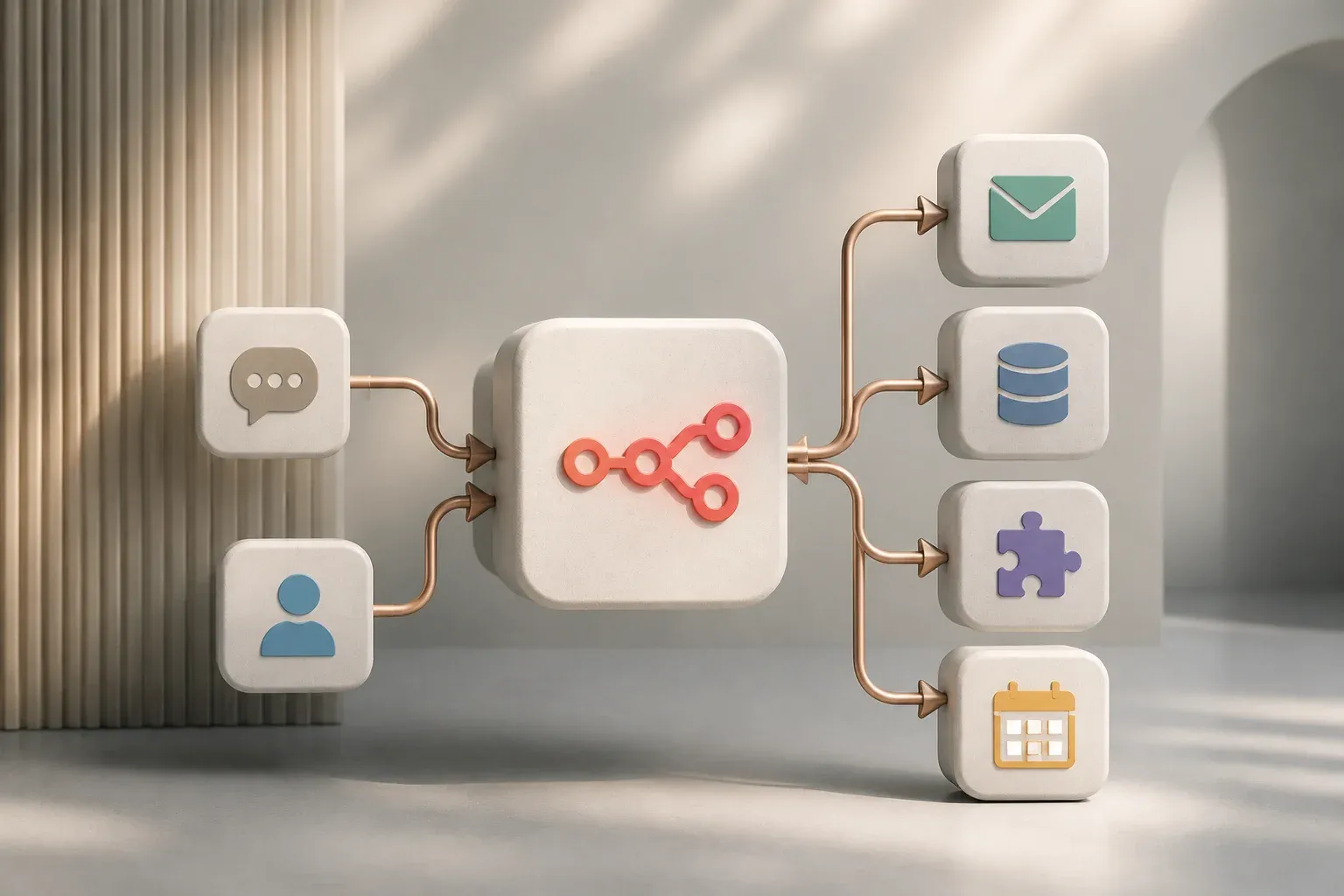
n8n has introduced two related AI automation capabilities that extend its platform beyond conventional, fixed workflow design. n8n Assistant converts plain-language requests into editable workflows on the n8n canvas, while n8n Agents provides configurable AI agents that can work through channels, schedules, tools, and existing workflows. Together, the releases make it easier to create automation and support tasks that require more flexible, back-and-forth handling.
The distinction matters. A workflow remains a defined sequence of steps that teams can inspect, edit, execute, and audit. An agent is intended for work where the path is less predictable, such as responding to incoming requests, gathering context from tools, and deciding which workflow to call next. n8n positions the two constructs as complementary rather than competing ways to automate work.
The official n8n Agents announcement describes agents as configurable units where users define the task, select a model, attach tools and workflows, and let the agent run. This adds a new operating layer to n8n's established workflow canvas without replacing it.
How n8n's new AI capabilities work
n8n Assistant builds workflows from plain-language requests
Launched on September 9, 2026, n8n Assistant is designed to take a request in everyday language and turn it into a working automation. It plans the workflow, adds nodes to the canvas, asks for credentials when required, executes the workflow, and can iterate on fixes.
A key design choice is that the generated automation remains visible on the n8n canvas. The workflow is still the single source of truth: users can modify it manually, review its execution history, and inspect logs. That approach differs from a purely prompt-driven automation experience where the logic is hidden behind a chat interface.
For teams that already know their process but lack time or deep technical knowledge to assemble every node, Assistant can shorten the initial build cycle. It does not remove the need to review permissions, credentials, and workflow logic. Instead, it aims to reduce the manual work required to turn a process description into a usable starting point.
n8n Agents handles less predictable tasks
Introduced on September 25, 2026, n8n Agents is aimed at tasks that do not fit neatly into a single predefined sequence. An agent has its own model, instructions, triggers or channels, tools, memory, sessions, and approvals. It can operate through Slack, Telegram, a schedule, or as a step within another workflow.
Agents can also call workflows as tools. Conversely, a workflow can invoke an agent. This lets a team keep reliable, repeatable steps inside workflows while using an agent where interpretation, follow-up, or routing decisions are needed.
Examples supported by the announced design include:
- Processing an incoming request through Slack or Telegram and using connected tools to gather context.
- Running scheduled agent tasks that can use existing workflows as reusable tools.
- Invoking an agent from a workflow when a task requires more open-ended handling.
- Reusing established workflows for actions that an agent needs to perform during a larger task.
| Capability | n8n Assistant | n8n Agents |
|---|---|---|
| Primary purpose | Builds, executes, and iterates on workflows from plain-language requests. | Runs configurable AI-enabled tasks that can use tools and workflows. |
| Core operating model | Creates an editable workflow on the n8n canvas. | Uses a model, instructions, channels or triggers, tools, memory, sessions, and approvals. |
| Relationship to workflows | The workflow remains visible, editable, and supported by execution history and logs. | Can call workflows as tools and can be invoked from workflows. |
| Availability described by n8n | Preview flag, available on n8n Cloud by default, with self-hosted Docker support beginning from a specified version. Enterprise support is planned. | Available on n8n Cloud's latest stable release, with community self-hosting and Enterprise preview options. |
| Cost model described | Uses AI credits separately from existing AI workflow builder usage. | Uses AI credits and execution usage. |
What this changes for business automation
The practical opportunity is not simply to add a chatbot to a business process. Assistant can reduce the effort needed to create a repeatable automation, while Agents can add AI-guided handling around work that arrives through messages, forms, schedules, or other triggers.
For example, a team could use a workflow to receive a form submission, check a CRM record, and create a ticket. Where the submission needs interpretation or a follow-up exchange, an agent could be invoked to handle that less structured part of the process. The workflow remains useful for the predictable steps, and the agent becomes a layer for handling the uncertainty around them.
This model can be relevant for onboarding, lead or request routing, customer-support triage, and other recurring operational processes. The releases do not guarantee a fully autonomous process. Sensitive actions still require attention to credential handling and approvals, and the quality of an agent's outcome will depend on its instructions, model, connected tools, and workflow design.
Availability and cost require planning
n8n has described staged availability for both releases. Assistant runs behind a preview flag and is available on n8n Cloud by default, while self-hosted Docker support begins from a specified version and Enterprise support is on the roadmap. Agents are available on the latest stable n8n Cloud release, with community self-hosting and preview Enterprise options.
Both capabilities introduce an additional cost consideration. Assistant usage is based on AI credits and is separate from existing AI workflow builder usage. Agent costs are tied to AI credits and execution usage. Teams testing either capability should therefore establish usage budgets and review how often agents are triggered, which models they use, and how many workflow executions they generate.
For businesses, the most practical starting point is a bounded process with clear success criteria. A simple intake-and-routing workflow, for instance, offers a more manageable test than handing an agent broad access to many systems on day one.
AI-enabled automation is most valuable when it fits a real operating process, not when it adds complexity to a task that is already working. Scalevise can help map suitable processes, connect the required apps, and build reliable workflows around the right level of AI assistance through its n8n workflow setup service. That can reduce manual handoffs while keeping important actions visible and reviewable. Discuss an n8n automation project with Scalevise.
Frequently Asked Questions
What is n8n Assistant?
n8n Assistant is a plain-language workflow builder that plans a workflow, adds nodes to the canvas, requests credentials when needed, executes the workflow, and can iterate on fixes. The resulting workflow remains editable and supported by execution history and logs.
What are n8n Agents?
n8n Agents are configurable AI-enabled agents that can run through Slack, Telegram, schedules, or other workflows. They can use selected models, tools, memory, sessions, approvals, and workflows called as tools.
Can n8n Agents and workflows work together?
Yes. Agents can call workflows as tools, and workflows can invoke agents. This allows workflows to handle defined steps while agents handle more open-ended tasks.
How are n8n Assistant and Agents priced?
n8n Assistant uses AI credits that are separate from existing AI workflow builder usage. n8n Agents use AI credits and execution usage. The supplied announcements do not provide further pricing figures.
Conclusion
n8n Assistant and n8n Agents mark a confirmed expansion of n8n's AI-native automation model. Assistant makes workflow creation more accessible while retaining an editable, auditable canvas, and Agents add a configurable option for tasks that need more flexible handling. The strongest use cases will combine both: dependable workflows for repeatable actions and carefully scoped agents for the parts of a process that cannot be fully predefined.