
Google AI Mode Reduced Publisher Clicks in a Controlled Search Experiment
A preregistered experiment found that routing searches into Google AI Mode reduced external publisher clicks, while trust and search frequency also declined.
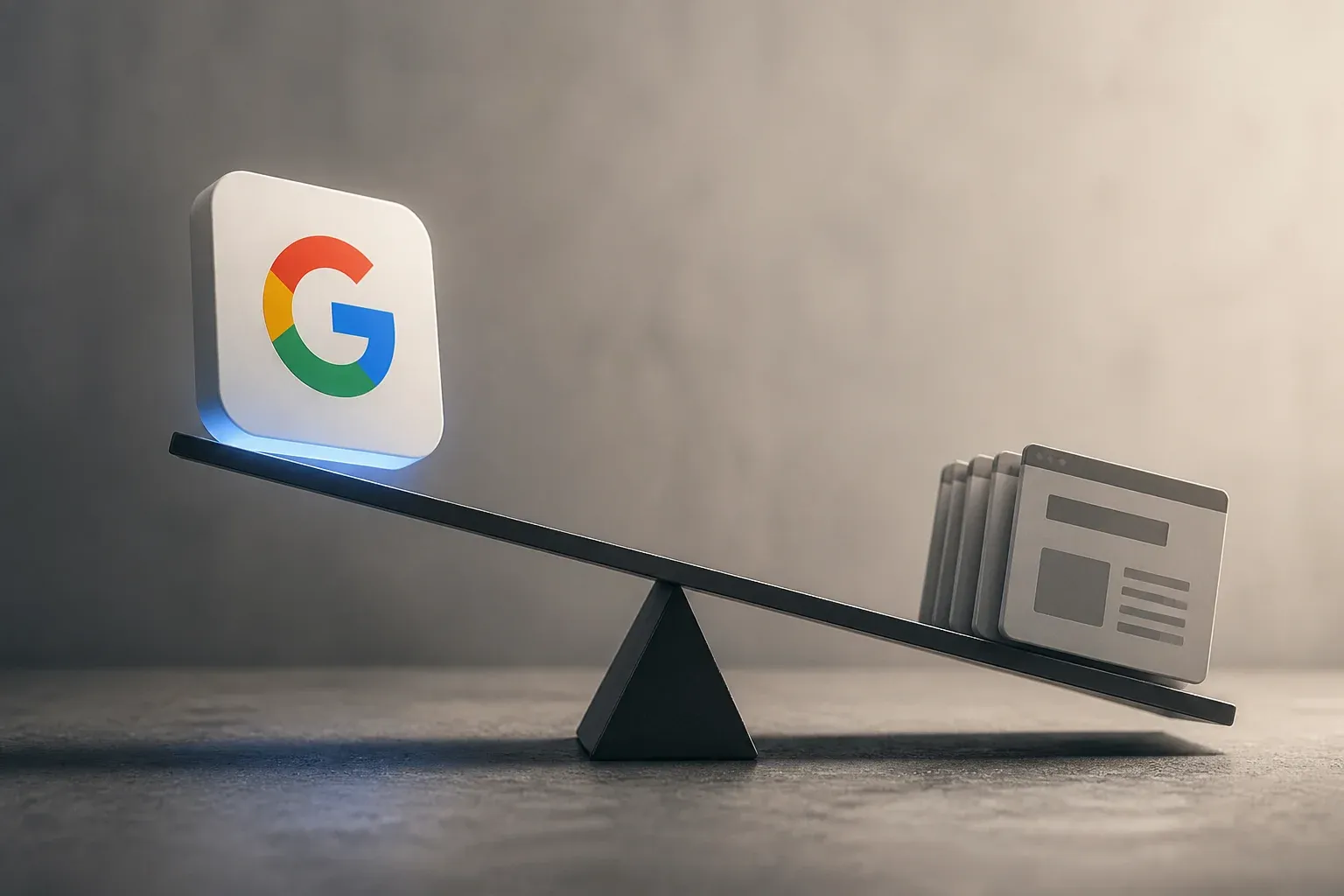
Google AI Mode reduced external clicks to publishers by 18.8 percentage points compared with standard Google Search in a preregistered field experiment involving 1,100 US participants. The study also found lower trust in information found through Google and fewer daily search sessions when participants were routed into AI Mode. For website owners, marketers, and businesses that depend on search referrals, the findings add evidence that AI-mediated search can change not only rankings, but whether users leave Google at all.
The research, AI in Search Reduces Publisher Referrals Without Improving User Experience: Experimental Evidence, tested Google Search over a seven-day period through a browser extension. Participants were randomly assigned to one of three experiences: a version without AI Search features, unmodified current Google Search, or a version that routed all queries into AI Mode. This design matters because it measures observed behavior during use, rather than relying only on surveys or aggregate traffic estimates.
The central result is not that Google Search stopped sending referrals. It is that forcing searches into AI Mode materially reduced the share of participants who clicked through to outside sites relative to the standard search experience. The authors also caution that the results reflect AI Mode's design and implementation during the experiment, so they should not be treated as a forecast for every future version of Google Search or every market.
What the experiment found about AI Mode and web traffic
AI Mode kept participants in an AI-mediated search experience for longer sessions, but that extra time did not translate into more engagement with the open web or stronger user sentiment. Compared with the Current Search condition, the AI Mode group recorded fewer daily Google search sessions and lower trust in the information they found.
| Measure | AI Mode Search compared with Current Search | What it indicates |
|---|---|---|
| External publisher clicks | 18.8 percentage points lower | Less traffic leaving Google for outside sites |
| Daily Google search sessions | About 0.92 fewer per participant | Lower search frequency during the treatment period |
| Trust in information found on Google | 0.34 points lower on a 7-point scale | Lower reported trust under AI Mode |
| Minutes per search session | Higher | More time spent within the AI-mediated experience |
The decline was visible across several types of destinations. Click-through to news sites fell by about 12.5 percentage points, Reddit clicks fell by about 21.2 points, and Wikipedia clicks fell by about 9.9 points. Effects were larger for heavier Google users, meaning people with higher daily search volumes saw a stronger change in behavior.
The No AI Search condition provides useful context. When AI Overviews were hidden and AI Mode was unavailable, external traffic could rise. That comparison supports the researchers' interpretation that current AI integrations can redirect attention away from publishers, rather than simply creating additional engagement that later flows to websites.
For businesses, this is a warning against treating search visibility and site visits as interchangeable. A page can remain visible in a search journey while receiving fewer visits if an AI answer satisfies enough of the user's immediate need inside Google.
The study does have important limits. Participants were US-based, recruitment occurred in March 2026, and the intervention deliberately routed every query in one group to AI Mode. Everyday use is more selective, and Google can change its product. The experiment nevertheless provides stronger evidence than a snapshot of referral analytics because assignment to the search experiences was randomized.
Practical implications for SEO and acquisition strategy
The immediate takeaway is not to abandon Google Search. It is to prepare for a measurement environment where click volume can become a less complete representation of search demand, brand discovery, and content usefulness.
Teams that rely heavily on informational content should monitor whether impressions, rankings, and clicks are moving in different directions. If visibility is stable or growing while clicks decline, AI-generated answer experiences may be one possible explanation. That pattern alone does not prove causation, but it is a reason to investigate query types, landing pages, and changes in how search results are presented.
A practical response can include four connected actions:
- Separate traffic by intent. Track informational, comparison, branded, and conversion-oriented queries separately instead of judging search performance through one aggregate traffic number.
- Build content that earns deeper visits. Publish original analysis, clear product detail, tools, examples, and decision-supporting information that cannot be fully replaced by a short answer.
- Diversify audience acquisition. Strengthen email, direct traffic, partnerships, communities, social distribution, and returning-user experiences so that one search interface is not the sole route to customers.
- Measure outcomes beyond clicks. Connect search reporting to leads, subscriptions, enquiries, sales, and assisted conversions where possible. A lower click count and a lower business outcome are not automatically the same thing.
This is particularly relevant for publishers, content-led businesses, and companies whose websites answer early-stage customer questions. Those pages may still establish expertise or introduce a brand, but their historic role as a reliable referral engine could weaken if AI answers increasingly resolve the query before a click occurs.
The study also complicates a simple efficiency narrative. AI Mode increased time per session, yet participants searched less often and reported lower trust. That does not establish why users felt less trust, nor does it mean every AI answer harms satisfaction. It does show that keeping people in an AI interface longer is not, by itself, evidence of a better search experience.
For businesses adapting to AI search, the priority is clearer visibility into where and how they appear in answer-driven results. Scalevise helps teams assess brand presence across AI search experiences, identify content gaps, and turn the findings into practical search and content priorities. Use the Scalevise AI Visibility and GEO Checker to establish a baseline before traffic patterns make the change harder to diagnose. Start an AI Visibility scan.
Frequently Asked Questions
What did the Google AI Mode experiment find?
The experiment found that participants forced into Google AI Mode clicked through to external publishers 18.8 percentage points less often than participants using unmodified Google Search. It also found lower trust and fewer daily search sessions.
Did the study show that AI Mode eliminates website traffic?
No. The study found a reduction in external clicks relative to standard Google Search in its experimental setting. It did not show that Google AI Mode eliminates referrals or predict results for every website, query, or future product version.
Why does AI Mode matter for SEO?
AI Mode can answer more of a user's question inside Google. If users obtain enough information without opening a result, a website may receive fewer visits even when it remains relevant to the search journey.
What should businesses measure as AI search expands?
Businesses should track impressions, rankings, clicks, query intent, landing-page performance, leads, sales, and assisted conversions. Comparing these metrics can reveal whether visibility and referral traffic are beginning to diverge.
Conclusion
The experiment offers concrete evidence that Google AI Mode can reduce referral traffic to outside sites while increasing time spent inside the search experience. Its controlled design and stated limitations both matter: the results are a meaningful signal, not a universal forecast. Businesses that depend on search should monitor AI-driven changes closely, protect their direct audience relationships, and evaluate search performance through business outcomes as well as clicks.