
Google Maps Complete Male Fruit Fly Connectome, While DOOMFLY Tests Control Potential
Google Research and collaborators have published a complete map of the adult male fruit fly brain and central nervous system. An independent Doom experiment illustrates an early, exploratory use of the data.
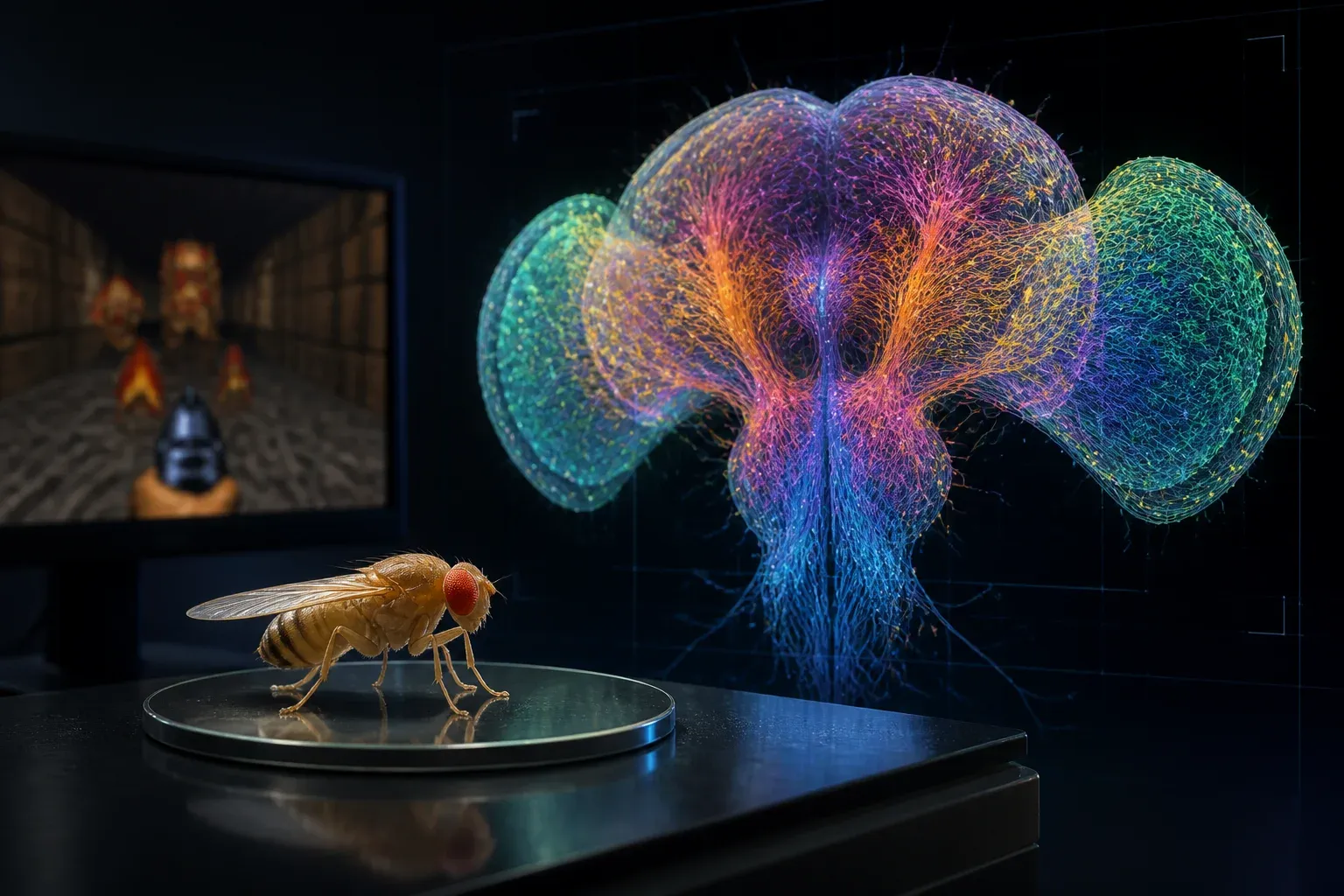
Google Research, working with HHMI Janelia Research Campus and other partners, has published a complete wiring diagram of the adult male fruit fly brain and central nervous system. The map contains roughly 166,000 neurons and 125 million synapses, making it the largest neuron-count brain map published to date. It is a neuroscience resource rather than a new AI product, but it provides a much richer foundation for studying how neural circuits turn sensory inputs into actions.
The milestone has also attracted attention because an independent project, DOOMFLY, uses retained connectome data in an experimental pipeline that drives the game Doom. That demonstration is an intriguing test of real-time control, but it should not be confused with Google having created a general-purpose AI agent, a trained game-playing system, or a commercial neuromorphic platform. The official achievement is the connectome itself. The gameplay experiment is an early exploration of one possible way to interact with such data.
What Google Research published
A connectome is a map of connections in a nervous system. In this case, researchers mapped the adult male fruit fly brain and central nervous system at a level that records neurons and the synapses connecting them. Google describes the result in its official connectomics milestone announcement, alongside work published by Januszewski, Jain, and collaborators in Cell.
The importance of a complete map is not simply its scale. Researchers can use it to investigate how biological circuits are organized and how they may support perception, action, and learning. Google says the work is part of a wider connectomics effort that combines AI-assisted reconstruction with human verification, while related projects continue to extend mapping approaches to species including fish and mice.
The program also makes data more usable through visualization and analysis tools, including Neuroglancer and the wider Janelia and FlyWire ecosystem. That matters because an enormous connectivity map is only useful when scientists can explore, query, and test hypotheses against it.
The official work has several clearly stated research goals:
- Understanding how neural circuits process sensory information and generate behavior.
- Creating a foundation for biological and medical research.
- Improving the methods used to reconstruct increasingly complete nervous systems.
- Informing the long-term design of neuromorphic hardware, which seeks inspiration from biological neural systems.
None of these goals means that a fruit fly brain has been reproduced as a capable digital intelligence. A connectome captures wiring relationships, but a full account of brain function also involves dynamics and other biological processes. The map is a major input to future research, not a finished explanation of intelligence.
What the DOOMFLY demonstration does, and does not show
DOOMFLY is a separate project hosted in the nftechie/doomfly repository. Its materials describe an experimental system that takes game frames, processes them through a simulated fly-brain model, and translates resulting activity into controls such as movement, turning, and shooting. The project also discusses neuroplasticity ideas and ongoing validation checks.
This is a useful distinction: connecting a biological wiring map to a live control task is different from proving that the underlying model understands a game, has learned its rules, or can generalize to unrelated tasks. DOOMFLY describes itself as exploratory and non-validated. It is not a living animal playing Doom, nor is it an official Google product demonstration.
| Aspect | Google Research connectome milestone | DOOMFLY demonstration |
|---|---|---|
| Primary purpose | Map the adult male fruit fly brain and central nervous system | Explore connectome-scale data in a real-time game control pipeline |
| Scale described | Roughly 166,000 neurons and 125 million synapses | Uses retained MaleCNS v1.0 connectome data |
| Status | Officially published research milestone | Independent, experimental, non-validated project |
| What it establishes | A foundational wiring resource for neuroscience research | A possible interface between a simulated connectome model and game controls |
The experimental work is still meaningful. Real-time tasks force researchers to confront practical questions about how a connectome-derived model receives inputs, produces outputs, and changes behavior. Those questions sit near the boundary between neuroscience, simulation, AI research, and hardware design. But the demonstration remains a research probe, not evidence that connectome-based systems are ready to replace mainstream machine learning.
Why the milestone matters beyond neuroscience
For businesses, the immediate implication is primarily one of technology direction rather than adoption. The research does not create a new software tool that companies can deploy to automate sales, customer service, or operations. Conventional AI models and established automation systems remain the practical options for those use cases.
Still, connectomics is relevant to the longer-term search for AI systems that can process information efficiently and respond to changing environments. Google's announcement explicitly places its work among efforts that may inform neuromorphic hardware design. Neuromorphic approaches are often explored because biological neural systems offer different ideas about computation from conventional software and hardware.
It would be premature to translate that ambition into claims about lower energy costs, faster business AI, or a near-term hardware replacement. The supplied research provides no performance, efficiency, pricing, or commercial availability figures for a connectome-derived system. What it does show is that the research infrastructure for studying biological neural wiring has advanced substantially.
For managers and technology teams, the practical lesson is to separate near-term tools from long-term signals. Businesses can use proven AI and automation where there is a defined workflow, reliable data, and a measurable outcome. Meanwhile, developments such as the fruit fly connectome are worth tracking because they may influence future AI architectures, specialized chips, and research methods, even if the route from laboratory map to business software remains uncertain.
Connectome research is not a deployment blueprint, but it is a useful signal that AI architectures and hardware may diversify. Businesses that build flexible workflows now can evaluate new AI capabilities without committing to unproven concepts. Scalevise helps teams identify practical use cases, assess integration constraints, and create an adoption roadmap tied to measurable operations. Request an AI consultancy with Scalevise to discuss where proven AI can reduce manual work today.
Frequently Asked Questions
What did Google Research publish?
Google Research and collaborators published a complete wiring diagram of the adult male fruit fly brain and central nervous system, containing roughly 166,000 neurons and about 125 million synapses.
Is DOOMFLY a living fruit fly playing Doom?
No. DOOMFLY is an experimental software pipeline that uses retained connectome data and a simulated fly-brain model to generate game controls.
Does the DOOMFLY experiment prove a new general AI system?
No. The project describes an exploratory, non-validated setup for testing connectome-scale models in a real-time control task. It does not claim a mature general AI or consumer product.
What could this research mean for neuromorphic hardware?
Google says connectomics may inform neuromorphic hardware design. The published map offers a resource for studying biological neural circuits, but it does not establish a commercial hardware product or quantified efficiency benefit.
Conclusion
The complete male fruit fly connectome is a significant advance in neuroscience because it gives researchers an unprecedented wiring-level resource for studying neural behavior. DOOMFLY adds an interesting but early example of connecting that kind of data to a live control task. Together, they point to a promising research frontier, while leaving the commercial and technical path to practical connectome-inspired AI largely open.