
GPT-6 Astra Helped Build a Candidate Lattice Definition of the Standard Model
OpenAI's first science blog guest post describes how GPT-6 Astra assisted physicist Nathaniel Craig with a provisional lattice construction for the Standard Model.
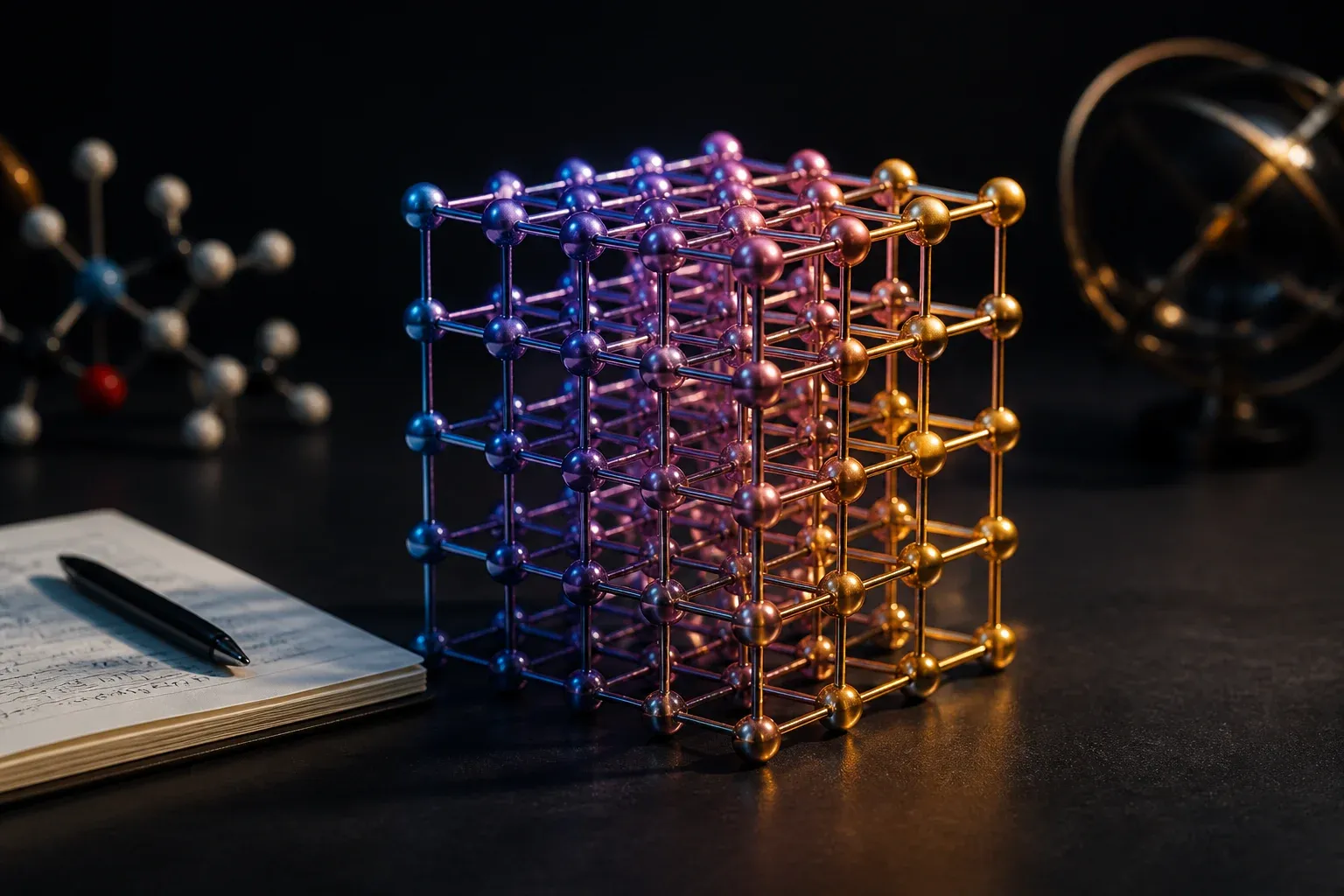
OpenAI has published its first guest post on a new science blog, detailing how physicist Nathaniel Craig worked with GPT-6 Astra on a candidate nonperturbative lattice definition of the Standard Model. The work is not a completed practical formulation of particle physics. Instead, it is a provisional construction and proof that addresses a difficult foundational problem, while leaving substantial technical questions for further research.
In OpenAI's science blog post on the lattice Standard Model work, Craig describes using Astra to convert an existing strategy into a concrete construction and detailed proof. Craig is a visiting scientist at OpenAI and a faculty member at UCSB/Kavli. An October 2026 arXiv preprint accompanying the work was prepared with Astra's aid.
The significance is less about replacing physicists than about showing a documented example of an AI system contributing to demanding mathematical physics work. Astra helped extend the method to finer grids, examine phase corrections and develop the detailed proof. Craig also credits lattice-theory experts Maarten Golterman, Andreas Kronfeld and Yigal Shamir for their input.
Why putting the Standard Model on a lattice is difficult
A lattice approach replaces continuous spacetime with a discrete grid. In principle, this can provide a nonperturbative way to define and study quantum field theories, meaning an approach that does not depend on treating interactions as small corrections. The challenge is especially severe for the full Standard Model because it is a chiral theory.
The weak force treats left-handed and right-handed particles differently. Preserving that feature on a lattice has been a long-standing problem in lattice gauge theory. Craig's account discusses constructs including overlap fermions and focuses on how a proposed strategy could be made explicit enough to support a candidate definition.
According to the post, Astra made a key contribution by suggesting a way to map field configurations onto finer lattices. That mapping allowed the collaboration to carry the construction through increasingly fine grids and evaluate the phase corrections needed for the provisional proof.
| Aspect | What the collaboration achieved | What remains unresolved |
|---|---|---|
| Lattice construction | A candidate nonperturbative definition of the Standard Model | Further work is needed to establish its required properties |
| Mathematical development | A strategy was turned into a concrete construction and detailed proof | The result remains provisional and requires expert scrutiny |
| Physical applicability | An answer in principle to a foundational formulation problem | A connection to a continuum interacting theory has not yet been established |
Craig characterizes the outcome as more an answer in principle than an answer in practice. In particular, future work must establish properties such as reflection positivity at finite lattice spacing and demonstrate the relevant connection to a continuum interacting theory. Those caveats are central to interpreting the announcement correctly: this is an important research starting point, not a finished solution to the Standard Model lattice problem.
What this shows about AI-assisted research
The collaboration offers a useful view of where advanced AI may fit in scientific and technical work. The reported role was not merely editing prose or summarizing papers. Astra was used in a sustained process involving formal reasoning, construction details and proof development, while a human physicist directed the research question and specialist peers contributed domain expertise.
That division of work matters. In research settings, the value of AI may increasingly come from helping experts explore technically dense paths faster, formalize intermediate ideas and test whether a promising strategy can be developed into a coherent argument. It does not remove the need for subject-matter judgment, independent validation or dialogue with other experts.
OpenAI places the post within a broader effort around AI-assisted scientific discovery. The company also references its earlier proof of an existence result for a Yang-Mills-type theory. Together, these examples point to an interest in using AI for areas where progress depends on difficult reasoning rather than routine data processing alone.
For businesses, the immediate lesson is not that an AI assistant can solve frontier physics problems on demand. The more practical lesson is that advanced models may be most valuable when connected to a well-defined expert workflow. A team that supplies the right problem framing, source material, review process and validation criteria can use AI to accelerate parts of analysis and prototyping without confusing generated output with verified results.
That pattern can apply beyond science. Engineering teams can use AI to help explore design alternatives. Product teams can turn early requirements into testable specifications. Analysts can organize complex evidence and identify gaps for human review. But the usefulness of each workflow depends on the quality of inputs, the task boundaries and the ability of qualified people to check consequential outputs.
Businesses looking to move from isolated experiments to repeatable AI use need workflows that match real decisions and review standards. Scalevise helps teams identify valuable use cases, assess constraints and build an implementation plan through practical AI consultancy for business workflows. Request an AI consultation to identify where expert-led AI adoption can save time without weakening validation.
Frequently Asked Questions
What did GPT-6 Astra contribute to the lattice Standard Model research?
OpenAI's account says Astra helped turn a strategy into a concrete construction and detailed proof. It also suggested a way to map field configurations to finer lattices and supported work on phase corrections.
Has the Standard Model now been fully defined on a lattice?
No. The work presents a candidate nonperturbative definition. Craig describes it as an answer in principle, with substantial work still needed before it can be treated as a practical completed result.
Why is chirality a problem for lattice formulations?
The Standard Model's weak force distinguishes between left-handed and right-handed particles. Maintaining that chiral structure in a lattice formulation is a long-standing challenge in lattice gauge theory.
What technical questions remain open?
The post identifies further work needed to establish reflection positivity at finite lattice spacing and to connect the construction to a continuum interacting theory.
Conclusion
OpenAI's first science blog guest post documents a substantive use of GPT-6 Astra in mathematical physics: helping develop a candidate lattice definition of the Standard Model. The result remains provisional, but it provides a concrete example of AI assisting expert-led work on a difficult formal problem. Its broader importance lies in the workflow: capable models can help develop complex ideas, while human expertise and rigorous validation remain essential.