
n8n Connects Firecrawl to Bring Real-Time Web Data Into Cloud AI Workflows
n8n Cloud's Firecrawl integration simplifies access to structured web content for LLM workflows, including RAG ingestion and lead enrichment templates.
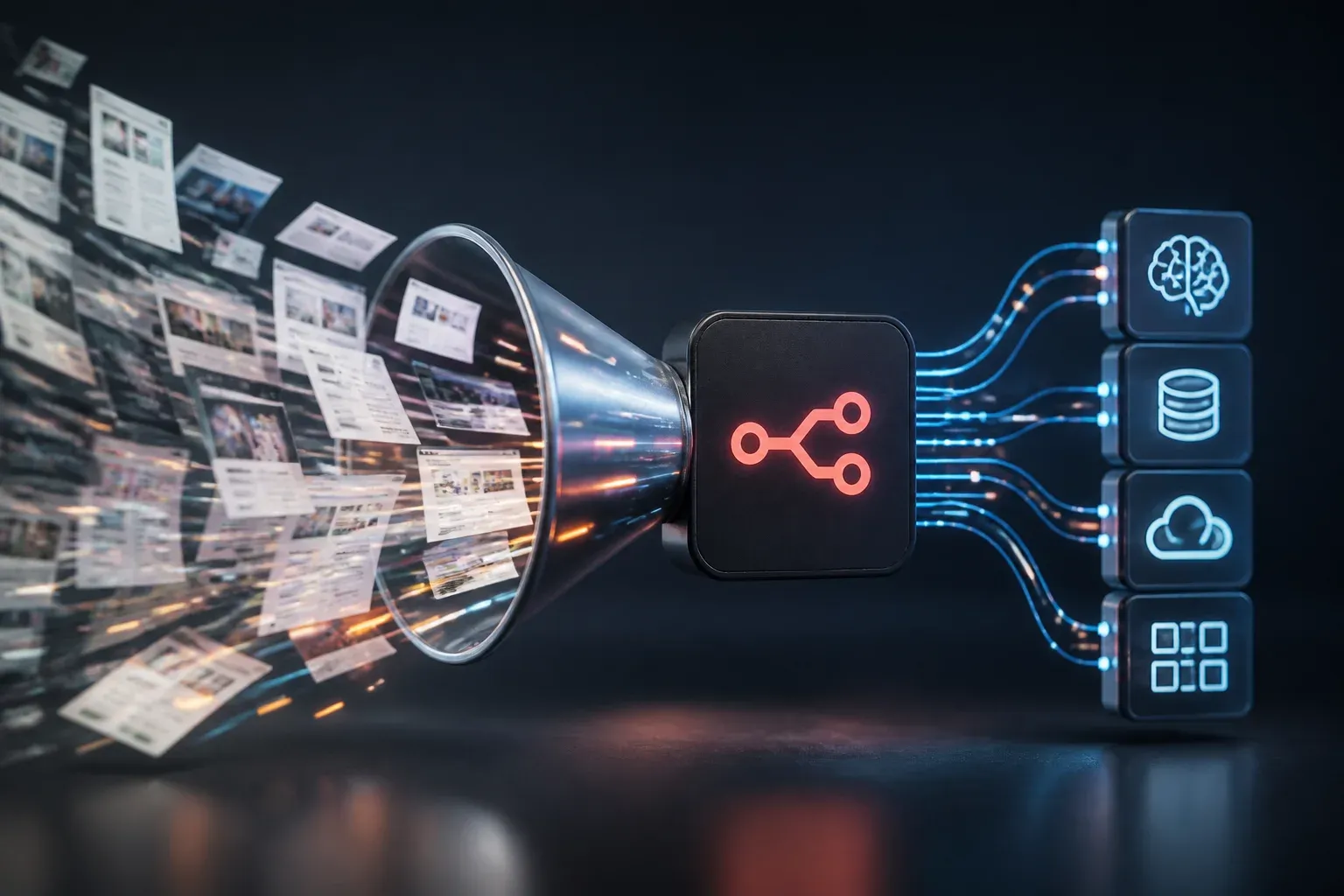
n8n has integrated Firecrawl into n8n Cloud to give AI workflows direct access to real-time, structured web data. The connection is designed to reduce the setup required to use web content in LLM applications, while supporting common workflow patterns such as retrieval-augmented generation (RAG) ingestion and company lead enrichment.
According to n8n's Firecrawl integration announcement, users can connect Firecrawl from the n8n canvas in one step on first use, rather than configuring a separate API key. The rollout matters because live web data is often useful to AI systems, but raw pages can be difficult to extract, normalize, and pass efficiently to an LLM or vector database.
What the Firecrawl integration changes
Firecrawl is built to turn websites into clean, LLM-ready data, including content from JavaScript-rendered pages. Within n8n Cloud, that capability becomes part of an automation workflow rather than a separately configured data-extraction service. The Firecrawl node is built and maintained by Firecrawl in partnership with n8n, according to the official integration page.
For developers, the practical change is less about a new model capability and more about the data layer around AI applications. A workflow can collect current web content, structure it for downstream processing, and send it to a storage or AI component already connected through n8n. This can make a workflow easier to assemble, particularly when the task depends on information that changes on the public web.
The documented integration and accompanying templates focus on three use cases:
- Web-page ingestion into a Pinecone RAG stack
- Web-page ingestion into Supabase pgvector
- Company lead enrichment using Firecrawl, OpenRouter AI, and Supabase
Firecrawl and n8n position the extraction layer as a way to avoid passing unnecessary page markup and other noise into a language-model workflow. The announcement reports 60% to 90% token savings compared with raw scraping, though that is a vendor-reported figure and actual results will depend on the site, extraction settings, and downstream prompt design.
| Workflow data approach | Raw web scraping | Firecrawl in n8n Cloud |
|---|---|---|
| Data format for LLM workflows | May include raw page content and markup | Designed to provide clean, structured, LLM-ready data |
| JavaScript-rendered pages | Implementation-dependent | Handled by Firecrawl |
| Initial Cloud connection | Not part of the n8n Firecrawl flow | One-step connection from the n8n canvas on first use |
| Reported token efficiency | Baseline used in n8n's comparison | 60% to 90% savings reported by the announcement |
A smoother connection is not the same as data governance
The integration is part of n8n's broader Cloud authentication improvements, which aim to make connecting services less cumbersome. That can accelerate prototyping and shorten the path from a workflow idea to a working AI data pipeline.
However, simpler authentication does not remove the need for engineering and governance decisions. Teams still need to determine which websites they are permitted to collect from, which content should enter a knowledge base, how frequently data should be refreshed, and what retention rules apply once content reaches Pinecone, Supabase, or another connected system. They should also evaluate extraction quality before relying on the resulting data in customer-facing or business-critical LLM workflows.
The March 2026 announcement also included an onboarding promotion for 100,000 Firecrawl credits. That offer ended on May 5, 2026. The supplied information does not establish ongoing Firecrawl pricing or the cost profile of a production workflow, so teams should assess their expected crawl volume, model use, and storage requirements through the applicable service configuration.
Where real-time web data fits in AI automation
The strongest use case for this integration is not simply adding a website to an LLM prompt. It is creating a repeatable pipeline that can retrieve relevant public information, prepare it for retrieval or analysis, and route the results into the next business step.
For a RAG workflow, Firecrawl can serve as the web-content intake layer before documents are loaded into Pinecone or Supabase pgvector. For lead enrichment, the combination of Firecrawl, OpenRouter AI, and Supabase demonstrates how web information can be collected, interpreted by an AI component, and saved into a structured system of record.
What developers should validate before deployment
n8n's templates provide a starting point, but production workflows need validation around the specific data source and business outcome. Useful checks include:
- Whether extracted content is sufficiently complete and clean for the intended retrieval or enrichment task.
- Whether refresh timing aligns with how quickly the relevant web information changes.
- Whether the vector-store schema and metadata make retrieved content traceable to its source.
- Whether AI-generated outputs are reviewed or constrained appropriately before they trigger downstream actions.
For businesses, the value is the potential to connect web research, AI processing, and operational systems in one workflow. The trade-off is that data freshness can increase the need for monitoring: changing source pages can affect both the information available to a model and the quality of the final output.
Teams building AI automations that depend on external data need more than a connector. They need a workflow design that controls data flow, validates outputs, and connects AI results to useful business actions. Scalevise's AI workflow automation services can help map that architecture from data collection through deployment, helping reduce manual handoffs and avoid fragile prototypes. Discuss an AI automation project with Scalevise.
Frequently Asked Questions
What is the n8n Firecrawl integration?
It is an n8n Cloud integration that connects Firecrawl to AI workflows for extracting and using real-time, structured web data.
Can Firecrawl be used for RAG workflows in n8n?
Yes. n8n provides templates for scraping and ingesting web pages into both a Pinecone RAG stack and Supabase pgvector.
Does the integration support JavaScript-rendered websites?
Yes. n8n describes Firecrawl as handling JavaScript-rendered content while converting websites into LLM-ready data.
Did n8n's Firecrawl promotion include free credits?
The March 2026 announcement included an offer for 100,000 Firecrawl credits, but n8n stated that the offer ended on May 5, 2026.
Conclusion
The Firecrawl integration gives n8n Cloud users a more direct route from live web content to AI workflows, RAG pipelines, and enrichment processes. Its significance lies in combining structured extraction with n8n's workflow orchestration, while leaving teams responsible for validating data quality, source permissions, and downstream AI behavior.