
n8n Demonstrates Fully Local AI Workflows on a Single NVIDIA DGX Spark
n8n has documented a DGX Spark deployment that runs model inference and workflow orchestration locally, using an OpenAI-compatible endpoint and LiteLLM routing.
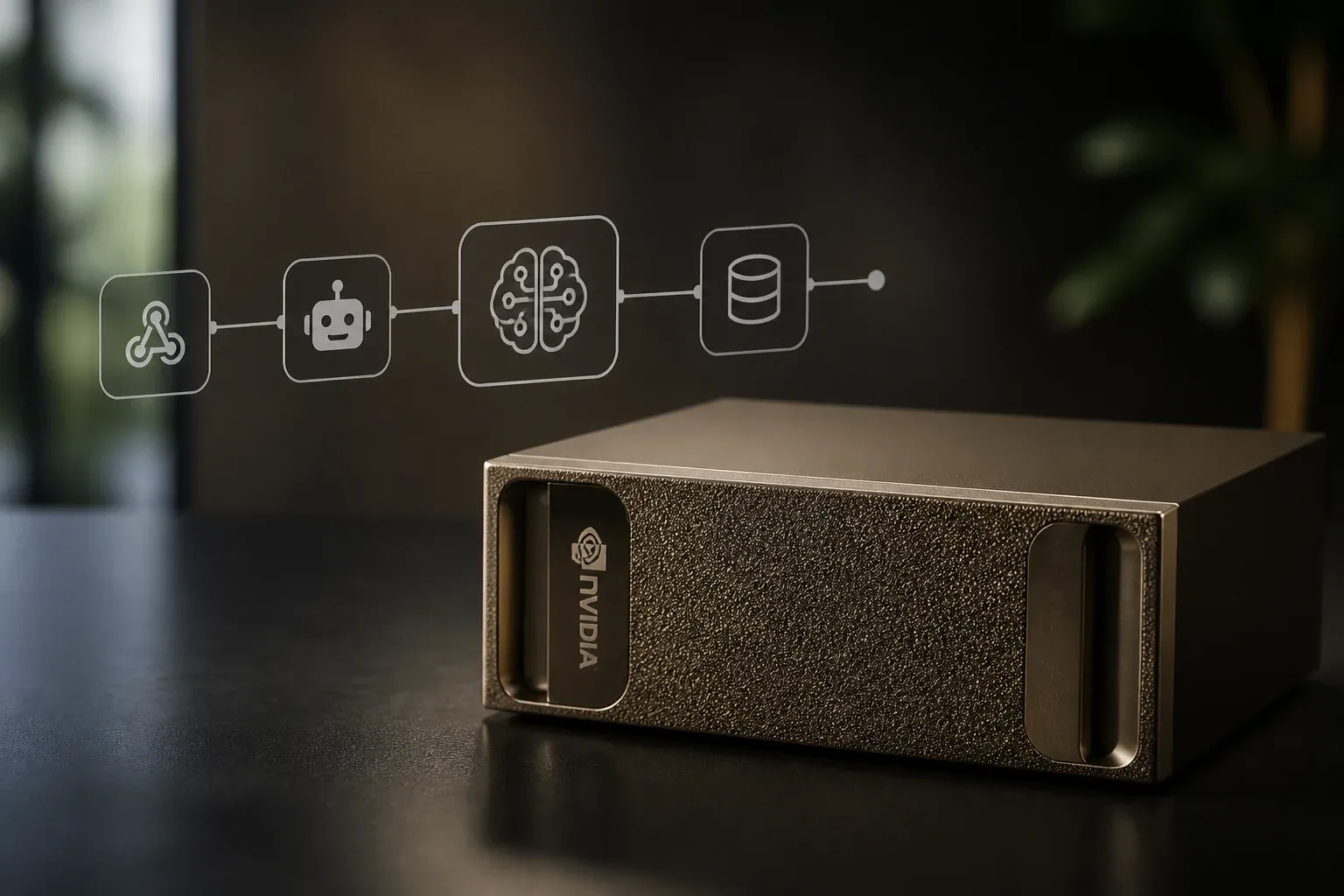
n8n has demonstrated a way to run AI workflows locally on a single NVIDIA DGX Spark, without relying on cloud AI APIs. The setup combines locally deployed models, an OpenAI-compatible endpoint, LiteLLM request routing, and n8n workflow orchestration. For organizations handling sensitive data or seeking more direct control over AI execution, the important development is not simply local model hosting. It is the ability to connect local inference to operational workflows without sending workflow requests to an external model API.
In its official DGX Spark deployment guide, published October 19, 2026, n8n outlines how multiple AI components can run on one DGX Spark. The documented architecture makes local models available through an endpoint compatible with the OpenAI API format, allowing n8n workflows and compatible applications to call them using a familiar integration pattern.
That approach gives businesses a practical alternative to workflows built entirely around hosted AI services. It does not mean every company should move inference on premises. Hardware, model operations, and integration work remain real considerations. But the demonstration shows that workflow automation and model inference can be deployed together in a local environment rather than split between internal systems and cloud APIs.
How the local n8n and DGX Spark architecture works
The core design separates model serving, request routing, and workflow automation while keeping each layer inside the local deployment. n8n describes using a LiteLLM proxy to route requests to local model endpoints and prevent calls from being sent to cloud providers. The proxy also provides a consistent OpenAI-compatible interface for the surrounding workflow.
The documented deployment includes several AI functions rather than a single chat model:
- Qwen3.6-35B-A3B-NVFP4 for language-model inference in NVFP4 format.
- Embedding and reranking models for retrieval-oriented workflows.
- Whisper for speech-to-text processing.
- OCR components for extracting text from documents and images.
- Image-generation components.
This matters because useful business workflows often require more than text generation. A document-processing flow, for example, may need OCR to read a file, embeddings to search internal content, a language model to classify or summarize information, and n8n to send the result to another business system.
n8n's guide also covers local model caching and pinning software commits. Those steps are operationally significant. Caching keeps required model files available locally, while pinning commits helps teams reproduce a tested deployment rather than depending on an untracked software revision.
| Workflow element | n8n DGX Spark reference setup | Cloud API-based workflow |
|---|---|---|
| Model execution | Runs on locally deployed models on a DGX Spark | Runs through an external model API |
| Request routing | LiteLLM routes requests to local endpoints | Requests are sent to the selected cloud provider |
| Application interface | OpenAI-compatible endpoint | Provider API or compatible endpoint |
| Cloud dependency for inference | No cloud API required in the documented setup | Required for model inference |
What changes for workflow builders
For teams already using n8n, an OpenAI-compatible local endpoint can reduce the amount of workflow redesign required to test local inference. Instead of building every step around a proprietary cloud-model connection, developers can point compatible nodes and applications at the local endpoint managed through the deployment.
The value is especially clear when AI needs to work alongside internal documents, support records, audio files, or operational data. Keeping inference local can support a design in which the workflow data and the model request remain on the organization's own infrastructure. That is a deployment property, not an automatic security outcome. Teams still need to configure access controls, credentials, network boundaries, logging, and the applications that feed data into the workflow.
The setup also avoids treating an AI model as a disconnected chatbot. n8n remains the orchestration layer that determines what triggers an AI task, what information is passed to it, which downstream systems receive the result, and where human review is needed. In practical terms, the model generates or processes information, while the workflow defines the business process around it.
Adoption considerations before moving local
The demonstration is a reference architecture, not evidence that local inference is simpler or less expensive for every use case. A cloud API can still be a more straightforward option for teams that need to start quickly, do not have suitable hardware, or prefer a provider to operate the model-serving layer.
Before pursuing a local deployment, decision-makers should clarify:
- Which workflows actually require local inference rather than a hosted API.
- Which models and supporting components are needed for tasks such as transcription, retrieval, OCR, or generation.
- How local endpoints will authenticate with n8n and other internal applications.
- Who will maintain model versions, cached assets, software revisions, and workflow monitoring.
- Whether a human approval step is needed before an automated workflow changes records, contacts customers, or triggers another business action.
The NVIDIA connection also has a broader context. NVentures participated in n8n's Series C financing announced in October 2025. The DGX Spark demonstration, presented around GTC Berlin 2026, shows a concrete technical path for combining NVIDIA hardware with n8n's workflow platform. The relevant takeaway is the architecture itself: local models can be exposed through a compatible interface and put to work in automated processes.
For companies considering local AI, the challenge is rarely just installing a model. It is building dependable workflows around it. Scalevise can help design and implement a production-ready n8n automation setup that connects AI tasks to the systems your team already uses, with practical handling for triggers, approvals, errors, and monitoring. A focused implementation can turn local inference from a technical experiment into a repeatable operational process. Request an n8n setup consultation.
Frequently Asked Questions
Can n8n run AI workflows without cloud APIs?
Yes. n8n's documented DGX Spark setup routes requests through LiteLLM to locally deployed models, so the workflow can operate without a cloud AI API.
What role does NVIDIA DGX Spark play in the n8n deployment?
DGX Spark is the local hardware platform used in n8n's documented deployment to run multiple AI components, including a language model, embeddings, reranking, Whisper, OCR, and image-generation components.
Why is an OpenAI-compatible endpoint useful for local AI?
It gives compatible applications and workflows a familiar API interface while directing requests to locally hosted models rather than an external cloud provider.
Does local AI remove the need for workflow management?
No. Local inference handles model execution, while n8n orchestrates triggers, data flow, downstream actions, and any human review steps in the business process.
Conclusion
n8n's DGX Spark deployment demonstrates a concrete local AI workflow architecture: models run on local hardware, LiteLLM routes requests, and n8n orchestrates the surrounding process. For organizations that need AI connected to internal operations without cloud model calls, it provides a documented starting point. The next question is not whether local inference is possible, but whether the required models, hardware, maintenance, and workflows fit the intended use case.