
Pew Study Shows Google AI Summaries Are Reshaping Search Click Behavior
A Pew Research Center analysis of nearly 69,000 Google searches found that AI-generated summaries were associated with lower clicks to traditional results and more sessions ending on the results page.
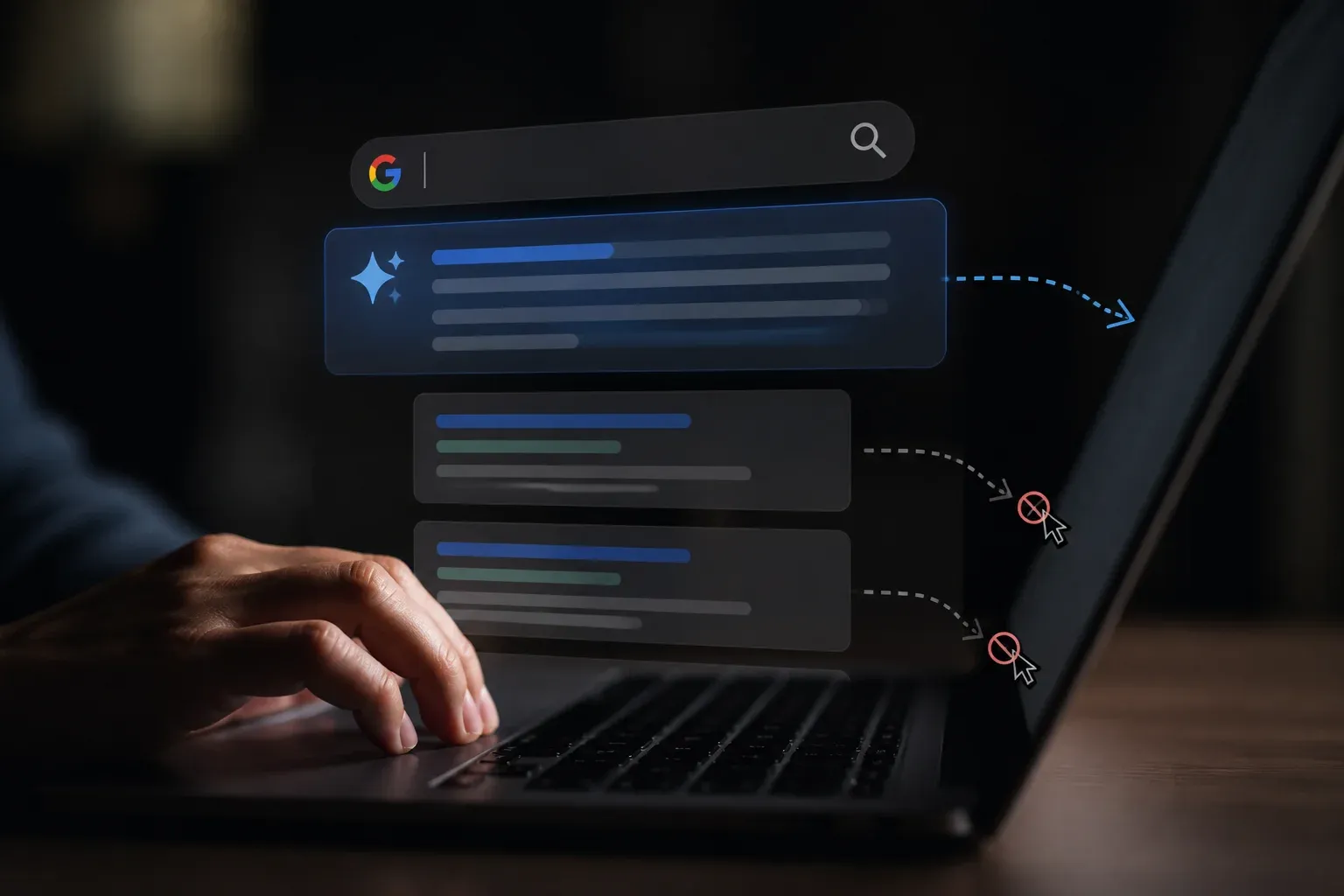
Pew Research Center has quantified a shift that publishers, SEO teams, and businesses have been watching closely: when an AI-generated summary appeared in Google search results, users clicked traditional result links in 8% of visits, compared with 15% when no summary appeared. The findings do not establish that summaries alone caused the difference, but they show a clear association between AI-led result pages and less outbound traffic to source sites.
The Pew Research Center analysis of Google AI summaries examined browsing activity from 900 U.S. adults during March 2025. Across 68,879 Google searches, the study also found that people clicked links within an AI summary in about 1% of visits. For organizations that rely on search referrals, the implication is direct: appearing in search results may no longer translate into a visit at the same rate when the results page itself supplies a concise answer.
What Pew's data says about AI summaries and discovery
Pew's study used data from KnowledgePanel Digital, covering the real-world browsing activity of participating U.S. adults. It is a snapshot of Google search behavior in March 2025, not a measure of every search engine, country, audience, or query type. That scope matters. The results should not be treated as a universal forecast of all AI search behavior.
Still, the sample is large enough to make the observed patterns consequential. About 58% of respondents performed at least one Google search that produced an AI-generated summary during the month. The typical summary contained roughly 67 words, a compact format that can satisfy straightforward informational needs without requiring a follow-up click.
| Search-result behavior | AI summary present | No AI summary present |
|---|---|---|
| Click on a traditional result link | 8% of visits | 15% of visits |
| End browsing session after the search page | 26% of visits | 16% of visits |
The session-ending figure is particularly important. Users were more likely to stop browsing after encountering a search page with an AI summary: 26% of visits, versus 16% for pages without one. In practical terms, the search experience can become the endpoint of a research journey rather than a gateway to publisher, retailer, developer, or service-provider websites.
The data also challenges an overly simple view of visibility. A page can rank, be represented in an AI-generated response, or remain discoverable in the results interface while receiving fewer visits. For teams whose business models depend on advertising impressions, lead capture, subscriptions, product exploration, or documentation usage, visibility and referral traffic are increasingly distinct outcomes.
Implications for publishers and SEO teams
Pew's findings do not mean traditional search optimization is irrelevant. They do mean that traffic reporting and content strategy need to account for a results page that may answer part of the query before a user reaches a destination site.
Publishers should focus on the value that a brief summary cannot fully replace. That can include original reporting, firsthand expertise, distinctive analysis, useful tools, detailed product information, and content designed to support deeper decisions. The goal is not simply to make a page eligible for discovery, but to give users a meaningful reason to continue beyond the initial answer.
Several operational priorities follow from the data:
- Separate ranking from traffic analysis. A stable position in Google may not produce stable referral volumes when AI summaries are present.
- Measure outcomes beyond sessions. Track qualified leads, subscriptions, product actions, and other business results alongside organic clicks.
- Strengthen source quality and clarity. Accurate, well-structured material helps users and systems identify what a publisher uniquely contributes.
- Review content governance. Teams should define ownership, review processes, and performance measures for content that may be summarized before it is visited.
Developers and enterprise search teams face a related challenge. If employees or customers increasingly receive synthesized answers at the interface layer, the quality, provenance, and maintenance of the underlying content become more important. Documentation, knowledge bases, and product data need clear structures and responsible update processes because they may influence discovery without delivering the familiar signal of a page view.
The study also leaves meaningful questions open. It does not show which types of websites lose the most traffic, whether users found the summaries accurate or useful, or how behavior changes across different query categories. Nor does it demonstrate a causal relationship between a summary and every reduced click. Google results, user intent, and query complexity can all affect whether someone chooses to visit a link. Those limits make careful measurement more valuable than broad assumptions.
For businesses that depend on search discovery, the issue is no longer rankings alone. It is whether AI systems surface the right brand, source, and evidence when users do not click through. Scalevise helps teams assess AI-led discovery, identify entity and content coverage gaps, and prioritize improvements that support measurable business outcomes. Start an AI Visibility scan with the AI Visibility / GEO Checker.
Frequently Asked Questions
What did Pew find about clicks when Google showed an AI summary?
Pew found that users clicked a traditional search-result link in 8% of visits with an AI-generated summary, compared with 15% of visits without one.
How many Google searches did Pew analyze?
The analysis covered 68,879 Google searches made by 900 U.S. adults whose browsing activity was observed during March 2025.
Did users click links inside AI-generated summaries?
Yes, but infrequently. Pew found that users clicked a link within an AI-generated summary in about 1% of visits.
Does the study prove that AI summaries cause lower publisher traffic?
No. The study reports an association between AI-summary pages and lower traditional-result clicks. Its March 2025 Google-specific findings do not prove causation or automatically apply to every engine, user group, or query type.
Why do the findings matter to SEO and content teams?
They show that search visibility may not lead to referrals at the historical rate. Teams may need to measure business outcomes beyond clicks and make their content more useful for deeper research and decision-making.
Conclusion
Pew's analysis provides concrete evidence that AI-generated summaries are changing the path from search to websites. With lower traditional-link click rates and more sessions ending on the results page, publishers and businesses need to evaluate discovery in terms of both visibility and downstream value. The study is limited to Google searches by U.S. adults in March 2025, but its central message is clear: AI-led search interfaces can materially reshape how audiences engage with online sources.