
Pew Study Shows How Google AI Overviews Are Changing Search Click Behavior
A Pew Research Center browsing study found that Google users were less likely to click traditional results when an AI Overview appeared, raising the stakes for useful, distinctive content and conversion measurement.
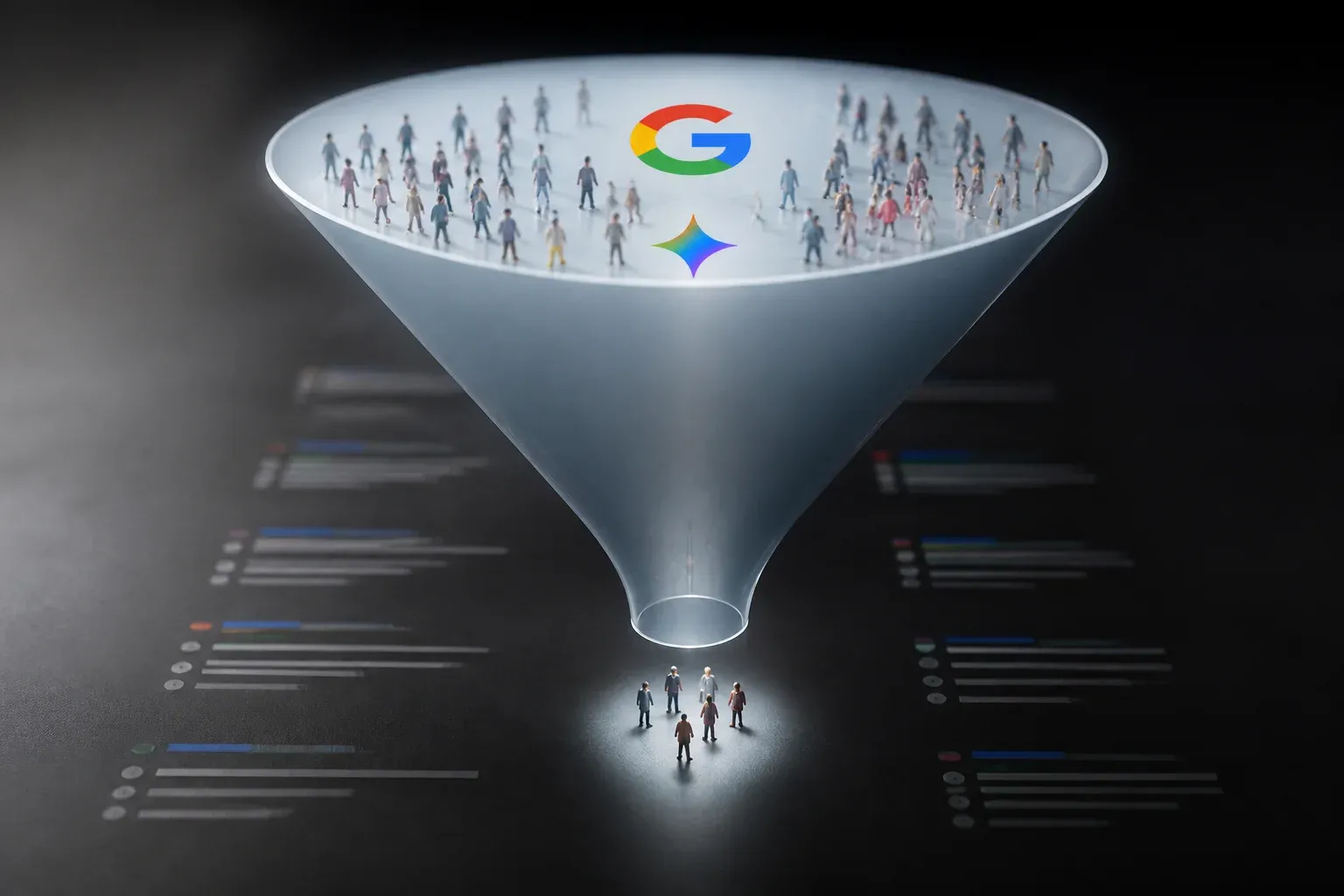
Google's AI Overviews are changing what a successful search result looks like. In a Pew Research Center study of Google browsing behavior, users clicked a traditional result in 8% of visits with an AI summary, compared with 15% of visits without one. That shift matters for businesses that depend on organic search traffic: a page can remain visible in results while receiving fewer visits because a searcher's immediate question has already been answered on Google.
The study examined 68,879 Google searches conducted by 900 U.S. adults in March 2025. Its official findings on Google AI summaries and link clicks offer a useful snapshot of how AI-generated answers affect search behavior. The central lesson is not that organic search has stopped mattering. It is that content strategy must account for a growing set of searches where the click is no longer the only, or even the most likely, outcome.
What Pew Research found about AI Overviews
Pew found that AI summaries appeared on roughly 18% of all Google searches in its sample. Their presence was not evenly distributed. Longer searches were much more likely to produce a summary: AI summaries appeared in 8% of one or two word searches, but in 53% of searches containing 10 or more words.
About 58% of respondents performed at least one search during the study period that generated an AI summary. Yet the summaries were not a major destination for outbound clicks. Users clicked links within them in only 1% of all visits.
| Observed behavior or result | Searches with an AI summary | Searches without an AI summary |
|---|---|---|
| Traditional result clicks | 8% of visits | 15% of visits |
| Sessions ending without a site visit | 26% | 16% |
| AI summary appearance for 1 to 2 word queries | 8% | Not applicable |
| AI summary appearance for queries with 10 or more words | 53% | Not applicable |
The difference in zero-click behavior is particularly important. Sessions ended without a visit to a website in 26% of cases where an AI summary appeared, versus 16% where no summary appeared. This does not establish that an AI Overview was the sole reason a user did not click. It does show that search journeys containing an AI summary were more likely to conclude on the results page.
AI summaries also typically draw from several sources. Pew found that 88% cited three or more sources. Wikipedia, YouTube and Reddit collectively accounted for about 15% of cited sources. Government sites appeared more often among AI-summary links than among standard search links, 6% versus 2%. News sites accounted for 5% in both formats.
Why traffic alone is becoming a weaker signal
For website owners, lower click rates on informational searches can make traditional traffic reports less complete as indicators of search performance. A declining visit count for a question-answering page may reflect a changed results page, rather than a loss of rankings or a decline in demand.
This is especially relevant for long, specific queries, since they were far more likely to trigger AI summaries in Pew's sample. Those searches often signal that someone wants a quick explanation, comparison or procedural answer. If Google provides enough information directly in the results, the remaining reason to visit a site must be clearer.
The opportunity is to focus on pages that offer value a concise summary cannot fully replace. Depending on the business and topic, that can include:
- Original evidence, such as research, tested data, documented methodology or direct expertise.
- Useful tools and resources, including calculators, templates, demonstrations or product information that requires interaction.
- Firsthand utility, such as detailed implementation guidance, examples grounded in real work, or answers specific to a buyer's situation.
- A clear next step, so visitors who do arrive can evaluate, contact, buy, subscribe or otherwise progress without unnecessary friction.
These are strategic priorities, not a guaranteed formula for appearing in an AI Overview or winning clicks from one. Pew's study measures user behavior, not a set of ranking factors or an optimization playbook published by Google.
How to adapt content and measurement
A practical response starts with separating pages that primarily answer simple questions from pages that support a decision or task. The former may remain valuable for visibility, but they may generate fewer visits when an AI summary is present. The latter should make their deeper value easy to identify.
Content should answer the main question directly, use descriptive section labels, and present claims with supporting context. That structure helps readers assess relevance quickly and gives search systems clear information to interpret. It should not come at the expense of substance. A short generic explanation is easier to summarize than a page with proprietary insight, useful detail or an interactive reason to continue.
Teams should also track outcomes beyond rankings and aggregate organic sessions. Review changes in search impressions, clicks, landing-page conversions and the paths visitors take after arrival. Where possible, compare query groups likely to trigger summaries, particularly longer informational searches, with pages built around high-intent actions. This makes it easier to distinguish reduced click opportunity from a genuine problem in page quality or demand.
AI-generated answers can reduce the number of visits available from some searches, but they also make brand presence within AI-driven results more consequential. Scalevise helps businesses understand where they appear in AI answers, identify content gaps and prioritize pages that can turn visibility into commercial value. Use the Scalevise AI Visibility and GEO Checker to assess how your brand shows up across AI search experiences and start an AI Visibility scan.
Frequently Asked Questions
What did the Pew Research Center study find about AI Overviews and clicks?
Pew found that users clicked a traditional Google result in 8% of visits when an AI summary appeared, compared with 15% of visits when no AI summary appeared. Links inside AI summaries were clicked in 1% of all visits.
How often did AI summaries appear in the Pew study?
AI summaries appeared on roughly 18% of the Google searches studied. They appeared in 8% of one or two word searches and 53% of searches with 10 or more words.
Do AI Overviews mean businesses should stop investing in SEO?
No. The study shows changed click behavior, not that search visibility no longer matters. Businesses should focus on content that provides original evidence, practical utility and a clear reason for users to visit.
What should businesses measure as AI Overviews become more common?
Track search impressions, clicks, landing-page conversions and visitor paths alongside rankings. Comparing longer informational queries with high-intent pages can help reveal where AI summaries may be affecting traffic opportunity.
Conclusion
Pew's findings show that AI Overviews can materially alter the path from search to website, particularly for longer queries. The most resilient response is not to chase a presumed shortcut into AI summaries. It is to publish content with distinct evidence and practical value, then measure whether search visibility is producing meaningful business outcomes.