
How Web Scraping, AI and Automation Turn Website Content into Social Media Posts
Discover how web scraping, AI and workflow automation can turn website content into automated social media posts using Browse AI, OpenAI and Make.
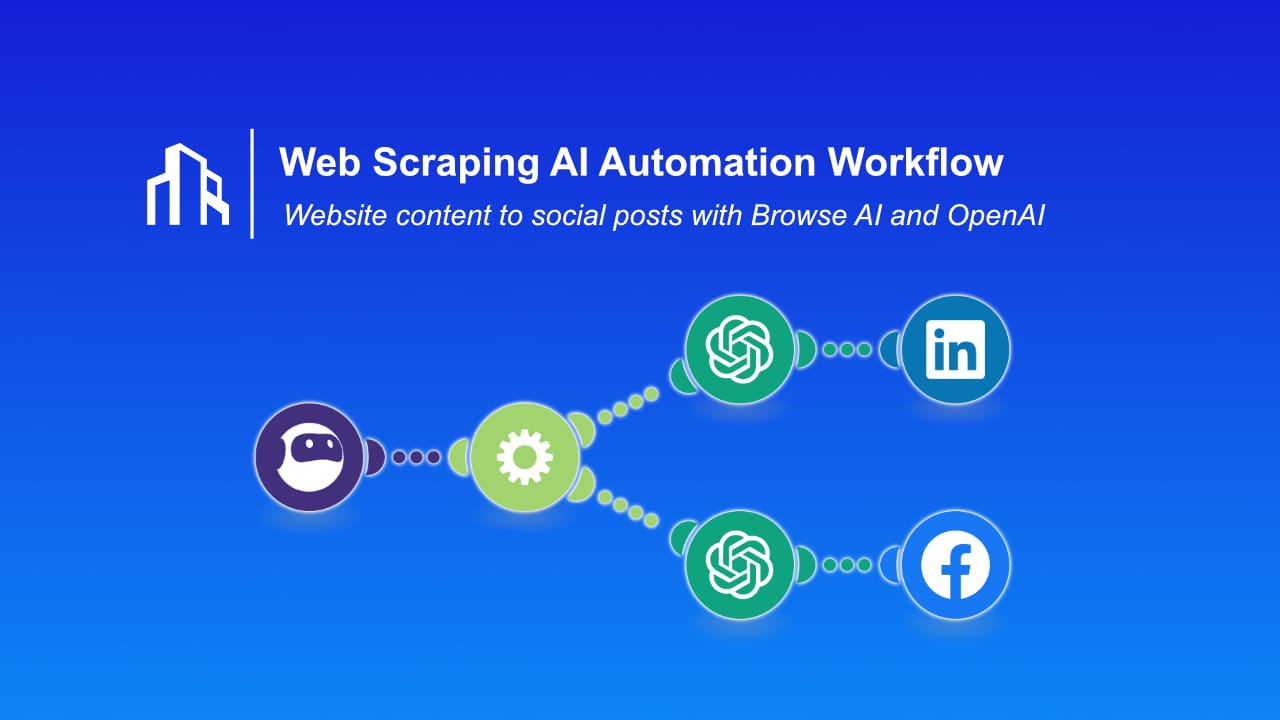
The modern content economy moves fast. Companies publish blogs, news updates, product launches, and announcements every day. But distributing that content across social media platforms consistently is still a manual process for many teams.
That is where web scraping, AI, and workflow automation come together.
By combining tools like Browse AI, the OpenAI API, and Make workflow automation, businesses can automatically monitor websites, extract relevant content, summarize it with AI, and publish it directly to social platforms like LinkedIn or Facebook.
This article explains how the system works, why it matters, and how organizations can build automated pipelines that turn website content into engaging social media posts.
Table of Contents
- What is Web Scraping
- What is Browse AI
- From Website to Data Source
- Using OpenAI to Generate Content
- The Workflow Automation
- Example Architecture
- Real World Use Cases
- Why Web Scraping is Growing
- Future of AI Driven Content Automation
- FAQ
What Is Web Scraping and Why It Matters
Web scraping is the automated process of extracting data from websites and converting it into structured formats such as spreadsheets, APIs, or databases.
Instead of manually copying information from web pages, a scraper collects data programmatically and processes it for further use. This technique is widely used in:
- market research
- competitive monitoring
- lead generation
- price tracking
- content aggregation
Modern scraping tools powered by AI are able to navigate complex websites and extract structured information automatically.
For example, AI-based scraping platforms can monitor blog posts, product listings, job openings, or news updates and convert them into datasets that can be processed automatically.
This is the first step toward building fully automated content workflows.
What Is Browse AI
Browse AI is an AI powered web scraping platform that allows users to extract and monitor website data without writing code.
Instead of building scrapers manually, users simply train a robot by clicking on the data they want to extract. The system learns the page structure and automates the scraping process.
Browse AI offers several capabilities that make it ideal for automation pipelines:
- point and click web scraping
- scheduled website monitoring
- automatic change detection
- exporting data to APIs or spreadsheets
- integration with automation tools
In practice, this means a robot can monitor a website every hour and detect when a new article, product, or announcement appears.
Once detected, the data can trigger an automated workflow.
Turning Websites into Automated Data Sources
One of the most powerful features of Browse AI is that it effectively turns websites into APIs.
Instead of manually reading a page, a scraper collects structured data such as:
- article titles
- summaries
- author names
- URLs
- timestamps
This dataset can then be sent to other systems automatically.
For example:
A scraper monitors a blog.
When a new article appears, it extracts the title and content preview.
That data is sent to an automation workflow.
This approach transforms static websites into live data feeds for automation systems.
Using the OpenAI API to Generate Social Media Posts
Once the content is extracted, the next step is to transform it into something useful.
This is where the OpenAI API comes in.
The OpenAI API enables developers to use advanced language models to generate human quality text from raw data.
For content workflows, AI can:
- summarize long articles
- generate social media captions
- create hashtags
- translate content
- rewrite text for different audiences
For example, a blog article can be converted into:
- a LinkedIn thought leadership post
- a short Twitter or X update
- a Facebook announcement
- a newsletter summary
Automation platforms already support direct integration between OpenAI and social media tools, allowing businesses to automatically generate and publish content at scale.
Orchestrating Everything with Workflow Automation
To connect all these components together, organizations use workflow automation platforms.
One of the most widely used tools for this is Make.
Make allows users to visually build automation pipelines that connect multiple services.
In a typical system, the workflow looks like this:
Step 1
Browse AI detects a new blog article on a website.
Step 2
The extracted data is sent to Make via webhook or API.
Step 3
Make sends the article content to the OpenAI API.
Step 4
AI generates a short social media post.
Step 5
Make publishes the generated content to platforms such as:
- Facebook Pages
- Twitter or X
- company Slack channels
This automation removes the need for manual content distribution.
Example Architecture
A common automation stack looks like this:
Website
↓
Browse AI scraper
↓
Make workflow automation
↓
OpenAI API processing
↓
Social media publishing
Each component has a specific role:
Browse AI handles data extraction.
OpenAI handles content generation.
Make handles automation orchestration.
Together they form a fully automated content pipeline.
Real World Use Cases
Businesses are increasingly using this combination of tools to automate repetitive content tasks.
Marketing automation
Companies can automatically transform blog articles into multiple social media posts.
This ensures every piece of content gets maximum distribution.
News monitoring
Media organizations monitor industry websites and automatically summarize new stories for social media feeds.
Competitor monitoring
Ecommerce companies scrape competitor product pages and automatically publish insights internally.
Lead generation
Recruitment firms scrape job boards and generate AI summaries for social posts targeting candidates.
Why AI Powered Web Scraping Is Growing
Traditional scraping required developers to build custom scripts using tools like Python and BeautifulSoup.
Modern AI scraping platforms dramatically reduce complexity.
AI tools can:
- understand page structure
- adapt to layout changes
- extract structured data automatically
This shift allows marketing teams and non technical users to build powerful automation systems.
Platforms like Browse AI now enable anyone to create scraping robots in minutes using simple point and click training.
Combined with AI language models, these systems can automatically turn raw website content into meaningful communication.
The Future of AI Driven Content Automation
The next evolution of automation is moving toward AI agents.
Instead of static workflows, intelligent agents will:
- monitor thousands of websites
- detect relevant content automatically
- generate insights and summaries
- publish updates across channels
This shift is already happening as AI systems increasingly scrape and analyze web content in real time to generate responses and summaries.
For companies that publish content frequently, automated AI pipelines will become a core part of their digital strategy.
Final Thoughts
The combination of web scraping, AI, and workflow automation is transforming how organizations manage content distribution.
Tools like Browse AI make it possible to extract website data without coding.
The OpenAI API can turn that raw data into engaging social media content.
Automation platforms like Make connect everything together into scalable workflows.
Together these technologies enable businesses to build systems that automatically transform website updates into social media engagement.
For companies looking to scale content marketing without increasing manual effort, this type of automation pipeline is quickly becoming a competitive advantage.
Frequently Asked Questions
What is web scraping
Web scraping is the automated process of extracting data from websites. Instead of manually copying information from web pages, software tools collect structured data such as titles, links, descriptions or product information. This data can then be used for automation, analytics or integrations with other systems.
How does AI improve web scraping workflows
AI can analyze and transform scraped data into meaningful content. For example, AI can summarize articles, generate social media captions, rewrite content or translate text. This allows businesses to automatically turn raw website data into marketing content or insights.
What is Browse AI
Browse AI is a web scraping platform that allows users to extract and monitor website data without writing code. Users train a robot by selecting elements on a page and the tool automatically collects that data. It can also monitor websites for changes and trigger automation workflows.
How does the OpenAI API work in automation
The OpenAI API allows developers to use advanced AI models to generate text, summaries or responses. In automation workflows, the API can analyze scraped content and convert it into social media posts, summaries or marketing copy.
What is workflow automation
Workflow automation connects different tools and services so tasks can run automatically without manual work. Platforms like Make allow businesses to build automated pipelines that move data between services such as web scraping tools, AI models and publishing platforms.
How can you automate social media posts from websites
Businesses can monitor a website with a web scraping tool like Browse AI. When new content appears, the data is sent to an automation platform like Make. The content can then be processed with the OpenAI API to generate a social media post which is automatically published.
Why combine web scraping with AI
Web scraping collects data while AI transforms that data into useful information. When combined with automation platforms, companies can build systems that automatically detect new content, analyze it and publish marketing messages or insights without manual work.
Is web scraping legal
Web scraping is generally legal when websites allow public access to their content and when the scraping respects the website’s terms of service. Businesses should always follow legal guidelines and avoid scraping sensitive or restricted data.
What are the benefits of automated content workflows
Automated content workflows save time, reduce manual work and ensure that new website content is immediately distributed across multiple channels. This helps companies maintain consistent marketing activity and scale their content distribution.