
XREAL AURA Launches With Android XR, Gemini and a Wired Compute Puck
Google, XREAL, and Qualcomm have launched XREAL AURA, wired Android XR glasses with Gemini support, a compact compute puck, and initial pricing from $1,099.
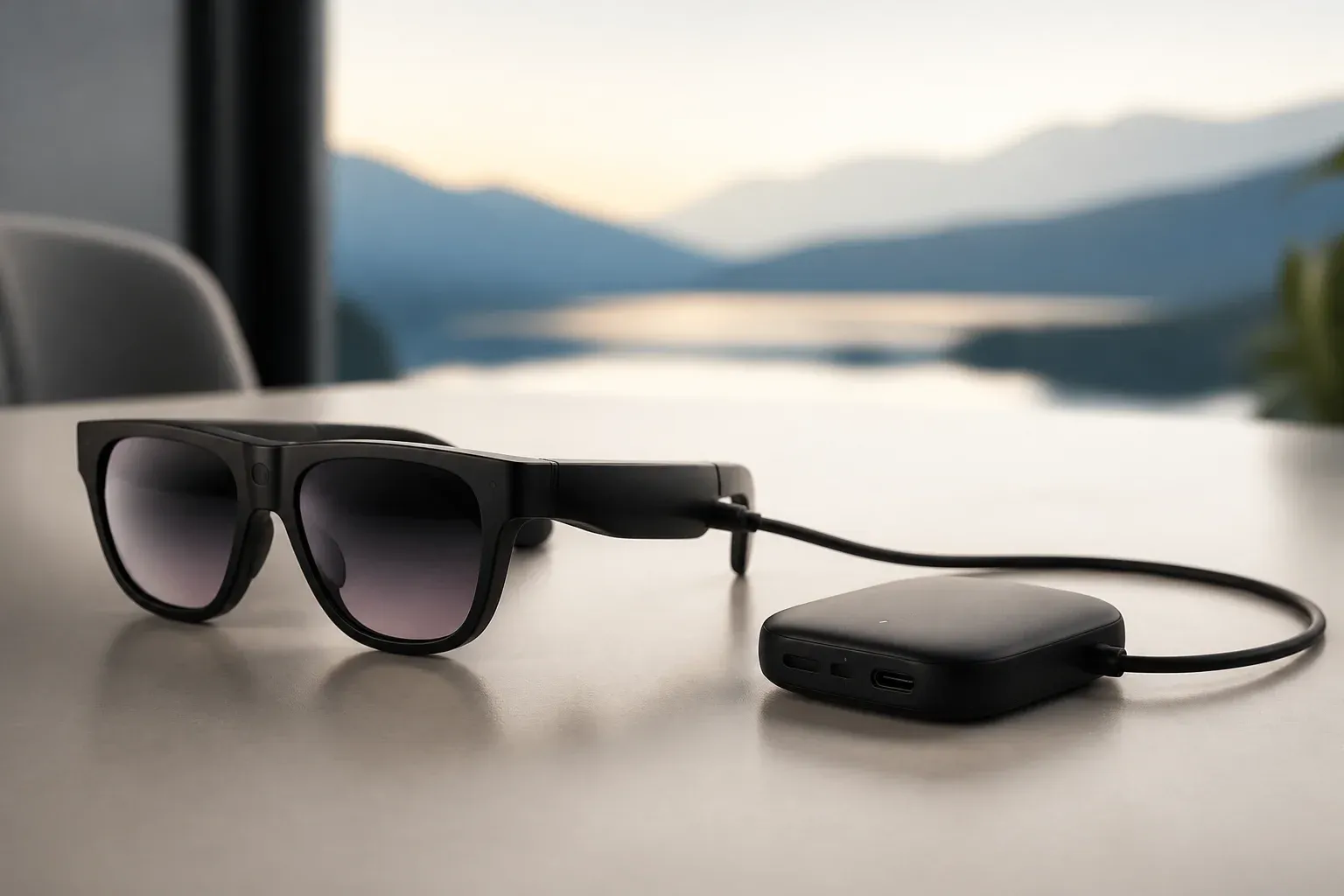
Google, XREAL, and Qualcomm have launched XREAL AURA, a lightweight, wired XR glasses system built on Android XR. Google describes AURA as the world's first wired XR glasses powered by Android XR, combining transparent lenses, a 70-degree field of view, Gemini AI capabilities, and a compact external compute puck. Orders opened on October 28, 2026, in the United States, Canada, and Korea, with Japan following on November 2 and shipments expected from mid-November.
The launch matters because it brings Google's Android XR platform into a glasses-style device rather than a conventional headset format. For companies evaluating spatial computing, AURA is not simply another display accessory. It is an Android XR device intended to support work, entertainment, and AI-assisted activity across XR apps and connected devices. Google's official XREAL AURA announcement outlines the product's hardware approach, platform integration, and rollout.
What XREAL AURA brings to Android XR
AURA splits its hardware between the glasses and an external compute puck. XREAL provides the optical and industrial design, Qualcomm supplies Snapdragon Reality Elite hardware, and Google provides Android XR and Gemini integration. That division is central to the product's positioning: the glasses can retain a lighter form factor while the compact puck handles processing.
Google says the transparent-lens device is designed for spatial computing with a 70-degree field of view. Gemini is positioned as an in-space AI assistant that can work across Android XR apps and connected devices. One confirmed connected-device example is desktop mirroring through a wired connection.
The collaboration also gives AURA a clearer platform story than an isolated XR product. Android XR, Gemini, and Qualcomm's hardware are all part of the launch proposition, while prior Google I/O and Made by Google references established the broader Android XR developer and ecosystem direction before the October availability announcement.
For prospective buyers, the important distinction is that AURA is a complete wired XR system, not glasses that operate independently. Its practical fit will therefore depend on whether a team can accommodate the compute puck and wired connections in the settings where it expects to use spatial interfaces.
| Configuration | Memory and storage | Announced price | Availability detail |
|---|---|---|---|
| Launch promotion | 12GB RAM, 256GB storage | $1,099 | Limited-time promotion through December 2026 |
| Higher-capacity configuration | 16GB RAM, 512GB storage | $1,299 | Announced at launch |
The regional rollout is also specific. Orders opened in the U.S., Canada, and Korea on October 28, 2026. Japan is scheduled to follow on November 2, and XREAL expects shipments to begin in mid-November. The announcements characterize this as an international launch, but they do not establish availability, pricing, or shipment timing for every market.
What businesses should assess before adopting it
AURA's combination of spatial interfaces, desktop mirroring, Android XR apps, and Gemini creates a plausible foundation for work-oriented experimentation. However, the launch materials do not quantify productivity gains or validate specific business workflows. Companies should treat the product as a new platform to test against a defined task, rather than assume that a glasses form factor will improve every process.
The most useful questions are practical:
- Which task needs spatial context? Desktop mirroring may be relevant when a user needs a large virtual workspace, but the business value depends on the work itself.
- Can the wired design fit the work environment? The glasses and compact compute puck are part of the system, so cable management and mobility should be evaluated in the intended setting.
- What Android XR applications are available or needed? The device joins an Android XR ecosystem with developer support, but organizations should confirm that the relevant apps and integrations exist for their use case.
- Where can Gemini assistance help? Google positions Gemini as an in-space assistant across apps and connected devices. Teams should test whether that interaction model improves a real workflow.
This is particularly relevant for teams considering visual guidance, remote collaboration, training, or field-oriented work. Those are potential categories where spatial interfaces may be worth assessing, but the supplied launch material does not claim that AURA has already delivered measured outcomes in any of them. A focused pilot can reveal whether the screen space, interaction model, and hardware setup are useful for the people doing the work.
The pricing also argues for selectivity. At $1,099 during the limited launch promotion for the 12GB and 256GB configuration, AURA is a meaningful per-user purchase. The $1,299 16GB and 512GB configuration raises that commitment further. Businesses should connect a trial to a defined operational question, such as whether a particular task can be completed more effectively with a spatial display and AI assistance, before considering wider deployment.
Spatial computing is only valuable when it fits a real workflow, device environment, and team capability. Scalevise helps businesses evaluate AI use cases, prioritize practical opportunities, and map implementation requirements before money is committed to new tools. A practical AI adoption consultation can clarify whether Android XR and AI-assisted interfaces fit your operations, or whether another approach will deliver faster value. Request an AI adoption consultation.
Frequently Asked Questions
When can XREAL AURA be ordered and shipped?
Orders opened on October 28, 2026, in the United States, Canada, and Korea. Japan is scheduled to follow on November 2, and shipments are expected to begin in mid-November.
What does XREAL AURA cost?
The 12GB RAM and 256GB storage configuration has a $1,099 launch promotion through December 2026. The 16GB RAM and 512GB storage configuration is priced at $1,299.
How does XREAL AURA handle processing?
AURA distributes processing between the glasses and a compact external compute puck. The launch collaboration combines XREAL's glasses design, Google's Android XR platform and Gemini capabilities, and Qualcomm Snapdragon Reality Elite hardware.
What work capabilities does Google highlight for AURA?
Google positions AURA for work, entertainment, and AI-assisted tasks. Confirmed examples include Gemini operating across Android XR apps and connected devices, plus desktop mirroring through a wired connection. The launch materials do not provide measured outcomes for specific workflows such as training or field service.
Conclusion
XREAL AURA is a confirmed expansion of Android XR into a wired, glasses-style system with Gemini support and a cross-company hardware and software foundation. Its launch gives businesses a concrete product to evaluate, but its value will depend on the fit between the device's wired spatial-computing design and a specific workflow.