
Yelp's OpenAI Agreement Sets Up ChatGPT Local Discovery With Reviews and Business Data
Yelp has confirmed an agreement with OpenAI to extend its content into the AI ecosystem, establishing a foundation for richer local discovery in ChatGPT.
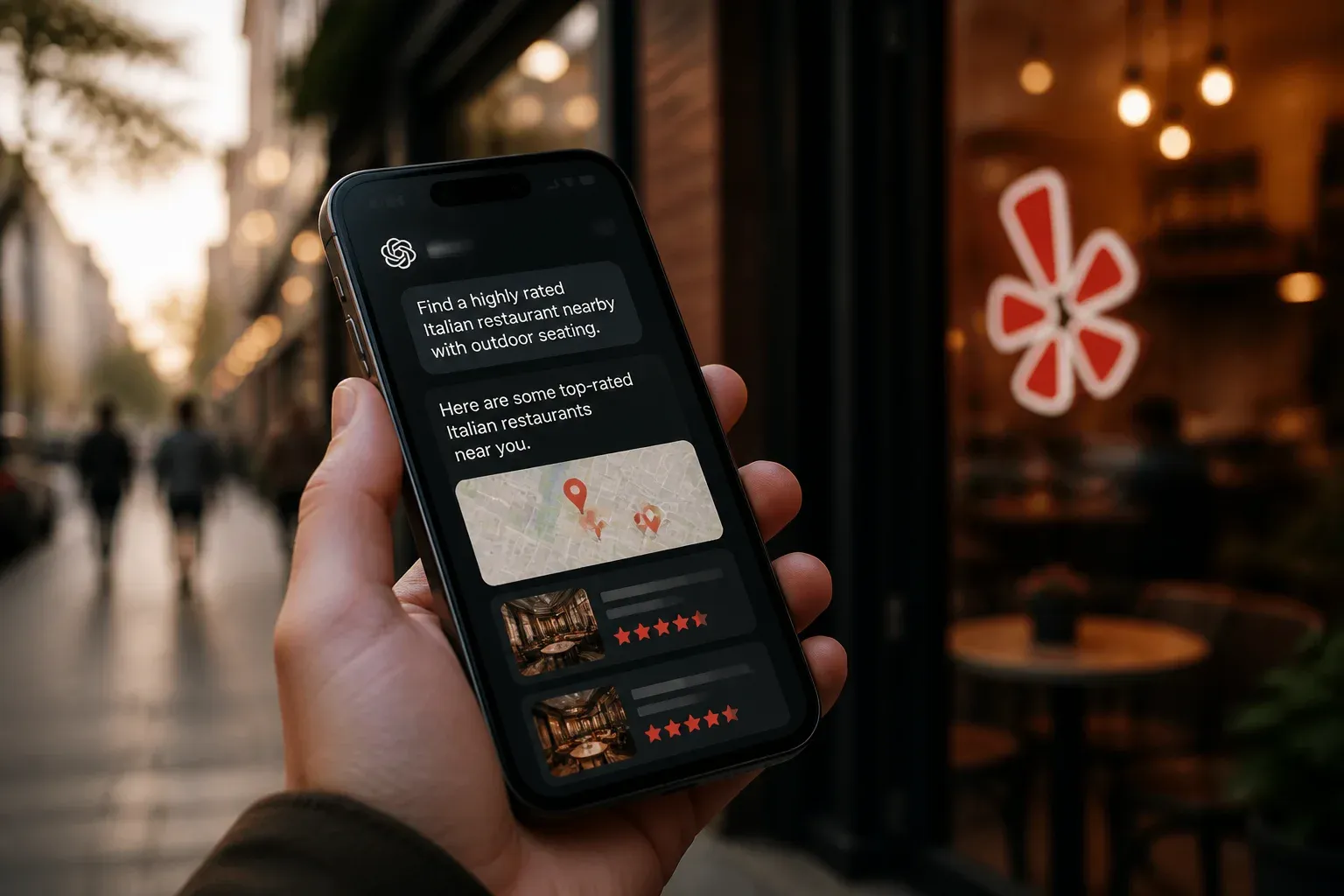
Yelp has confirmed an agreement with OpenAI to extend its trusted content into the AI ecosystem, creating a foundation for AI-driven local discovery on OpenAI platforms. The agreement matters because conversational tools such as ChatGPT could move beyond broad local recommendations toward answers informed by Yelp's business information. Reporting on the arrangement indicates that reviews, ratings, photos and other business details are expected to be part of that experience, although key product and rollout details remain undisclosed.
The formal confirmation came in Yelp's February 12, 2026 investor communications. In Yelp's official announcement of its OpenAI agreement, the company said it had signed an agreement with OpenAI to power AI-driven local discovery across the AI ecosystem. Yelp framed the relationship within a broader AI transformation strategy and a push to distribute its content more widely.
That distinction is important. Yelp's statement confirms the commercial relationship and strategic objective, but it does not provide a consumer launch date, a list of supported locations or categories, or a detailed description of the ChatGPT interface. Axios reported in July 2026 that Yelp is licensing reviews, photos and other business information to OpenAI for use in ChatGPT responses. That reporting provides the clearest account so far of the content that may inform local recommendations.
What the Yelp and OpenAI agreement changes
The core shift is not simply that ChatGPT may be able to name nearby businesses. Local discovery is more useful when an answer can incorporate the signals people use to assess a business: customer reviews, ratings, photos and current business information. Yelp's agreement potentially makes those signals available in a conversational setting, where a user can refine a request rather than start a new keyword search.
For example, a local query may involve constraints that are difficult to express in a conventional search box, such as the kind of service needed, preferences reflected in reviews, or whether a business appears suitable for a particular situation. Yelp's content is relevant because it combines structured business listings with community-generated material. The reported use of real-time business data also points to a need for current information, not just a static directory snapshot.
The arrangement also has a transactional dimension. Yelp already supports Request a Quote flows for local services, and its Spring 2026 release introduced Yelp Assistant, an AI-powered chatbot that can surface insights from Yelp content and support actions including booking or requesting quotes. Those existing capabilities do not confirm how quote requests will work in ChatGPT. They do, however, show that Yelp is building AI-supported paths from discovery to an action.
The practical implications are likely to differ across three groups:
- Consumers could receive more context-rich local answers, provided the eventual experience clearly shows where information comes from and how current it is.
- Local businesses may gain another discovery surface for their Yelp presence, especially when potential customers ask conversational, service-specific questions.
- Platform and product teams will need to consider attribution, freshness, user privacy and the handoff from an AI answer to a business listing, booking flow or quote request.
| Area | Yelp's established data and AI approach | OpenAI agreement and reported ChatGPT use case |
|---|---|---|
| Strategic role | Yelp offers data licensing and APIs for partner access to business data and integrations. | Yelp says the agreement extends its trusted content into the AI ecosystem for AI-driven local discovery. |
| Content and context | Yelp's own AI efforts use its content to surface business insights and support actions. | Axios reported that reviews, ratings, photos and other business information will help inform ChatGPT responses. |
| Actions | Yelp Assistant supports actions such as booking or requesting quotes for services. | Whether and how ChatGPT will expose quote requests or other actions has not been detailed officially. |
| Availability details | Yelp documents partner-oriented licensing and API access. | Regions, categories, timing and any ChatGPT product-tier limits have not been announced. |
The unanswered implementation questions
The value of local data in an AI answer depends heavily on how it is implemented. Neither Yelp's investor announcement nor the reported details settle several issues that will shape the user and business experience:
- Coverage and timing: There is no official rollout schedule or confirmed geographic and category coverage.
- Data freshness: The companies have not described refresh frequency, latency or how time-sensitive business changes will be represented.
- Attribution and presentation: The eventual interface may determine whether users can readily identify Yelp content, inspect supporting details and reach the underlying business.
- Licensing and governance: Pricing, usage limits, moderation responsibilities, privacy handling and consent mechanics have not been publicly specified.
These are not minor operational questions. Local recommendations can influence spending and lead generation, so accurate status information, meaningful source context and clear responsibility for content quality will be central to trust.
Yelp's existing data-licensing program provides relevant context. Its Leads API and Insights API are designed to give partners access to business data for internal use, analytics and third-party integrations. The OpenAI agreement therefore fits a broader pattern in which Yelp treats its business and review content as a resource that can power products beyond the core Yelp app. What is new is the potential scale and conversational reach of an OpenAI platform.
Organizations assessing conversational local discovery should avoid assuming that the agreement alone answers implementation questions. They should watch for official product documentation and rollout notices that clarify the supported experience. Businesses that want to prepare their own systems for AI-assisted discovery and service workflows can work with Scalevise on AI architecture, workflow automation and API integration.
Frequently Asked Questions
What has Yelp officially confirmed about OpenAI and ChatGPT?
Yelp confirmed that it signed an agreement with OpenAI to extend Yelp's trusted content into the AI ecosystem and power AI-driven local discovery across that ecosystem.
What Yelp information may appear in ChatGPT responses?
Axios reported that Yelp is licensing reviews, ratings, photos and other business information to OpenAI for ChatGPT responses. Yelp's official announcement confirms the agreement but does not enumerate the exact content fields.
Will ChatGPT support Yelp quote requests for local services?
Yelp already supports Request a Quote capabilities and its Yelp Assistant can support quote-related actions. The companies have not officially detailed whether or how quote requests will appear in ChatGPT.
When and where will the Yelp integration be available?
No official rollout timeline, regional availability, category coverage or ChatGPT product-tier requirements have been announced.
Conclusion
Yelp's confirmed OpenAI agreement establishes a meaningful new distribution path for its local-business content and supports a more actionable form of AI-driven discovery. Reporting suggests ChatGPT could use Yelp reviews, ratings, photos and business data to add depth to local answers, but the most consequential details, including availability, presentation and governance, still await official disclosure.