
Claude Cowork: What It Is, How It Works, and Why It Changes Productivity
What if AI didn’t just answer questions, but actually did your work? Claude Cowork is redefining productivity by turning prompts into real execution.
Claude Cowork is an AI-powered desktop agent developed by Anthropic that can perform real tasks on your computer, such as organizing files, analyzing documents, and executing multi-step workflows. Unlike traditional AI chat tools, it moves beyond answering questions and focuses on completing work.
This shift marks a new phase in AI adoption, where users no longer rely on instructions alone, but delegate execution. Claude Cowork is designed to reduce manual effort, streamline workflows, and improve productivity by turning simple prompts into actionable outcomes.
For businesses focused on efficiency, automation, and scale, this is not just another AI feature. It represents a structural change in how digital work gets done.
What Is Claude Cowork?
Claude Cowork is an AI-powered desktop agent designed to operate directly within a user’s working environment. Instead of responding to prompts with text alone, it can take action across files, documents, and workflows.
At its core, it combines three layers:
- Natural language understanding from Claude
- Local file system interaction
- Task execution across multiple steps
This creates a system that behaves less like a chatbot and more like a junior operator that can follow instructions and deliver outcomes.
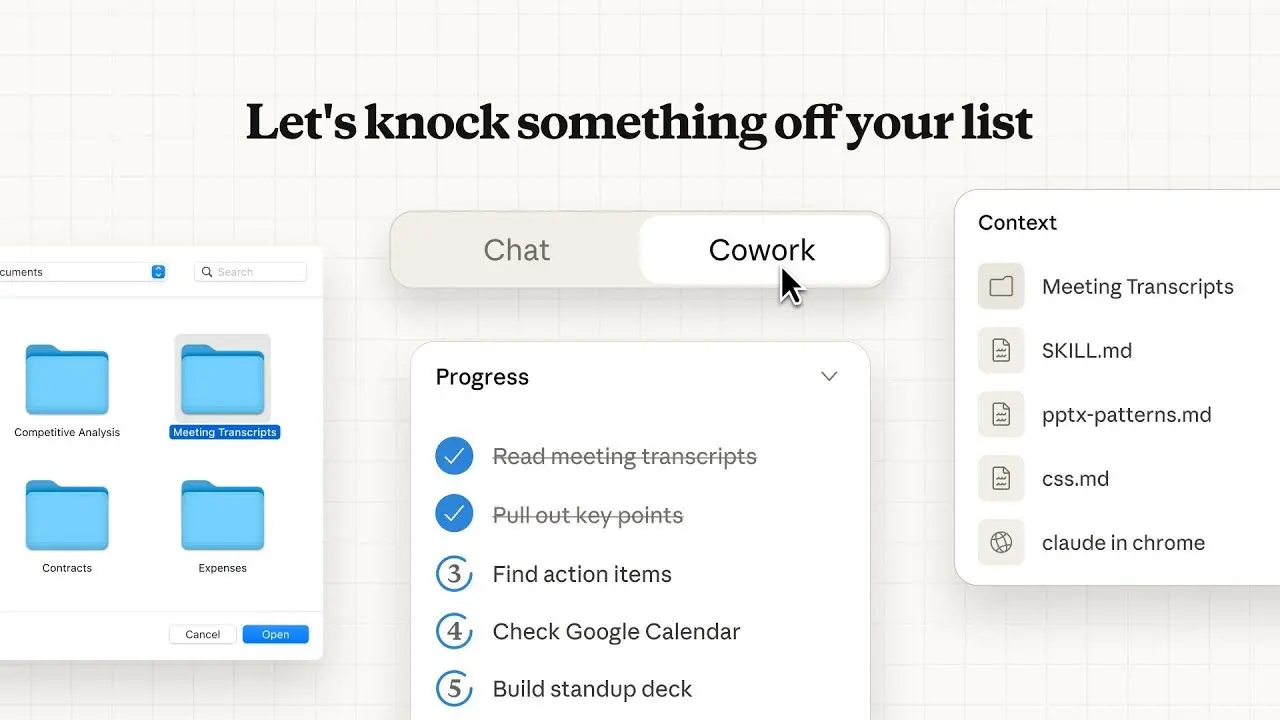
For example, instead of asking for guidance on how to analyze data, a user can instruct Claude Cowork to review a folder, extract insights, and produce a structured report. The difference is subtle in concept, but massive in execution.
What Claude Cowork Actually Does?
Claude Cowork is built to handle real tasks, not just conversations. It can read, write, organize, and transform files while maintaining context across steps.
Typical workflows include document processing, data summarization, and content restructuring. A user might provide a directory of contracts, and the system can extract key clauses, standardize formatting, and generate a consolidated overview.
What makes this powerful is not any single action, but the ability to chain actions together. Traditional tools require users to orchestrate every step manually. Claude Cowork reduces that overhead by handling sequences autonomously.
This positions it closer to an execution layer than a productivity tool.
Why This Matters for Productivity
Most productivity tools optimize individual tasks. Claude Cowork targets the gaps between tasks.
In real-world business environments, the majority of time is not spent on complex thinking, but on repetitive coordination. Moving files, reformatting data, summarizing documents, and switching between tools all create friction.
Claude Cowork addresses this by collapsing multi-step workflows into single instructions.
Instead of:
- Opening multiple tools
- Copying and pasting data
- Repeating formatting steps
Users can define the outcome and let the system handle the process.
The result is a shift from task execution to outcome management.
From a productivity standpoint, this has three direct effects:
First, it reduces context switching. Users no longer need to jump between applications to complete a workflow.
Second, it increases throughput. Tasks that previously took hours can be completed in minutes.
Third, it lowers the barrier for non-technical users. Complex workflows become accessible without scripting or automation tools.
A Strategic Shift for Businesses
From a Scalevise perspective, tools like Claude Cowork are not just operational improvements. They redefine how teams should be structured.
If a single employee can execute the workload of multiple roles through AI assistance, the focus shifts toward orchestration, validation, and strategy.
This has implications for:
- Hiring strategies
- Process design
- Tool selection
- Automation roadmaps
Companies that continue to optimize manual workflows will fall behind. The competitive advantage will come from how effectively organizations integrate AI agents into their daily operations.
At Scalevise, this aligns directly with the move toward headless architectures and automation-first systems. Claude Cowork fits into this landscape as a user-facing execution layer that connects human intent with automated processes.
Limitations You Should Not Ignore
Despite its potential, Claude Cowork is not a complete replacement for existing systems.
It currently operates within controlled environments, with limited access to broader system functions. This means it cannot yet fully replace enterprise-grade automation platforms or deeply integrated backend workflows.
There are also considerations around security, data privacy, and governance. Allowing an AI system to interact with local files introduces risks that need to be managed carefully.
For companies operating under strict compliance requirements, this is not a plug-and-play solution.
It is a capability that needs to be implemented with clear boundaries and oversight.
Where This Is Going
Claude Cowork is an early signal of a broader trend toward autonomous digital workers.
The direction is clear:
- From tools to agents
- From manual workflows to automated execution
- From isolated tasks to end-to-end processes
As these systems mature, they will integrate more deeply with business infrastructure, including CRMs, ERPs, and internal APIs.
The long-term outcome is a hybrid workforce where human decision-making is augmented by AI execution at scale.
How Scalevise Helps Businesses Implement AI Workflows
At Scalevise, we help companies move beyond experimentation and implement AI systems that deliver real operational value. From workflow automation to custom AI agents, our approach focuses on scalability, security, and measurable ROI.
If you are exploring tools like Claude Cowork, the real opportunity lies in integrating them into your broader infrastructure. This includes connecting AI agents to your existing systems, defining governance, and ensuring consistent performance across workflows.
Final Perspective
Claude Cowork is not just a feature. It is a preview of how work itself is evolving.
For companies serious about productivity, the question is no longer whether to adopt AI, but how to operationalize it effectively.
At Scalevise, we see this as a clear inflection point. Businesses that move early and design their processes around AI execution will outperform those that treat it as an add-on.
The opportunity is not in using tools like Claude Cowork occasionally. The opportunity lies in embedding them into the core of how work gets done.