
How EU-Funded AI and Organ-on-Chip Research Could Reshape Chemical Safety Testing
A coordinated EU research effort is combining AI with human-cell and organ-on-chip models to build more human-relevant approaches to chemical safety assessment.
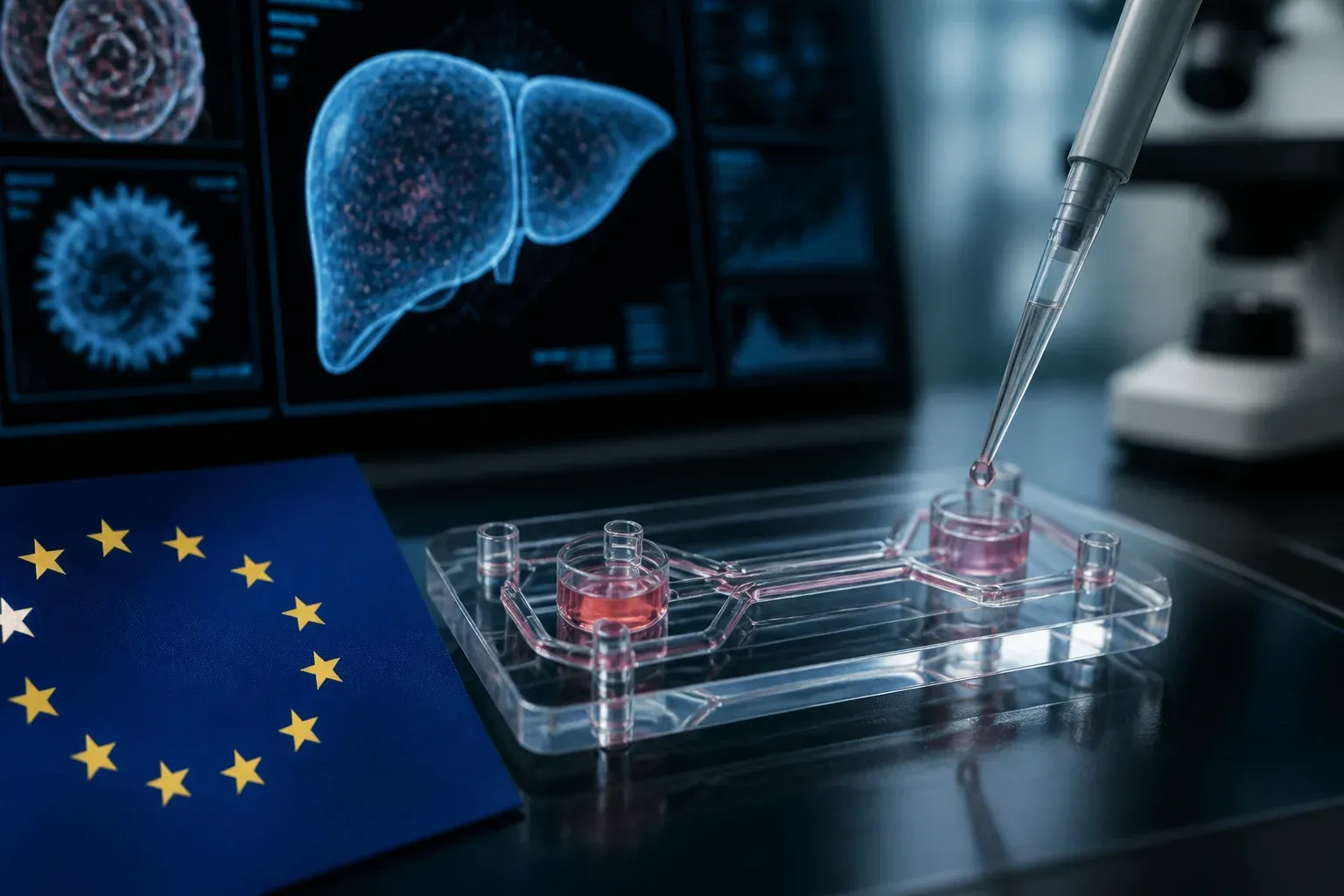
European researchers are building a more human-relevant approach to chemical safety testing by combining artificial intelligence, human cells and organ-on-chip models. The EU-backed work aims to improve predictions of how chemicals may affect people while reducing dependence on animal experiments. It does not promise an immediate end to animal testing, but it marks a coordinated attempt to make non-animal evidence more useful in toxicology and regulatory decision-making.
The work is organised through the ASPIS cluster, an approximately €60 million group of projects focused on next-generation chemical safety testing. As outlined in the European Commission's Horizon Magazine report on AI and animal testing, the cluster brings together complementary methods: AI-supported toxicity prediction, cross-species testing and the integration of laboratory findings with exposure data from the real world.
This matters because chemical safety assessment is not simply a laboratory challenge. For a non-animal method to influence formal decisions, its results must be dependable, interpretable and usable across organisations. The research therefore has implications beyond biotech. It highlights the data governance, validation and interoperability requirements that enterprises will face as AI becomes part of regulated scientific workflows.
From animal studies to new approach methodologies
The EU effort sits within the 3Rs framework: Replacement, Reduction and Refinement of animal use in science. Its practical focus is on new approach methodologies, often called NAMs. These methodologies can include human-cell systems, computational models, organ-on-chip technologies and other non-animal approaches that generate evidence about biological effects.
Organ-on-chip models are particularly relevant because they use human cells in systems designed to model aspects of organ function. Combined with AI, the resulting data may help researchers identify patterns associated with toxic effects and assess results across complex datasets. The objective is not merely to generate more data. It is to create evidence that better reflects human biology and can support chemical safety assessment.
ASPIS has been active since 2021 and includes three linked initiatives with distinct roles:
| Initiative | Primary focus | Role in chemical safety research |
|---|---|---|
| ONTOX | AI-driven toxicity testing for kidney, liver and brain | Develops approaches for predicting toxicity in key human-relevant organ systems. |
| PrecisionTox | Cross-species testing | Compares responses across five model organisms and human cells for around 200 chemicals. |
| RISK-HUNT3R | Risk assessment integration | Combines non-animal test results with real-world exposure data to assess risk. |
Together, these projects address different parts of the same problem. ONTOX focuses on toxicity signals in specific organs, PrecisionTox explores what can be learned by comparing biological responses across species and human cells, and RISK-HUNT3R links experimental evidence to the exposure conditions that shape real-world risk. That combination is important: a laboratory signal alone is not equivalent to an assessment of human risk.
Why AI is useful, and where it is not enough
AI can help analyse the varied data generated by cell-based tests, organ-on-chip models and other NAMs. In principle, it can identify relationships that would be difficult to detect manually and support more consistent toxicity predictions. Yet an AI output does not automatically become regulatory-grade evidence.
Several conditions will determine whether these methods can move into formal safety pipelines:
- Standards and validation are needed to establish when a method produces reliable, reproducible results.
- Data interoperability is essential if results from different laboratories, systems and projects are to be combined meaningfully.
- Clear governance is required to document methods, inputs and decision processes in regulated settings.
- Regulatory acceptance remains central, because promising scientific methods must still fit the evidence requirements used in chemical safety evaluations.
The Horizon Magazine report notes growing scientific and regulatory engagement, including interest from the OECD. That engagement is significant because common approaches and accepted methods can determine whether research advances remain confined to projects or become usable at scale.
The regulatory challenge is as important as the model
The research is directly relevant to the EU's REACH framework for chemical regulation. REACH creates a substantial need for evidence on chemical hazards and safety, while the 3Rs framework creates pressure to find credible alternatives to animal testing. NAMs could help reconcile those needs, but only if their results can be assessed with appropriate confidence.
The current position is more measured than a claim that animal testing is about to disappear. The researchers' aim is to replace or substantially reduce animal testing, while recognising that complete abolition is not yet feasible. That distinction matters for companies, policymakers and technology providers. The near-term opportunity is likely to be the targeted adoption of validated non-animal methods within broader assessment workflows, rather than a wholesale switch from one evidence system to another.
For biotech organisations, this places equal emphasis on biology and operational design. Teams need systems that preserve data quality, record provenance and allow results to be reviewed across research, safety and compliance functions. For enterprise AI teams, the lesson is similar: model performance alone is insufficient where outputs contribute to high-stakes decisions. Traceability, interoperable data structures and well-defined human oversight must be designed into the workflow.
As AI-supported NAMs mature, the organisations best positioned to benefit will be those that treat governance as a capability, not a late-stage compliance exercise. Building trusted pipelines early can make it easier to evaluate new models, connect experimental and exposure data, and respond when regulators establish clearer expectations.
For biotech and chemical-sector leaders, this shift raises a practical question: can your AI and data architecture support evidence that scientists, compliance teams and regulators can scrutinise? Scalevise helps organisations translate emerging AI requirements into governed implementation plans, from workflow design to oversight and integration. A focused AI consultancy conversation with Scalevise can identify where your current tooling creates risk or slows adoption, and where a more auditable approach can create value. Request a consultation to assess your AI governance readiness.
Frequently Asked Questions
What is the ASPIS cluster?
ASPIS is an approximately €60 million EU-backed cluster of projects developing next-generation approaches to chemical safety testing. Its linked initiatives include ONTOX, PrecisionTox and RISK-HUNT3R.
How do organ-on-chip models support chemical safety testing?
Organ-on-chip models use human cells in systems intended to model aspects of organ function. They can provide human-relevant biological data that researchers may use alongside AI and other non-animal methods.
Will AI and organ-on-chip models fully replace animal testing?
Not yet. The EU research aims to replace or substantially reduce animal testing, but the supplied research notes that complete abolition is not currently feasible.
What are new approach methodologies, or NAMs?
NAMs are non-animal methods used to generate evidence about chemical effects. They can include human-cell systems, organ-on-chip models, computational approaches and other techniques.
Why do standards and data interoperability matter for NAMs?
Formal chemical safety evaluation requires reliable and interpretable evidence. Standards, validation and interoperable data help make results comparable, reproducible and usable across laboratories, organisations and regulatory processes.
Conclusion
The ASPIS projects show that AI-enabled toxicology is becoming a coordinated scientific and regulatory effort, not a standalone technology experiment. Human-cell and organ-on-chip models may make chemical testing more relevant to people and less reliant on animals, but their wider impact depends on validation, shared standards and trusted data governance. The next milestone is not simply better models. It is turning their evidence into methods that can support real chemical safety decisions.