
EU Funds Merikarhu Pilot to Speed Emergency Submarine Cable Repairs in the Baltic
Merikarhu will develop rapidly deployable repair modules for submarine telecommunications cables in the Baltic Sea under a new EU-funded pilot.
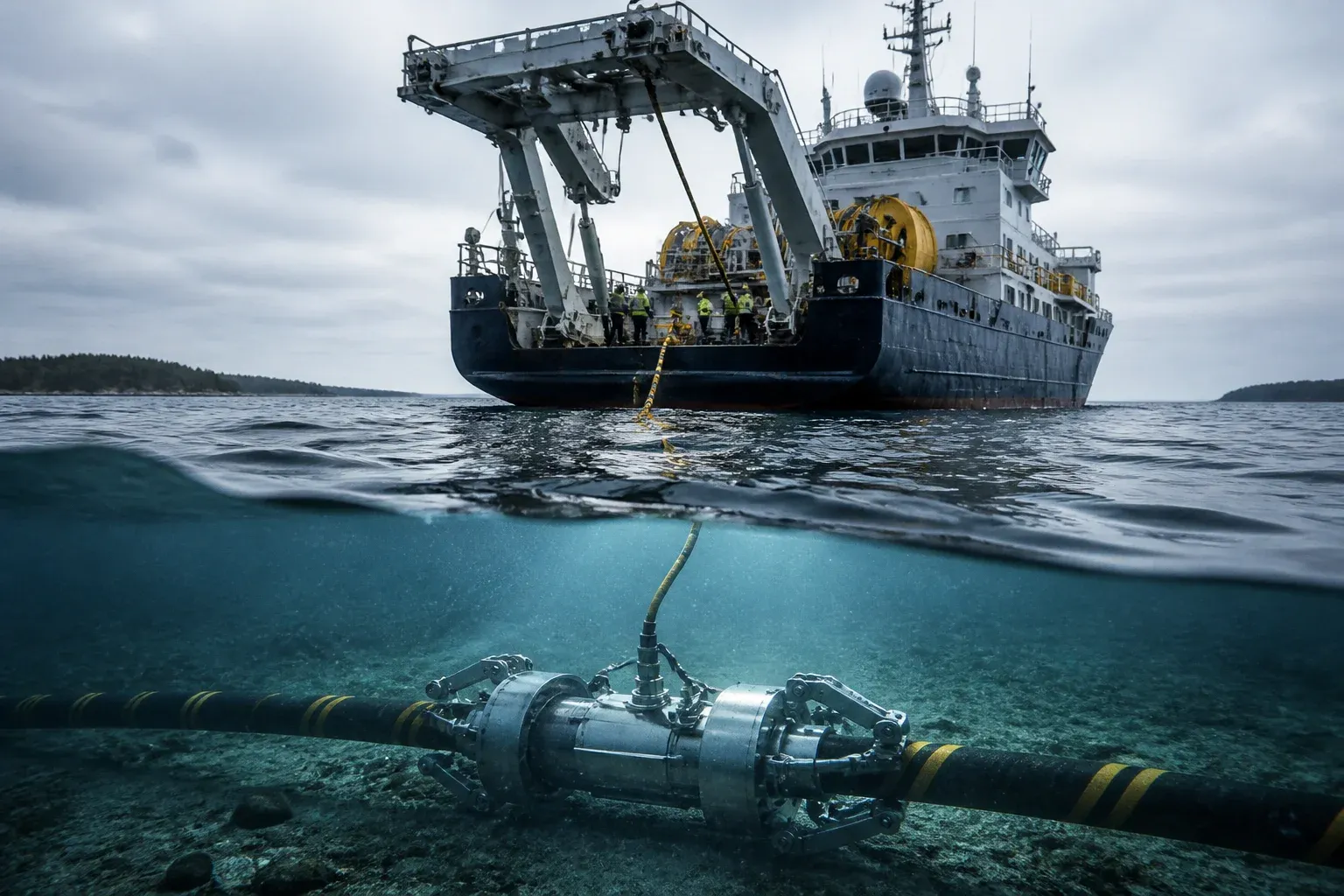
The European Union has awarded up to €9.5 million to Merikarhu, a Baltic Sea pilot intended to strengthen emergency repair capacity for submarine telecommunications cables. The project will develop adaptable repair modules that can be held in ports or shipyards and fitted to repair vessels quickly, addressing a critical weakness in the infrastructure that carries digital connectivity across borders.
The funding moves cable resilience from policy planning to a defined implementation project. Under the EU's Connecting Europe Facility Digital programme, Merikarhu is designed as a public-interest emergency-response capability coordinated by Finland's national emergency supply centre. According to HaDEA's official contract-signing announcement, the grant agreement has been signed, allowing the project to proceed to pre-financing and implementation.
For companies, the significance is not a new connectivity product or a direct subsidy. It is an investment in the repair readiness behind the networks that support cloud services, online sales, remote work, communications and cross-border operations. The project does not state a guaranteed restoration time or an expected uptime improvement, but its design aims to reduce the time needed to mobilise equipment after an emergency.
What the Merikarhu pilot is designed to change
Submarine cable repairs require specialised vessels, equipment and technical preparation. Where equipment is unavailable, incompatible or located far from a suitable vessel, the period before repair work can begin can add to a service disruption. Merikarhu's approach is to establish modular, deployable repair capacity rather than relying solely on a fixed, permanently configured resource.
The modules are intended to be hosted at ports or shipyards, then installed on a repair vessel within a tight operating window. The project target is installation within up to three days of a vessel's arrival. The stated scope covers all types of cable damage and is intended to support rapid service restoration in emergency situations.
That distinction matters. The initiative is focused on readiness before a cable incident, including the physical equipment and operational capacity needed to begin a repair. It is not a claim that every outage can be fixed in three days, nor does the EU material publish performance targets for completed repairs. Weather, vessel availability, the location and nature of damage, and operational conditions can all affect the wider restoration process.
A Baltic pilot with a wider EU direction
Merikarhu was selected through the CEF Digital pilot call focused specifically on Baltic Sea cable repair capacity. The European Commission formally published the selection decision in October 2026, while the European Health and Digital Executive Agency, known as HaDEA, announced the signed grant agreement on 13 November 2026.
The project also sits within the EU's Cable Security Action Plan and related regional surveillance and response work. Its immediate objective is Baltic preparedness, but the Commission and HaDEA have signalled an intention to extend the repair-capacity model. A second call is planned for the Mediterranean, Atlantic and EU Outermost Regions, with a separate budget of about €40 million.
| Area | Merikarhu Baltic pilot | Planned second call |
|---|---|---|
| Geographic focus | Baltic Sea | Mediterranean, Atlantic and EU Outermost Regions |
| EU funding | Up to €9.5 million | About €40 million separate budget |
| Status | Grant agreement signed and moving to implementation | Planned expansion call |
| Purpose | Modular emergency cable repair capacity | Similar repair-capacity efforts in additional sea basins |
What remains to be established
The confirmed funding establishes the project and its high-level operating concept, but several operational details are not yet public in the supplied material. The full list of consortium participants and their roles has not been specified here. Nor have the technical composition of the modules, supplier arrangements, deployment milestones or measurable post-deployment uptime results been disclosed.
Those details will determine how the model performs in practice. The key milestone for observers is whether modular equipment can be made consistently available and integrated with suitable repair vessels under real emergency conditions. The planned second call will also show how far the EU intends to replicate the Baltic approach across other maritime regions.
For businesses, the practical lesson is that connectivity resilience extends beyond an individual internet contract. Firms with high dependence on cloud platforms, payments, customer communications or distributed teams can use this development as a prompt to review their own continuity arrangements. That can include identifying critical connectivity dependencies, alternative communications methods and the operational processes that need to keep functioning during an external network incident.
Reliable connectivity also depends on how well a company's internal systems handle disruption. Scalevise can help teams replace fragile manual handoffs and disconnected tools with custom business software built around resilient workflows, giving staff clearer processes when normal systems are unavailable or delayed. Discuss a practical software project with Scalevise today.
Frequently Asked Questions
What is the Merikarhu project?
Merikarhu is an EU-funded Baltic Sea pilot that will develop adaptable, rapidly deployable modules for emergency repairs to submarine telecommunications cables.
How much EU funding has Merikarhu received?
The project has received a grant of up to €9.5 million through the EU's Connecting Europe Facility Digital programme.
How quickly are Merikarhu's repair modules intended to be installed?
The project envisages installing the modules on a repair vessel within up to three days of the vessel arriving at the relevant port or shipyard.
Will the EU extend this cable repair model beyond the Baltic Sea?
The EU has signalled a planned second call for similar capacity in the Mediterranean, Atlantic and EU Outermost Regions, with a separate budget of about €40 million.
Conclusion
Merikarhu is a concrete EU-backed step toward faster emergency readiness for Baltic submarine cable incidents. Its value will depend on implementation and real-world deployment, but the signed grant establishes a modular repair-capacity model that the EU intends to explore beyond the Baltic Sea.