
HIVE Robots Tests VR-Trained Humanoids for Overnight Retail Work in Denmark
A HIVE Robots trial at a Danish Føtex store shows how VR teleoperation and data capture could prepare humanoid robots for retail replenishment work.
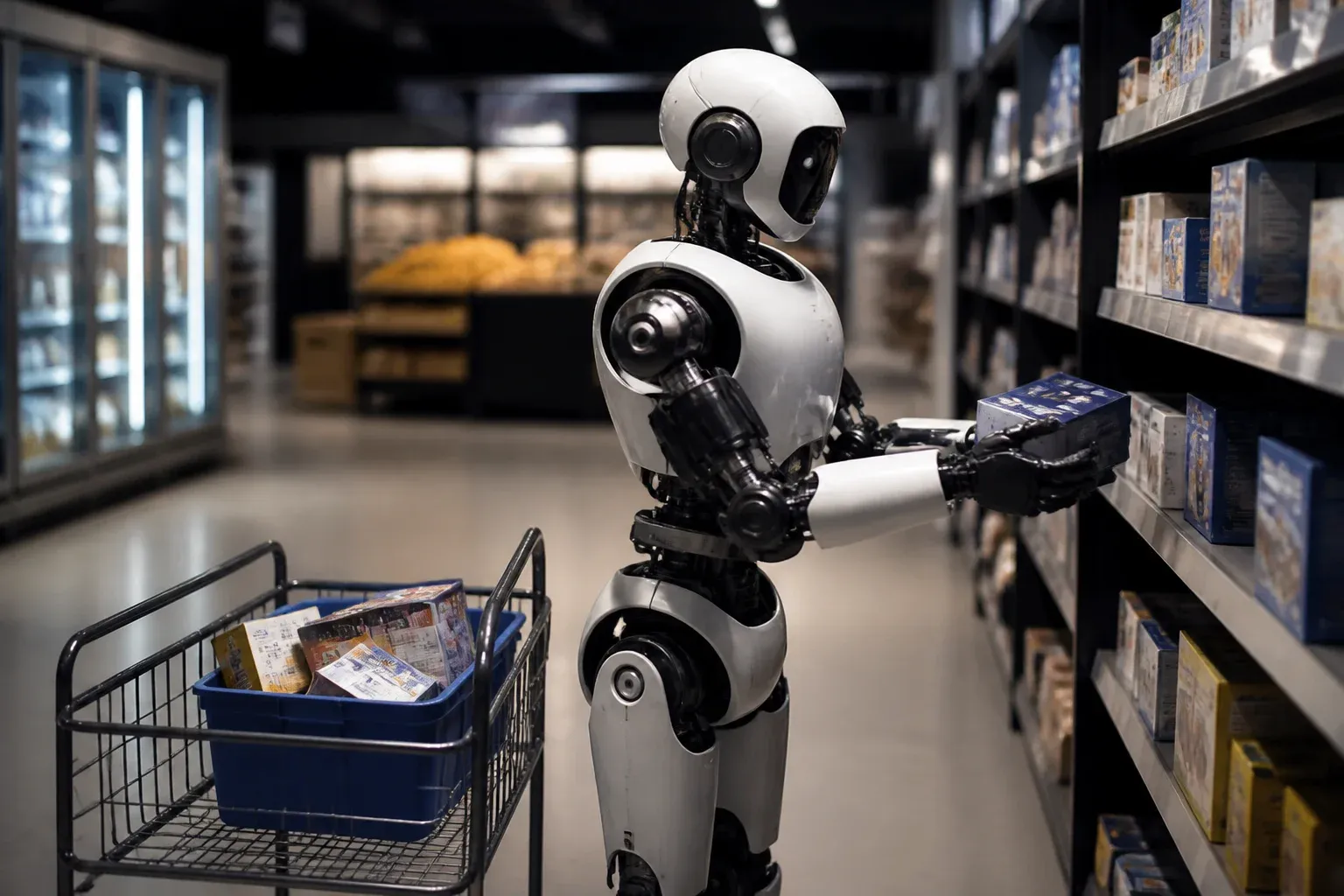
HIVE Robots is testing humanoid robots for overnight shelf replenishment in a Føtex supermarket in Denmark. The Denmark-based startup is combining Unitree-based humanoid hardware with virtual reality teleoperation, allowing remote pilots to guide robots through product placement and replenishment at real store shelf heights. The live trial is significant because it shows a practical route from human-guided robot operation to retail autonomy, but the robots are not yet independently working in customer-facing store areas.
The project is a co-innovation partnership with Føtex, which is owned by Salling Group. HIVE presents night-time replenishment as available today through a Robot as a Service model, while positioning autonomous capability as a later milestone. Its official retail trial information describes live Føtex sessions and the focus on overnight work. The distinction matters: the current deployment is built around human-robot collaboration, not fully hands-off store operations.
How HIVE's retail robot workflow works
HIVE's approach links physical robots to Heimdall, its platform for VR piloting, data capture and in-house model training. A remote pilot uses a low-latency VR interface and whole-body control to direct a humanoid robot as it handles store tasks. That interaction produces operational data that can support the development of more autonomous behavior over time.
This is different from treating a humanoid robot as an appliance that can simply be placed on a shop floor and left to work. Retail shelves, packaging and product positions vary, and the robot must operate in the dimensions of a functioning store. Teleoperation gives operators a way to complete work while collecting data from those real conditions.
The current and intended operating models can be summarized as follows:
| Area | Current Føtex trial | Stated direction |
|---|---|---|
| Core task | Overnight replenishment and product placement | Independent restocking |
| Human role | Remote pilots supervise or intervene through VR control | Greater robot autonomy, subject to safety and regulatory conditions |
| Operating environment | Night-time, non-customer-facing activity | Potential broader store operation if conditions permit |
| Timeframe | Live trial sessions | Goal of independent restocking by early 2027, according to Euronews coverage |
What the pilot does, and does not, establish
The trial demonstrates that humanoid robots can be operated in a real supermarket workflow rather than only in a laboratory. It also tests a service-oriented model that HIVE says it intends to scale across EU stores. HIVE states that pilots and store data are processed within EU infrastructure in Denmark, making data location part of its operating proposition.
However, the pilot does not establish that a store can replace a night team with autonomous humanoids today. HIVE's own communications describe a 2024 to 2026 partnership pipeline and a move toward autonomy as safety and regulatory frameworks allow. Media reporting similarly indicates that regulatory changes would be needed before robots could operate independently among shoppers.
For retailers, the most relevant near-term question is therefore not whether humanoids are universally ready. It is whether a tightly defined task, such as replenishment outside opening hours, can be performed reliably enough under human oversight to justify a pilot. The answer will depend on the task design, operating hours, store layout and the level of remote support required.
How businesses should assess feasibility and return
A useful assessment starts with the workflow, not the robot. Replenishment includes more than moving items to shelves: staff may need to identify the correct location, handle different packaging, resolve exceptions and work around changing layouts. HIVE's VR-led approach is designed for this reality because a human can guide the robot when it encounters a task that has not yet become sufficiently repeatable.
Businesses considering comparable technology should define measurable pilot boundaries before attempting a rollout. Relevant questions include:
- Which replenishment tasks can be safely confined to closed-store hours?
- How often does a remote pilot need to guide or correct the robot?
- Which exceptions still require an on-site employee?
- What information must move between the store's operational systems and the robot workflow?
- How will managers compare the service cost, staff time and task completion quality?
Store systems also deserve careful attention. Inventory, product-location and replenishment data may be important inputs for a production workflow, but the available material does not specify which store systems HIVE currently integrates with. Companies should therefore treat integration scope as a question for a pilot discussion, rather than assume compatibility with point-of-sale, inventory or warehouse tools.
The supplied research does not provide pricing, throughput figures or a quantified return on investment for the HIVE trial. That means there is no supported basis for claiming a specific payback period or labor saving. A credible business case would need pilot data on the task itself, including the frequency of intervention and the quality of completed replenishment.
Store systems also deserve careful attention. Inventory, product-location and replenishment data may be important inputs for a production workflow, but the available material does not specify which store systems HIVE currently integrates with. Companies should therefore treat integration scope as a question for a pilot discussion, rather than assume compatibility with point-of-sale, inventory or warehouse tools.
For companies exploring AI-enabled operations, this Danish trial offers a more grounded lesson than broad promises of fully autonomous work: automation can advance in stages. Remote control, data collection, constrained operating hours and human intervention may be the practical bridge between a manual process and future autonomous capability.
For businesses evaluating AI-driven physical workflows, Scalevise can help turn a broad automation idea into a practical plan that identifies suitable tasks, integration needs and measurable pilot outcomes. Our AI implementation consultancy focuses on selecting realistic use cases and connecting them to everyday operations, so teams can assess value before committing to complex technology. Request an AI consultation to map your highest-value automation opportunity.
Frequently Asked Questions
What is HIVE Robots testing at Føtex?
HIVE Robots is running live sessions with humanoid robots for overnight shelf replenishment and product placement at a Føtex store in Denmark. Remote pilots currently guide and supervise the work through VR teleoperation.
Are the humanoid robots operating independently in the store?
Not yet. The current model relies on human pilots for supervision or intervention. HIVE is working toward greater autonomy, while independent operation in customer areas remains subject to safety and regulatory considerations.
What role does VR play in the retail robot trial?
VR provides a low-latency interface for remote, whole-body robot control. It enables pilots to guide robots through real store tasks while the Heimdall platform captures data for in-house model training.
When could autonomous shelf replenishment be available?
Euronews coverage cited an aim of achieving independent restocking by early 2027. That is a stated target, not a confirmation that autonomous store operation is already available.
Can retailers calculate the return on investment from this trial today?
The available research does not provide pricing, throughput or return-on-investment figures. Retailers would need task-specific pilot data, including intervention needs and completion quality, to assess a business case.
Conclusion
HIVE Robots' Føtex trial is a real-world test of VR-operated humanoids in a defined retail task, not evidence that autonomous shop-floor robots have arrived. Its importance lies in the staged model: human-guided work can generate the operational data needed to pursue autonomy, while safety, regulation and practical store performance continue to set the pace.