
n8n and EU AI Act Compliance: Enterprise Automation Without Regulatory Risk
A practical enterprise-focused guide on using n8n in compliance with the EU AI Act, covering governance, architecture, and AI orchestration risks.
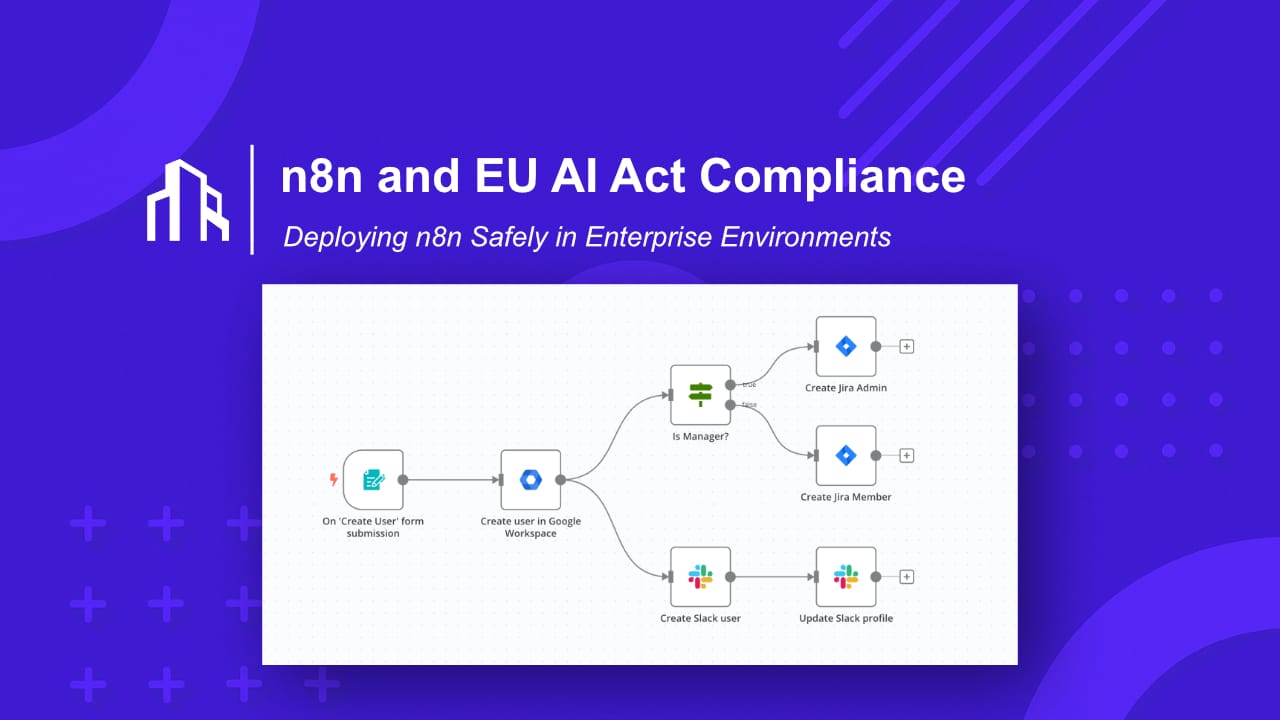
Workflow Automation platforms are becoming a permanent layer in modern enterprise architectures. n8n is increasingly used to orchestrate integrations, workflows, and AI-assisted processes across departments. At the same time, regulatory pressure is rising. The EU AI Act introduces strict obligations for organizations that deploy systems involving artificial intelligence.
For enterprises, the challenge is not whether n8n is “EU AI Act compliant” out of the box. It is about how n8n is architected, governed, and operated when it orchestrates AI-driven components. Compliance is not a feature. It is a design choice.
How the EU AI Act Applies to n8n
The EU AI Act introduces a risk-based framework that categorizes AI systems based on their potential impact. n8n itself does not qualify as an AI system. It does not make autonomous decisions or train models. However, n8n often coordinates AI services, decision engines, and automated actions.
This is where regulatory exposure arises.
When n8n workflows route AI outputs into business processes, trigger decisions, or affect individuals directly, the resulting system may fall under limited-risk or high-risk classifications. In those cases, obligations such as transparency, human oversight, auditability, and accountability apply.
From an enterprise perspective, n8n should therefore be treated as part of the regulated system boundary.
Why Enterprises Choose n8n in Regulated Contexts
n8n is attractive to enterprises precisely because it avoids heavy abstraction. It offers architectural control where other automation tools prioritize convenience.
Key characteristics that matter in an EU AI Act context include:
- Self-hosting and private cloud deployment options
- Full control over data residency and network boundaries
- Extensible workflows and custom logic
- No enforced vendor lock-in for AI providers
This level of control enables compliance, but it also removes excuses. If governance is missing, it is an organizational failure, not a tooling limitation.
Designing n8n Workflows With Compliance in Mind
Human Oversight Is a Workflow Decision
One of the EU AI Act’s core principles is meaningful human oversight. In practice, this means enterprises must consciously decide where automation stops and human judgment begins.
In n8n, this is not a theoretical concept. It is implemented through workflow structure. Approval steps, review queues, and conditional pauses ensure that AI outputs do not directly trigger sensitive actions without validation.
Typical enterprise patterns include:
- Manual approval before customer-facing actions
- Review steps for AI-generated classifications or recommendations
- Escalation paths when confidence thresholds are not met
Fully autonomous workflows are rarely defensible when legal, financial, or employment-related outcomes are involved.
Transparency and Traceability by Design
The EU AI Act requires organizations to explain how AI-supported decisions are made. While n8n does not explain AI logic itself, it can enforce traceability across the workflow.
Well-designed enterprise deployments log:
- Execution context and timestamps
- Workflow versions and change history
- AI prompts, responses, and decision branches where permitted
This transforms automation from a black box into an auditable system. Without this discipline, enterprises will struggle during audits or incident investigations.
Data Governance and Risk Containment
EU AI Act compliance builds on existing data protection principles. Automation does not reduce those obligations. It amplifies them.
In n8n-driven architectures, data flows can easily expand beyond their original purpose. Enterprises must actively prevent this by enforcing data minimization at the workflow level.
n8n supports these patterns technically. Governance ensures they are applied consistently.
Security and Access Control in Enterprise n8n Deployments
Security is not a supporting concern under the EU AI Act. It is foundational.
In enterprise environments, n8n often holds credentials with broad system access. That makes access control and segregation of duties critical. Developers should not automatically have execution rights in production. Operators should not modify workflow logic without oversight.
These controls are expected by regulators and auditors alike.
Using n8n as an AI Governance Layer
One of the most strategic uses of n8n under the EU AI Act is vendor and model governance.
Enterprises remain responsible for third-party AI services they integrate. n8n can centralize AI interactions, making it possible to enforce approved providers, control routing based on data sensitivity, and replace models without disrupting downstream systems.
This turns n8n into a governance layer rather than a passive automation tool.
Common Enterprise Mistakes to Avoid
Most compliance failures involving automation are not technical. They are organizational.
Recurring issues include:
- Shadow automation built outside central governance
- Missing documentation of workflow intent
- AI-driven actions without explicit oversight
- Poor logging and version control
These problems scale quickly once automation is embedded across departments.
Need a Compliant n8n Architecture?
Designing n8n workflows that comply with the EU AI Act is not a matter of toggling settings or installing the right plugins. It requires deliberate architectural choices, clear governance boundaries, and an understanding of how automation and AI interact within regulated enterprise environments.
We help organizations design and implement compliant n8n structures that are built for scale and auditability. This includes setting up secure self hosted n8n environments, defining workflow patterns that enforce human oversight where required, and structuring AI orchestration in a way that limits regulatory exposure instead of amplifying it.
Reach out to discuss how a compliant n8n architecture can support innovation without compromising control or regulatory obligations.
Final Thoughts for Enterprise Leaders
n8n can be deployed in alignment with the EU AI Act, but it demands maturity. Enterprises must abandon the idea that automation is neutral infrastructure. In regulated environments, automation is governance.
Those who design compliance into their workflows now will move faster later. Those who postpone it will pay in remediation, audits, and lost trust.
n8n gives enterprises the control they need. What they do with that control determines whether automation becomes a competitive advantage or a regulatory risk.