
Rakuten AI: How Japan’s Ecosystem Giant Is Building a Real Agentic AI Platform
A clear breakdown of Rakuten AI and the agentic platform behind it, including how it connects services, supports multimodal intelligence and enables task-level automation.
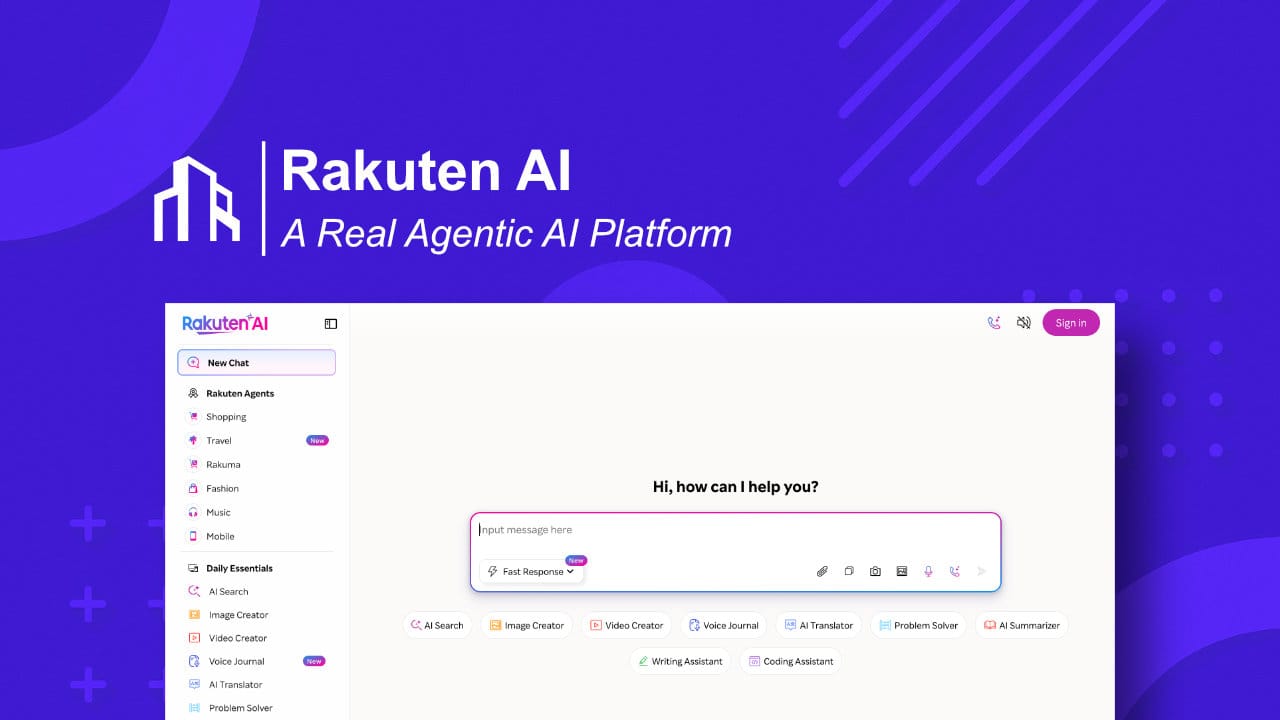
Japan is moving quickly to redefine how intelligent digital ecosystems work, and Rakuten AI sits at the centre of that shift. Rather than positioning itself as just another chatbot, it is designed as a practical agentic platform that supports search, task execution and cross‑service orchestration. The goal is to create a unified intelligence layer that operates across the company’s telecom, e‑commerce, fintech and content services.
A Connected AI Experience
Rakuten AI stands out because it is deeply embedded in an existing multi‑service ecosystem. Instead of living as a standalone AI tool, it is integrated directly into messaging, shopping, account management and content applications. Users interact through text, voice or images, and the assistant responds with personalised, context‑aware insights.
The platform’s design choice is strategic: by understanding user preferences across multiple services, Rakuten AI can make decisions or recommendations that feel consistent and relevant. This aligns with the global shift toward assistant‑driven navigation rather than manual browsing.
Multimodal Intelligence for Everyday Use
The assistant handles a range of tasks, all supported by multimodal input:
- Answering questions and summarising long content
- Translating documents or conversations
- Analysing images or extracting details
- Helping with written communication
- Handling voice‑based interactions for mobile users
These capabilities position Rakuten AI as a versatile support tool, one that caters to both casual users and more demanding workflows.
Deep‑Reasoning Search
The platform’s search layer is built for deep reasoning rather than surface‑level lookups. It interprets intent, context and behavioural patterns to deliver richer results. This approach supports agentic workflows, where an AI must understand the deeper purpose behind a query and return outcomes that align with that purpose.
For example, instead of simply showing product lists, Rakuten AI may compare items, highlight differences or explain advantages, depending on the user’s criteria. This is markedly different from keyword‑based search engines.
Proprietary Model Architecture
Under the hood, the company developed its own large language models to power the system. The flagship model uses a Mixture‑of‑Experts architecture, enabling efficient scaling and high‑quality language understanding. A compact version is available for lighter devices or limited environments.
These models are optimised for Japanese language patterns and communication styles, giving Rakuten AI an advantage in local markets. The models are available under an open commercial licence, allowing adaptation for industry‑specific use cases or research initiatives.
The Agentic Strategy
Rakuten AI is based on a clear strategic shift: moving from static AI responses to operational agent behaviour. The platform aims to execute tasks, orchestrate flows across services and reduce the user’s cognitive load.
The broader vision revolves around:
- Turning answers into actions
- Creating workflow‑level orchestration
- Unifying isolated services under one intelligence layer
This direction reflects the next major wave in global AI development, where assistants become operators rather than advisors.
Deployment Across the Ecosystem
The assistant is currently available through a major communication app as well as a browser‑based interface that any account holder can access. Integration with e‑commerce and fintech services is expanding, enabling the assistant to support purchasing decisions, reward point optimisation, account actions and general service navigation.
As more services adopt Rakuten AI, the platform becomes more capable—because the assistant can access broader context and deliver more relevant output.
Enterprise Applications
Beyond consumer use, there is a dedicated business version. It provides tools for:
- Drafting corporate documents
- Executing translations across departments
- Conducting research or competitive analysis
- Retrieving internal data via RAG pipelines
- Assisting customer support teams
- Improving cross‑team productivity
The business version operates in an encrypted environment that prioritises governance and security.
Market Position
Rakuten AI occupies a strong strategic position. It is backed by a company that operates extensive e‑commerce, telecom and fintech networks, giving the platform access to real usage patterns and service‑level data. Combined with proprietary model development, this creates a competitive differentiation that most AI providers do not have.
In markets where ecosystem integration drives value, Rakuten AI can grow into a central intelligence hub.
Opportunities and Constraints
Opportunities
- Strong personalisation across many services
- Streamlined navigation for ecosystem users
- High‑quality Japanese language performance
- Expansion into agentic workflows for consumers and businesses
Constraints
- International adoption depends on multilingual expansion
- Governance requirements will increase as agentic features grow
- Competing with global AI brands requires clear differentiation
Conclusion
Rakuten AI presents a clear example of how agentic platforms evolve when paired with a broad digital ecosystem. Instead of acting as a separate AI interface, it functions as a connected intelligence layer that enhances search, simplifies tasks and orchestrates workflows across services. With a balanced mix of proprietary modelling, ecosystem integration and long‑term agentic strategy, Rakuten AI is positioned as one of Asia’s most promising AI developments.