
AgentKit: Workflow Automation Agent Builder for the Future of Work
AgentKit enables teams to build intelligent workflow automation agents with governance, memory, and reasoning. Here’s how it works, and why it’s a game-changer.
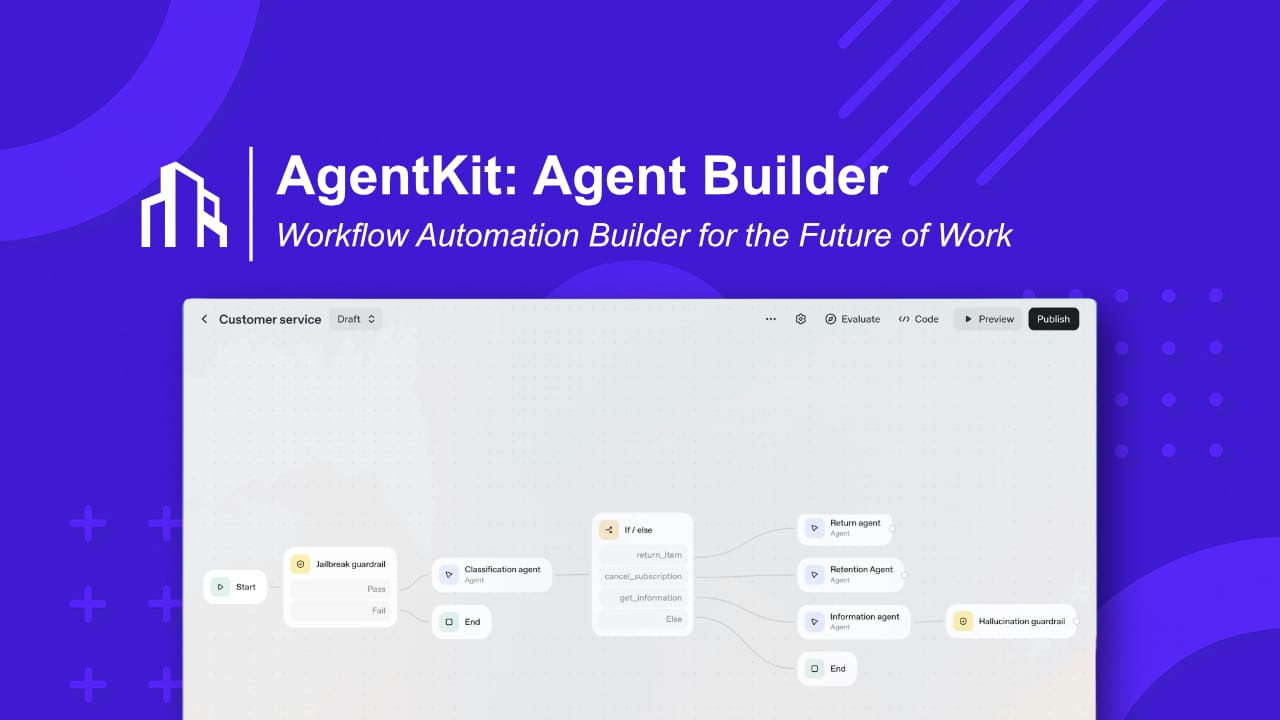
What Is AgentKit?
AgentKit is a framework for building agentic automation workflows intelligent agents that don’t just automate tasks, but make decisions, handle context and execute across systems autonomously.
Unlike rule-based tools like Make.com or n8n, AgentKit focuses on autonomy, continuous context, memory and modular reasoning. It is designed for organisations that want to shift from static integrations toward systems that adapt and optimise.
How It Works
AgentKit’s architecture is composed of:
- Workflow modelling: visual and modular design of steps, decisions and transitions
- Tool integration: connectors and typed interfaces to APIs, databases, RPA tools, and business logic
- Memory & context: persistent state and knowledge so agents maintain continuity across tasks
- Governance & observability: role-based access, human-in-the-loop controls, full audit logs
- Evaluation & optimisation: metrics, feedback loops and versioning to improve agent behaviour over time
Business Impact
Implementing AgentKit leads to measurable shifts:
- Operational scalability: Greater throughput with fewer manual interventions
- Process resilience: Workflows able to adapt, recover and learn over time
- Cross-functional consistency: One agent architecture spanning HR, finance, support and sales
- Compliance by design: Full tracing of decisions, actions and outcomes for audits
- Speed to deploy: From pilot to production in weeks rather than months
Key Use Cases
Customer Support
Agents built with AgentKit can triage incoming requests, enrich data, draft responses and execute permitted actions (e.g. refunds or account changes) while escalating to humans when required.
HR & IT Onboarding
Agents automate account provisioning, permissions assignment, training scheduling and device compliance checks ensuring every onboarding step is covered and documented.
Finance & Compliance
Agents reconcile invoices against POs and bank lines, flag anomalies based on policy, trigger investigations and produce audit-ready logs automatically.
Sales Enablement
Agents qualify leads using firmographic and behavioural data, enrich CRM records, draft quotes, route for approval and initiate renewal workflows.
Governance and Risk Controls
Key governance features include:
- Principle of least privilege: tools expose only the necessary actions
- Human-in-the-loop (HITL) gates: required for irreversible or high-risk operations
- Audit logging: every prompt, tool call, input/output and decision is recorded
- Versioning & rollback: workflows treated like code, with staging and production environments
- Data boundaries and segmentation: sensitive data isolated and tokenised where needed
- Budget and rate-limiting: protect underlying systems and control cost
The Future of Workflow Automation
AgentKit embodies a paradigm shift toward “agentic” automation systems that reason, adapt and act rather than just follow preset flows.
Competitors & Alternatives
| Platform | Focus | Strengths |
|---|---|---|
| LangChain / LangGraph | Agentic reasoning & graph-based orchestration | Large ecosystem, flexible pipelines |
| CrewAI | Multi-agent collaboration and planning | Out-of-the-box team-of-agents patterns |
| UiPath Agents | Enterprise RPA with agentic add-ons | Good for existing RPA-heavy organisations |
| LlamaIndex Workflows | Data-centric retrieval & agent workflows | Strong for document-intensive operations |
| Make.com / n8n | Low-code workflow automation | Simple, deterministic workflows |
| Microsoft Agent Framework | Open-source agent orchestration in .NET/Python | For developers wanting full control |
| AgentKit | Unified build, deployment & observability for agents | End-to-end platform with UI, evals and traceability |
When to Use AgentKit
Adopt AgentKit if your organisation:
- Needs centralised management of multiple automation workflows
- Requires strong compliance, logging and governance
- Operates across many tools, APIs and domain areas
- Wants to shift from task automation to outcome-automation
- Prefers faster deployment with less fragmented tooling
Final Thoughts
AgentKit is much more than just another automation tool. It represents a step toward enterprise systems that act autonomously, yet remain governable and auditable.
How Can Scalevise Help with This?
Scalevise helps businesses turn complex digital challenges into scalable solutions. Whether you're facing compliance, automation, integration or innovation hurdles our team delivers custom strategies and implementations that work. Schedule a call with us:
FAQ
Q: What is AgentKit?
A: AgentKit is an agent builder platform designed for workflow automation. It enables teams to create autonomous agents that plan, reason and execute actions across systems under strict governance and observability.
Q: How does AgentKit benefit businesses?
A: AgentKit allows businesses to automate complex workflows with traceability, compliance and adaptive intelligence. It improves scalability, accuracy and operational transparency.
Q: What are the main competitors of AgentKit?
A: Competitors include LangChain, CrewAI, UiPath Agents, LlamaIndex Workflows, Make.com and Microsoft Agent Framework. Each offers distinct strengths in workflow orchestration and agentic automation.