
Google Gemini 4 Argon and Canvas Hint at a New Path From PDFs to Interactive Content
Gemini 4 Argon can analyze complex PDFs, while Gemini Canvas can create interactive outputs from research. Google has not yet documented a direct end-to-end workflow between them.
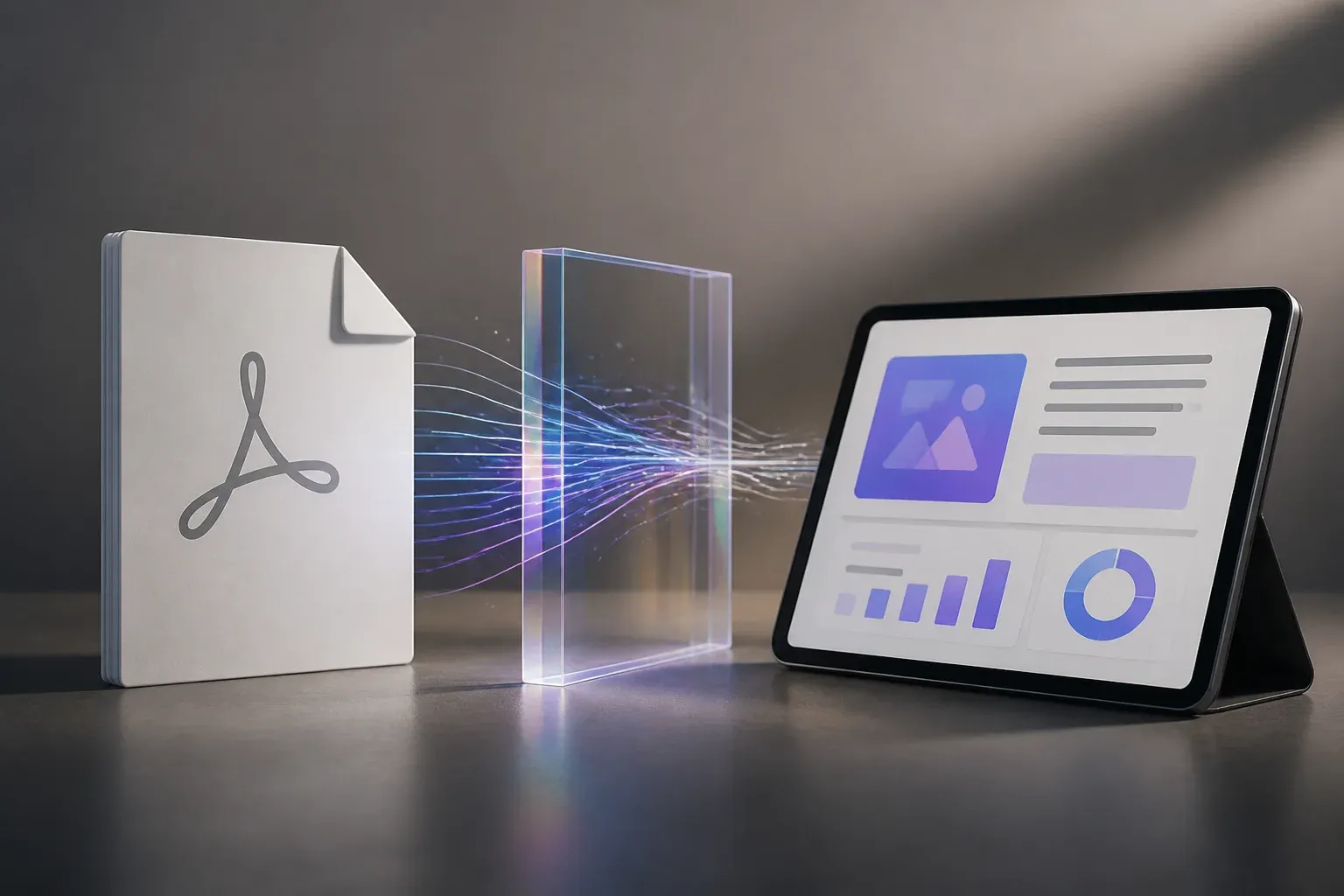
Google's Gemini 4 Argon and Gemini Canvas point toward a potentially useful workflow for turning complex source material into more accessible digital experiences. Argon is positioned for multimodal document understanding and complex data synthesis, while Canvas can turn Deep Research outputs into web pages, interactive quizzes, infographics, apps and other formats. However, Google has not yet published a dedicated, end-to-end workflow that automatically converts a PDF into a fully interactive, animated web app.
That distinction matters for teams considering the technology for onboarding, training, product documentation or research-heavy customer content. The underlying capabilities are real, but the specific PDF-to-interactive-app process remains a credible possibility rather than a documented product promise.
What Google confirms about Gemini 4 Argon and Canvas
In its October 13, 2026 announcement, Google's official Gemini 4 Argon announcement described the model as globally rolling out through the API, AI Studio and Gemini app. Google highlighted deep multimodal document understanding, complex data synthesis and interactive analytical sandboxes among its intended strengths.
The announcement also says Argon can synthesize complex PDFs and patents for information extraction, and it cites professional outputs such as proposals, dashboards and 3D visualizations. These claims establish a strong document-analysis foundation. They do not, by themselves, establish that Canvas takes any uploaded PDF and turns it into a finished interactive web application.
Gemini Canvas supplies the other part of the picture. According to the official Canvas overview, users can transform Deep Research reports into apps, games, interactive quizzes, web pages and infographics. Canvas can also generate working apps or pages from a prompt. Its documented Create action supports converting a Deep Research output into a web page, infographic, quiz or audio overview.
Taken together, these capabilities suggest a plausible route: analyze a dense document, develop research from its contents, then create an interactive output in Canvas. Google has not yet documented that route as a one-step or automatic PDF-to-web-app feature.
| Capability | What official material confirms | What remains undocumented |
|---|---|---|
| Gemini 4 Argon | Complex PDF and patent synthesis, information extraction, multimodal document understanding and data synthesis | A dedicated handoff from a PDF to a finished Canvas app |
| Gemini Canvas | Creation of apps, web pages, quizzes, infographics and other outputs from Deep Research content or prompts | A blanket one-click conversion of arbitrary PDFs into interactive, animated web apps |
Availability and pricing
Google says Gemini 4 Argon is rolling out globally across its API, AI Studio and Gemini app for everyday users, enterprises, researchers and cybersecurity defenders. The announcement lists pricing of $2 per million input tokens and $10 per million output tokens, with an introductory period. The supplied material does not specify how those model prices apply to a potential PDF-to-Canvas workflow, nor does it define separate availability or pricing for such a workflow.
That is important for planning. Teams should not assume that access to Argon automatically includes a particular Canvas creation path, deployment option or usage allowance. Those details would need to be confirmed in product documentation before a production rollout.
Why the possible workflow is relevant to businesses
PDFs remain a common format for manuals, reports, policies, product specifications and training packs. They are portable and familiar, but they can be difficult to navigate, update and absorb, especially when readers need to find a small set of answers quickly.
If Google documents and delivers the combined workflow more explicitly, it could help teams explore new formats without starting with a conventional web-development project. Potential uses could include:
- Turning internal training material into guided interactive learning content.
- Creating explorable product documentation from long manuals or technical briefs.
- Converting research reports into web-based summaries, quizzes or dashboards.
- Giving sales and customer-facing teams a more navigable way to work with approved product information.
These are potential applications, not confirmed Argon or Canvas templates. The quality and reliability of any generated output would still depend on the source document, the instructions used and human review. A polished interface can make information easier to explore, but it does not guarantee that every extracted detail is correct or appropriate for external publication.
The practical implementation question
The most immediate opportunity is not necessarily full automation. A sensible early use case would be a controlled internal pilot with a stable, non-sensitive document and a clear reviewer. A team could compare the original PDF against a Canvas-generated page or interactive format, checking whether the structure is useful, whether important details are preserved and whether the output suits the intended audience.
That approach also helps separate two decisions that are often conflated: using AI to interpret source material, and publishing an interactive experience. The first concerns document comprehension and extraction. The second concerns content design, accessibility, brand presentation and approval. Argon and Canvas may reduce effort across both stages, but they do not remove the need to validate the result.
Turning research-heavy PDFs into useful interactive material is not simply a prompting exercise. Businesses need to choose the right documents, test output accuracy, define review steps and decide whether a generated page belongs in a customer or internal workflow. Scalevise helps teams assess practical AI use cases and build a workable adoption plan through AI implementation consultancy. Request a consultation to map a controlled pilot for your documentation or training process.
Frequently Asked Questions
Can Gemini 4 Argon analyze PDFs?
Yes. Google's Gemini 4 Argon announcement says the model can synthesize complex PDFs and patents for information extraction, alongside broader multimodal document understanding.
Can Gemini Canvas turn a PDF directly into an interactive web app?
Google has not published documentation confirming a direct, automatic PDF-to-interactive-web-app workflow. Canvas is documented as creating interactive outputs from Deep Research content and prompts.
What can Gemini Canvas create from Deep Research?
Google says Canvas can transform Deep Research reports into apps, games, interactive quizzes, web pages, infographics and audio overviews.
How much does Gemini 4 Argon cost?
Google lists $2 per million input tokens and $10 per million output tokens, with an introductory period. The supplied information does not state separate pricing for a PDF-to-Canvas workflow.
Conclusion
Gemini 4 Argon and Canvas provide confirmed pieces of a compelling document-to-interactive-content workflow: advanced PDF understanding on one side and interactive creation on the other. For now, the direct conversion path remains a credible interpretation rather than a documented Google feature. Teams interested in the idea should watch for clearer workflow guidance and test any future capability with appropriate human review.