
GitHub Copilot SDK: From AI Agents to Production-Ready Workflows
The GitHub Copilot SDK exposes Copilot’s agent runtime, enabling teams to build scalable, multi-step AI workflows without custom orchestration frameworks.
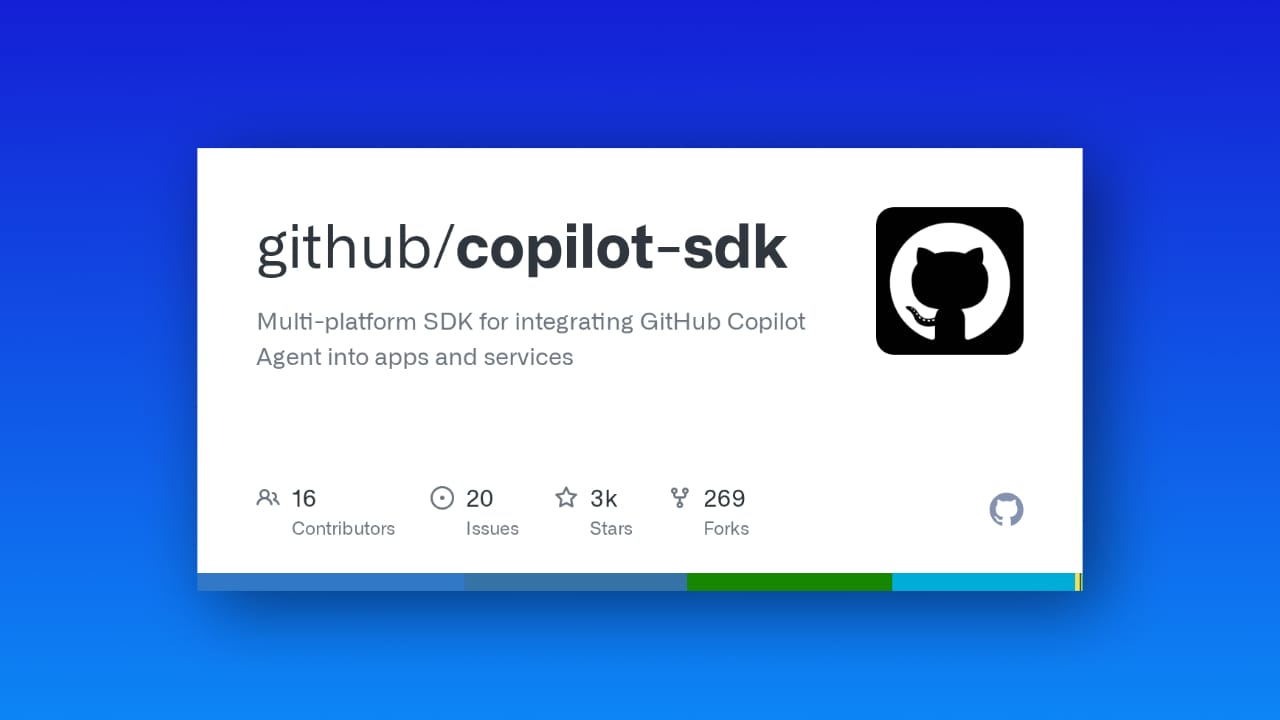
Why the GitHub Copilot SDK Matters
The GitHub Copilot SDK marks a concrete shift from experimental AI agents toward operational, embedded systems. Until now, teams that wanted to build agentic workflows had to design orchestration layers themselves. Context management, tool routing, memory handling, error recovery, and model selection all had to be solved before any real business value could be delivered.
By exposing the same agentic core that powers GitHub Copilot CLI, the SDK removes that foundational burden. Teams can focus on solving problems instead of building infrastructure.
For SaaS platforms, internal tooling teams, and engineering organizations, this is a meaningful acceleration point.
What the GitHub Copilot SDK Actually Is
The SDK is not a prompt wrapper and not a simple API abstraction. It is a full agent runtime.
It provides programmatic access to Copilot’s execution engine, allowing applications to run structured, multi-step AI workflows with planning, tool usage, persistent memory, and recovery logic built in.
The technical preview currently supports Node.js with TypeScript, Python, Go, and .NET, covering most modern backend and platform stacks.
Why Building Agentic Workflows Is Hard Without It
Teams building agentic AI from scratch tend to underestimate the hidden complexity. In practice, the same problems appear repeatedly:
- Maintaining reliable context across multiple steps
- Safely orchestrating tools and commands
- Selecting the right model per task without cost blowups
Before long, a custom orchestration framework emerges, and maintaining it becomes the real project. The SDK removes the need to build and own that layer.
Core Capabilities That Enable Production Use
The real value of the Copilot SDK is how its capabilities work together as a system.
Agents can run session-based workflows instead of single prompts. Tool orchestration is handled through Model Context Protocol servers, enabling structured interaction with external systems. Multi-model routing allows teams to balance performance and cost. Memory can persist across sessions, making long-running and stateful workflows viable.
This combination is what makes the SDK suitable for production environments rather than demos.
Where the Copilot SDK Fits Best
The SDK delivers the most value when agents are embedded directly into existing workflows instead of acting as standalone chat interfaces.
Common applications include
- Internal developer tools such as migration assistants or CI helpers
- SaaS platforms embedding AI-driven onboarding or configuration flows
- Enterprise environments requiring governed, auditable AI agents
Because the SDK is interface-agnostic, these agents can run in CLIs, IDE extensions, web applications, desktop tools, or internal dashboards.
What the Copilot SDK Does Not Solve Automatically
It is important to be direct about limitations.
The SDK accelerates development, but it does not replace architectural responsibility. Teams must still define access boundaries, control data exposure, and ensure observability. Persistent memory requires clear retention rules. Tool access must be explicitly scoped.
Used well, the SDK reduces risk. Used carelessly, it amplifies it.
Questions to Answer Before Adopting the SDK
Before committing to the SDK, teams should align on a few fundamentals:
- What data an agent may access by default
- Which tools can run autonomously versus with approval
- How agent behavior is logged and monitored
These decisions determine whether an agent becomes a scalable asset or an operational liability.
How Scalevise Helps with Copilot SDK Implementations
At Scalevise, we treat agentic AI as infrastructure, not experimentation.
We help teams design and implement solutions that are production-ready from day one. That includes architecture design, custom agent development, secure tool orchestration, and integration with existing platforms and workflows.
Our focus is on systems that scale, pass audits, and deliver measurable business value.
When It Makes Sense to Act
If your team is already experimenting with agentic workflows, the signals that the ecosystem is maturing. Continuing to invest in custom orchestration layers will quickly turn into technical debt.
Starting with a proven agent runtime allows teams to move faster without losing control.
If you want to build agentic workflows using the GitHub Copilot SDK in a secure, scalable, and production-ready way, Scalevise can help.
We support teams from architecture through implementation and governance.