
ChatGPT 5.2 vs Gemini 3: The Real Differences And GPQA Benchmark Score
An in depth comparison of GPT 5.2 and Gemini 3 with a focus on real world capabilities, reasoning performance and workflow impact.
Updated: 04-02-2026
AI innovation is accelerating, and the release of GPT 5.2 has pushed the competitive pressure between OpenAI and Google to a new level. Both GPT 5.2 and Google Gemini 3 position themselves as next-generation intelligence platforms that support complex reasoning, extended context workflows, and multimodal capabilities. Despite similar ambitions, the two models take very different approaches. This analysis breaks down the real performance and strategic differences and outlines when each model makes sense for business adoption.
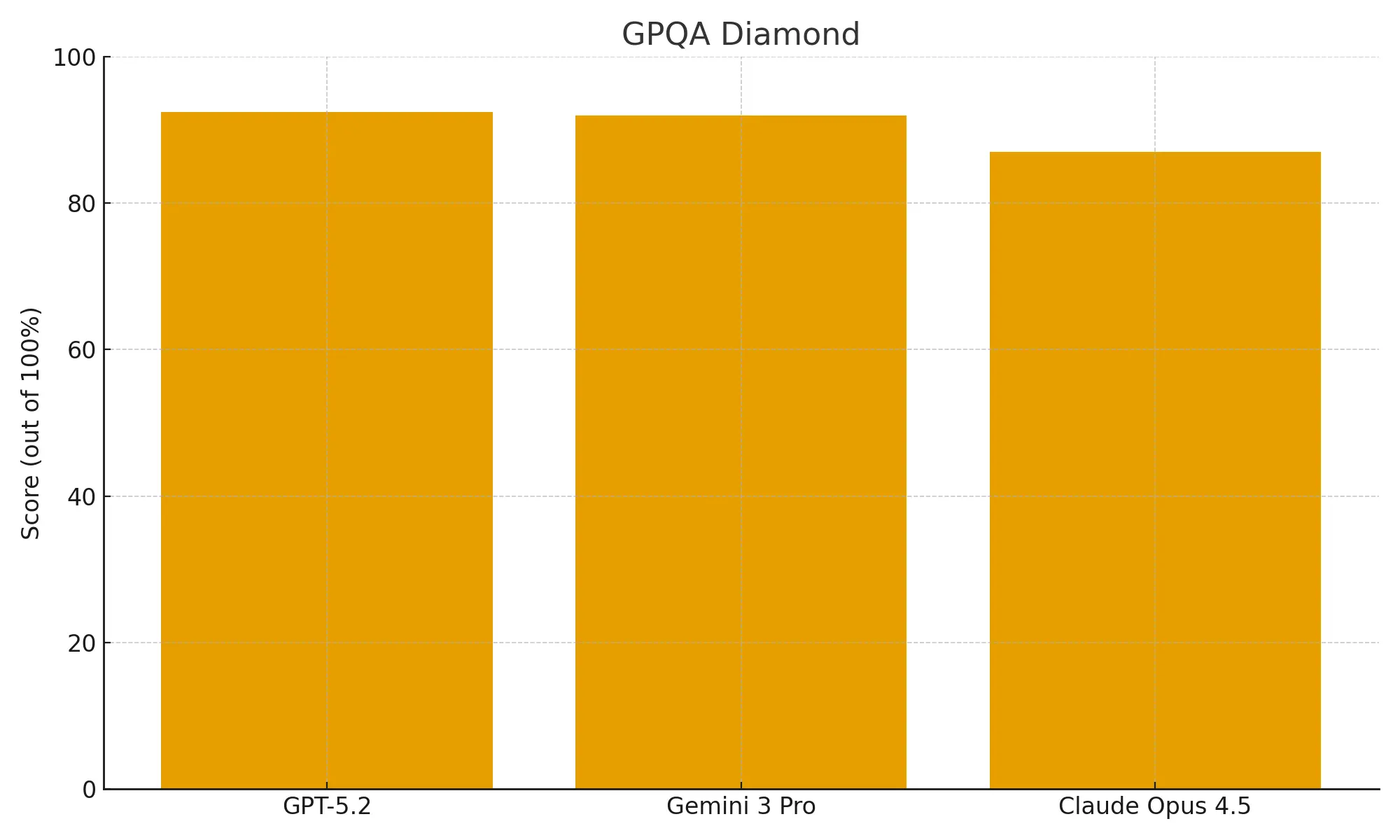
GPT-5.2 GPQA Diamond Score
What GPT 5.2 Actually Improves
GPT 5.2 introduces significant upgrades that focus on practical output and reliability in knowledge work. OpenAI positions this release as a leap in professional capability rather than a purely experimental jump in model size. The improvements can be summarized in four key areas.
- Stronger Reasoning for Structured Work: GPT 5.2 performs better on tasks that require precision, such as spreadsheet generation, document analysis, formula creation, financial summaries, and legal-style reasoning.
- More Stable Long-Context Understanding: GPT 5.2 maintains coherence over long conversations and large documents. This makes the model better suited for multi-step workflows and agent-style executions where memory consistency is essential.
- Enhanced Multimodal Alignment: Image analysis and tool integration feel more predictable. The model recognizes patterns in images faster and executes tool calls with fewer errors.
- New Model Variants for Different Use Cases: Instant, Thinking, and Pro editions provide targeted behavior. Instant focuses on responsiveness. Thinking provides deeper reasoning. Pro aims at maximum capability for complex tasks.
In short, GPT 5.2 focuses less on flashy demos and more on real-world business utility.
What Gemini 3 Brings To The Table
Gemini 3 is Google’s answer to enterprise-class AI, and it carries several strengths that make it competitive and in some areas superior.
- High-Performance Reasoning: Gemini 3 performs exceptionally well on scientific and technical reasoning tests, especially in the Deep Think mode available to upper-tier users.
- Massive Context Windows: Gemini 3 offers extreme long-context capabilities. This is valuable for legal reviews, multi-chapter documents, software repositories, and analytics tasks that rely on massive inputs.
- Ecosystem Integration: The power of Google’s stack is significant. Gemini works smoothly with Search, Workspace, YouTube, Android, and internal Google datasets. This gives Gemini a natural advantage for organizations that already rely on Google infrastructure.
- Strong Multimodal Foundations: Gemini 3 demonstrates impressive visual and audio understanding and is especially strong in creative and media-oriented tasks.
Gemini 3 is clearly designed to dominate in environments where scale, context, and ecosystem reach matter.
Direct Comparison: GPT 5.2 vs Gemini 3
| Feature | GPT 5.2 | Gemini 3 | Key Difference |
|---|---|---|---|
| Reasoning Quality | Better operational reasoning (business analysis, planning) | Edges ahead in scientific and logic-heavy workloads | Use Case Alignment |
| Context Handling | Wins on contextual stability and clarity in multi-turn talks | Wins on extreme context length (size) | Stability vs. Scale |
| Productivity | Better tuned for document workflows, spreadsheets, code gen | Strong in research and large-scale data processing | Structured Output Focus |
| Multimodal | Leads on applied multimodal productivity | Pushes ahead for creative visual and media tasks | Applied vs. Creative |
| Integration | Deep integration into OpenAI and Microsoft ecosystems | Deep integration into Google's platform (Workspace, etc.) | Ecosystem Choice |
The Honest Perspective
Both models are at the top of the industry, and both outperform most human equivalent tasks in reasoning, generation, and information synthesis. The question is no longer which model is "smarter." The question is which model delivers predictable value inside a real business environment.
- GPT 5.2 is the stronger option when the use case is stable, repetitive, operational, and tied to measurable outputs. Its behavior is controlled and reliable. It fits organizations that need precision, documentation, compliance reporting, automation, and agent workflows.
- Gemini 3 is a powerful choice when context size is the primary constraint or when teams rely heavily on Google infrastructure. It also shines in research, media, video analysis, and tasks that demand creative multimodal interpretation.
The honest truth is that the performance gap between the two is now more strategic than technical. GPT 5.2 excels at turning work into structured output. Gemini 3 excels at large-scale reasoning and ecosystem intelligence. Mature organizations may even use both depending on the specific workflow.
Final Verdict: Choose Your Tool
GPT 5.2 is ideal for:
- Productivity workflows
- Automation pipelines
- Analysis and decision support
- Enterprise documentation
- Operational AI agents
Gemini 3 is ideal for:
- Deep research
- Large document processing
- Creative and visual work
- Google-centric organizations
- Extremely long context tasks
Neither model is universally better. They are different tools with different strengths. Companies that choose based on workflow, not hype, will outperform competitors who simply chase the newest release.