
Make AI Web Search Brings Real-Time Web Data Into Your Automations
Make AI Web Search lets your scenarios pull live internet data during execution and act on it instantly. No scraping. No delays. Just real-time web signals inside your workflows.

Make has introduced AI Web Search as a native way to pull live web data directly into running scenarios. APIs only expose what vendors allow. Scrapers break constantly. Scheduled data imports are always late. Until now, workflows could not truly see what was happening on the live internet.
With the introduction of AI Web Search, Make removes that limitation. Scenarios can now actively search the live web in real time and immediately act on the results inside automations. This changes how data enters workflows, how triggers are designed and how fast organisations can respond to external events.
This is not an add-on. It is a new input layer for automation itself.
What Make AI Web Search Actually Does
It allows a scenario to perform a live AI-driven search query on the open web during execution. Instead of relying on predefined datasets, APIs or static sources, the automation dynamically retrieves fresh information at the moment it runs.
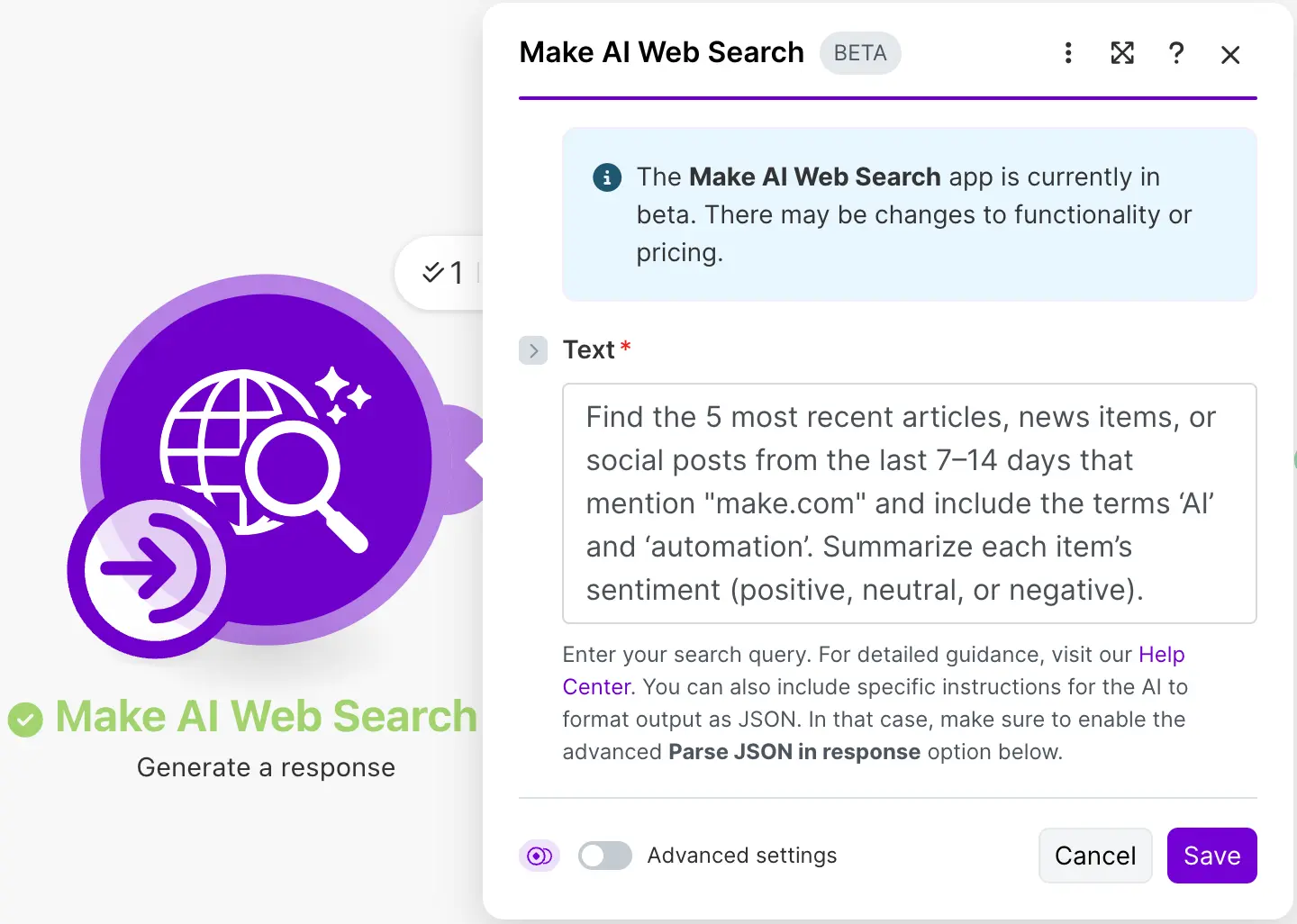
The result is simple but powerful. Your automation is no longer limited to what your systems already know. It can actively look outside your ecosystem and pull in data that did not exist seconds earlier.
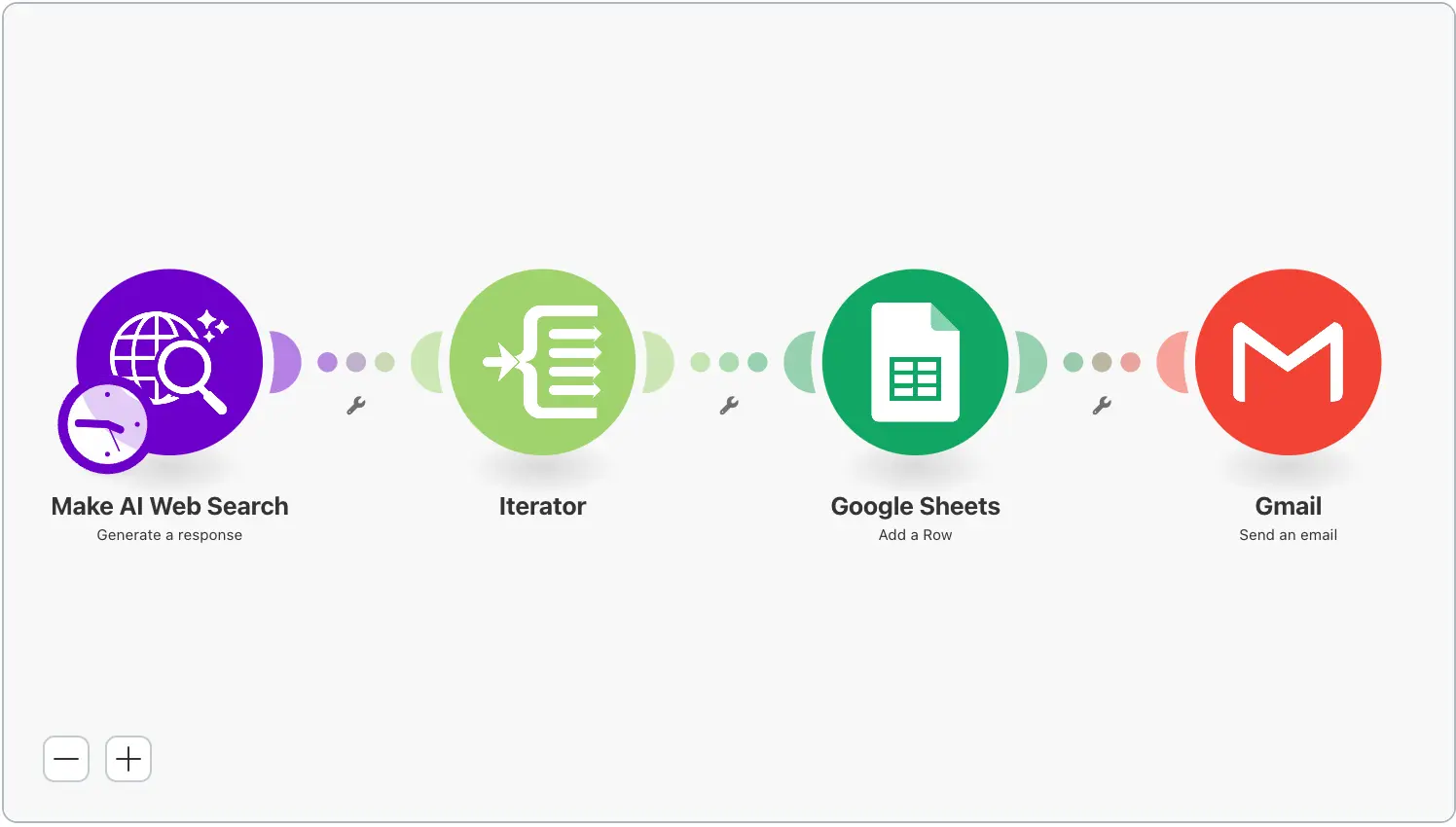
This turns Make scenarios into self-updating research and monitoring engines.
How This Technically Changes Automation Design
Before AI Web Search, workflows were built around fixed triggers and known data structures. With live web search, the trigger itself can now be external reality.
A scenario can search the web, interpret the result with AI logic, apply conditions and immediately execute actions based on what it finds. This removes the traditional separation between research, monitoring and execution.
In practice, this means that automations can now start with a question instead of a webhook.
The Core Use Cases in One Overview
This is the single bulletpoint section, as requested:
- Live monitoring of competitors, products, pricing pages and public announcements
- Automatic detection of regulatory updates, policy changes and enforcement news
- Real-time lead intelligence based on company launches, hiring activity or funding news
- Continuous brand monitoring across blogs, forums and review platforms
- AI-driven research workflows that never rely on outdated sources
Everything outside this section intentionally remains in full text.
Why This Is More Than Just “Search Inside Automation”
Most tools that claim real-time data still depend on intermediaries. They poll APIs. They scrape HTML. They sync structured feeds. This is different because it uses AI to interpret unstructured web content directly during execution.
This allows scenarios to work with pages that were never designed for automation in the first place. Blog posts, PDFs, changelogs, announcements and documentation updates become machine-readable without building parsers.
That is the real technical innovation here.
Where the Risks Start If You Implement This Blindly
Real-time web input also introduces new risks. Public web data is noisy, inconsistent and sometimes incorrect. Without validation and governance, automations can act on false signals.
The most common failure patterns are:
- Scenarios that trigger on unreliable sources.
- Automations that react to duplicate or outdated pages.
- Workflows that execute actions without confidence thresholds.
- No logging of what external data was actually used.
This is exactly why AI Web Search must be implemented as part of a controlled automation architecture, not as a standalone experiment.
How Scalevise Implements AI Web Search in Production Environments
At Scalevise, the new module is never deployed as a loose module. It is embedded into a governed automation layer that includes data validation, approval steps, confidence scoring, audit logging and fallback logic.
The goal is not just faster automation. The goal is reliable real-time automation.
What This Changes for Teams Using Make Today
Teams that already rely on Make can now move entire manual research processes into automated flows. Tasks that previously required daily checking now become event driven.
- Sales no longer waits for weekly lists.
- Compliance no longer monitors manually.Marketing no longer reacts after campaigns are visible.
- Operations no longer learns about changes through tickets.
The internet becomes an active event source instead of a passive information pool.
When This Becomes a Serious Competitive Advantage
The advantage does not come from using AI Web Search once. It comes from integrating it deeply into your automation design.
When live web data feeds directly into CRM, governance systems, alerting pipelines and internal dashboards, automation stops being a support tool and becomes an operational intelligence layer.
That is where Scalevise positions this capability. Not as a feature. But as infrastructure.
Want to explore how this applies to your stack? Book a short call.