
You’re Not Ranking in ChatGPT and Here’s Why Your Website Is Being Ignored
Most websites are not visible in AI tools like ChatGPT, Gemini, Copilot, and Claude. Learn why your website is being ignored and how to improve your AI visibility.
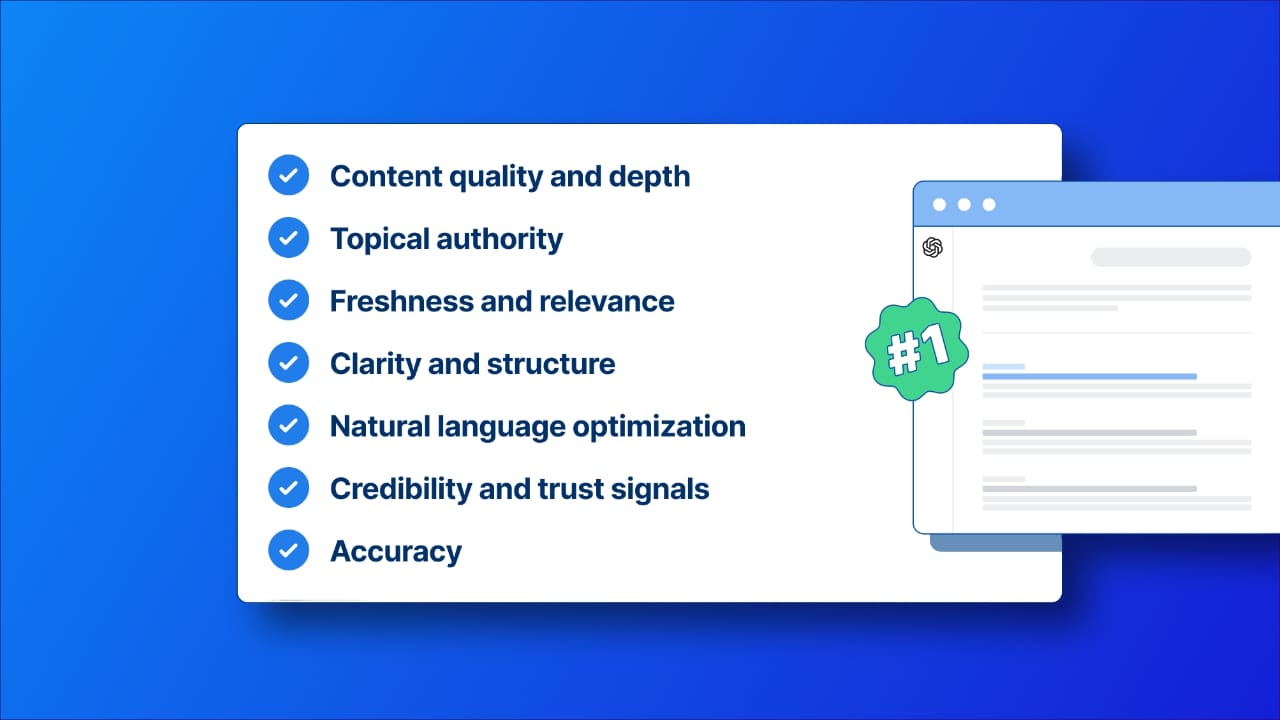
For years, businesses focused on Google rankings, backlinks, and keyword optimization. That worked because traditional search engines relied on structured signals and link authority.
AI systems like ChatGPT, Gemini, Copilot, and Claude are becoming the first point of contact for answers. And here is the problem:
⚠️ Most websites never appear in AI answers. Test your page with the GEO Checker and see why.
Table of Contents
- What is AI Visibility
- Why Are You Not Ranking in ChatGPT
- Introducing GEO
- How To Improve AI Visibility
- Analyze Your Website
- FAQ
What Is AI Visibility
AI visibility refers to how well your website can be discovered, interpreted, and used by AI systems when generating answers.
Unlike traditional SEO, AI does not just rank pages. It interprets them.
That means:
- Your content needs to be machine-readable
- Your structure needs to be clear and semantic
- Your signals need to be consistent and contextual
If AI cannot confidently understand your content, it simply ignores it.
No matter how good your rankings are.
Why You Are Not Ranking in ChatGPT
Let’s be direct.
If your website is not showing up in AI-generated answers, one or more of these issues is likely happening.
1. Your Content Is Not Structured for AI
AI models rely heavily on structure.
If your content is:
- unorganized
- inconsistent
- lacking headings
- missing clear sections
then AI struggles to extract meaning.
A well-structured page with clear H1, H2, and logical flow performs significantly better in AI interpretation.
2. You Lack Strong Entity Signals
AI does not think in keywords. It thinks in entities.
That means:
- brands
- topics
- relationships
- context
If your website does not clearly define:
- who you are
- what you do
- what you are related to
then AI has no anchor to trust your content.
3. Your Website Is Technically Invisible to AI
Many websites look fine to humans, but fail technically.
Common issues:
- missing structured data
- poor semantic HTML
- weak internal linking
- inconsistent metadata
AI relies on these signals to understand your page.
Without them, your content becomes guesswork.
4. Your Content Is Not “Citable”
AI systems prefer content they can confidently reuse.
If your content:
- lacks clear answers
- is too vague
- is overly promotional
- does not provide direct value
it will not be selected.
AI looks for:
- concise explanations
- factual clarity
- structured answers
5. You Are Optimizing for Google, Not for AI
This is the biggest mistake.
Traditional SEO focuses on:
- backlinks
- keyword density
- rankings
AI visibility focuses on:
- understanding
- clarity
- structure
- trust
These are not the same game anymore.
Introducing GEO: The Next Layer of Optimization
GEO stands for Generative Engine Optimization.
It is the evolution of SEO, specifically focused on how AI systems interpret and use your content.
Where SEO asks:
“How do I rank?”
GEO asks:
“How do I get used in AI answers?”
This includes:
- structured data implementation
- semantic HTML improvements
- entity clarity
- content formatting for AI extraction
- internal linking for context building
GEO is not a replacement for SEO.
It is the next layer on top of it.
How to Improve Your AI Visibility
If you want your website to appear in AI-generated answers, you need to adapt.
Here are the fundamentals.
1. Fix Your Content Structure
- Use a single clear H1
- Add logical H2 and H3 sections
- Break content into readable blocks
- Avoid large, unstructured paragraphs
Clarity beats creativity here.
2. Implement Structured Data
Structured data helps AI understand your content instantly.
Focus on:
- Organization schema
- Article schema
- FAQ schema
- Product or service schema where relevant
This is one of the highest impact improvements.
3. Strengthen Internal Linking
Internal links provide context.
They help AI understand relationships between pages.
Make sure:
- your pages are connected
- anchor texts are meaningful
- key pages are easily discoverable
4. Improve Content Clarity
Write like AI is reading your content.
Because it is.
- Answer questions directly
- Avoid fluff
- Be specific
- Use clear language
5. Build Entity Authority
Make it obvious:
- who you are
- what you specialize in
- what topics you own
Consistency across your website matters more than volume.
The Hidden Opportunity Most Businesses Miss
Right now, AI visibility is still underutilized.
Most companies are still focused on traditional SEO.
That creates an opportunity.
If you optimize for AI today, you are early.
And early means:
- less competition
- faster visibility gains
- stronger positioning
This window will not stay open forever.
Analyze Your Website for AI Visibility
If you want to understand where you stand, you need data.
That is exactly why we built the AI Visibility GEO Checker.
It analyzes:
- structured data
- content structure
- internal linking
- entity signals
- technical AI readiness
And shows you exactly what is missing.
👉 https://scalevise.com/ai-visibility-geo-checker
Final Thoughts
You are not ranking in ChatGPT for a reason. Not because your website is bad, but because it is not built for how search works today.
AI is not replacing search. It is redefining it. And the businesses that adapt early will gain a significant advantage in this new layer of visibility.
The real question is simple: will your website be understood by AI, or ignored by it?
Frequently Asked Questions
What does it mean to rank in ChatGPT or AI search?
Ranking in AI search does not work the same way as traditional search engines like Google. AI systems do not simply rank pages based on keywords or backlinks. Instead, they interpret content and select sources that are clear, structured, and trustworthy enough to be used in generated answers. If your website is not structured in a way that AI can understand, it will not be included, regardless of your traditional rankings.
What is AI visibility and why does it matter?
AI visibility refers to how well your website can be discovered, interpreted, and reused by AI systems such as ChatGPT, Gemini, Copilot, and Claude. As more users rely on AI for answers instead of clicking through search results, being visible in AI-generated responses becomes a critical growth channel. Without AI visibility, your website risks losing relevance in modern search behavior.
What is the difference between SEO and GEO?
SEO focuses on improving rankings in traditional search engines through signals like backlinks, keywords, and technical optimization. GEO, or Generative Engine Optimization, focuses on how AI systems interpret and use your content. While SEO is about ranking, GEO is about being selected and cited in AI-generated answers. Both are important, but GEO is becoming increasingly critical.
Why is my website not showing up in AI-generated answers?
There are several common reasons. Your content may lack proper structure, such as missing headings or logical flow. You might not have strong entity signals that clearly define your brand and expertise. Technical elements like structured data and internal linking may also be missing. In many cases, the content itself is not written in a way that AI systems can easily extract and reuse.
Does improving AI visibility also improve SEO?
In many cases, yes. Improvements such as better content structure, clearer semantics, and stronger internal linking benefit both AI systems and traditional search engines. However, the intent is different. SEO aims to improve rankings, while AI visibility focuses on making your content understandable and usable by AI systems.
How can I test my website for AI visibility?
The most effective way is to analyze your website using a dedicated tool that evaluates AI-related signals. This includes structured data, content clarity, entity strength, and technical indicators. You can use the AI Visibility GEO Checker to scan any webpage and identify exactly what is missing and how to improve it.