
Anthropic MHS Brings AI Agents to Biotech Labs and Quantum Hardware
Anthropic's Model Hardware Standard research preview documents early AI-agent pilots at Genentech, HHMI Janelia and QuEra, spanning laboratory automation, microscopy and quantum hardware.
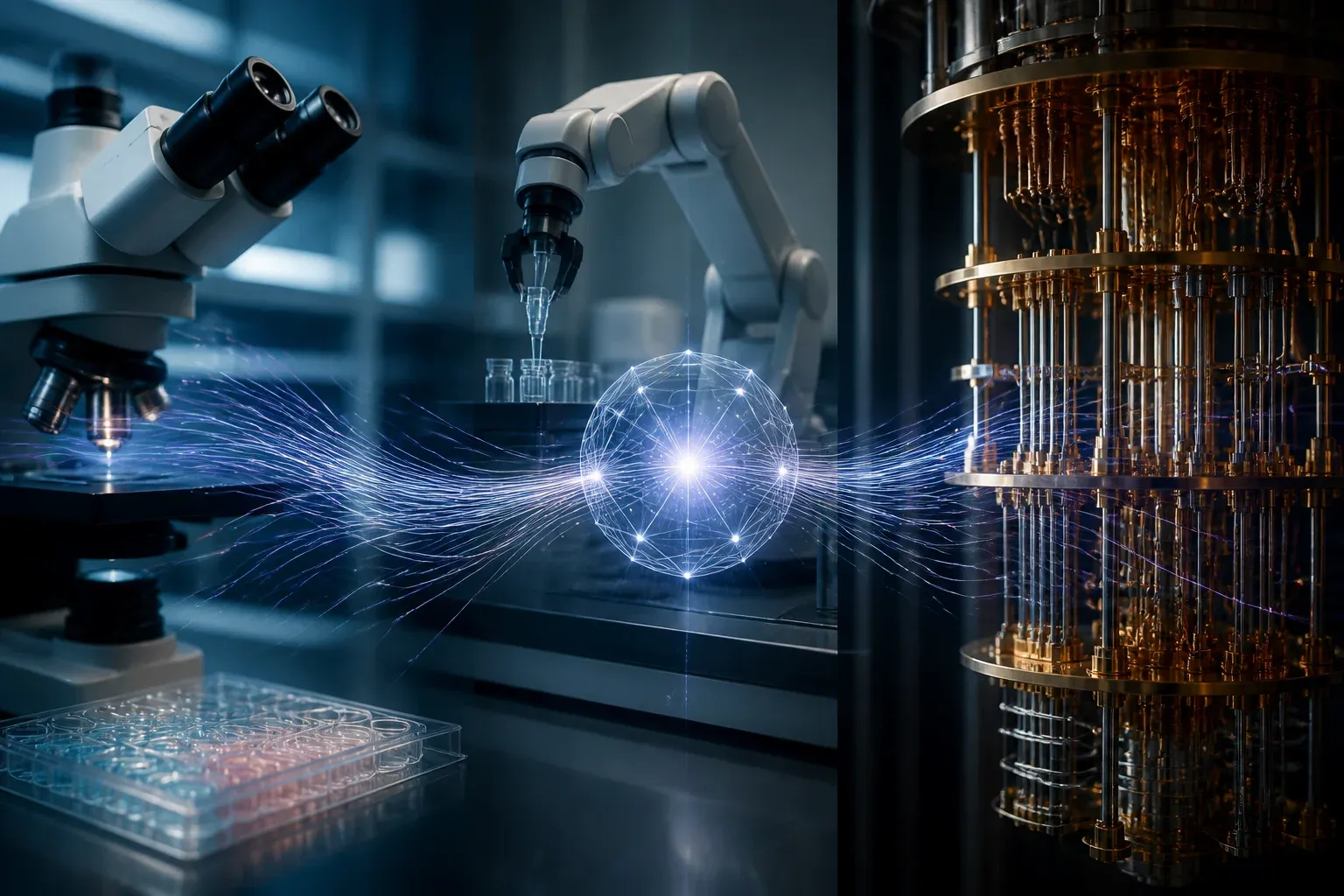
Anthropic has introduced a Model Hardware Standard (MHS) research preview that aims to help AI agents operate physical laboratory and industrial equipment. Early pilots at Genentech, HHMI Janelia Research Campus and quantum-computing company QuEra show the approach being applied to lab automation, microscopy and laser control. The significance is not simply that an AI model can issue commands. MHS is intended to reduce the friction of connecting agents to varied hardware and software while retaining safety checks and human approvals for higher-risk decisions.
In Anthropic's Model Hardware Standard research preview, the company describes MHS as a public research preview for an initial cohort of labs and manufacturers. The work originated in a collaboration between Anthropic and HHMI Janelia. It is an early-stage effort, rather than a general declaration that labs can safely hand every scientific decision to an autonomous agent.
The three demonstrations matter because they cover very different operational environments. A liquid-handling workflow, a microscopy rig and a laser subsystem in a neutral-atom quantum computer each involve distinct equipment, software and failure modes. MHS is being tested as a common orchestration layer that lets an agent work across those systems.
What Anthropic's MHS pilots demonstrate
Genentech: coordinated protein-assay automation
At Genentech, Anthropic says MHS was implemented around a BCA protein assay workflow. The deployment coordinated a liquid handler, robotic arm and plate reader, allowing an agent to run the workflow with real-time error handling. This is a practical example of where hardware automation often becomes difficult: the individual instruments may already be automated, but transferring samples, sequencing tasks and responding to exceptions can still require people and custom integration work.
For laboratory teams, the useful lesson is that AI-led automation is most credible when attached to a defined, repeatable process with clear equipment roles. The pilot does not establish that an agent can replace scientific judgment. It shows how an agent can coordinate work that would otherwise move between multiple hardware systems and operators.
HHMI Janelia: a single layer for microscopy workflows
HHMI Janelia used MHS to unify disparate vendor software into one orchestration layer for microscopy rigs. Anthropic says the work enabled faster and safer operation, and early testing compressed an imaging experiment that had taken weeks into a day.
Microscopy is a relevant test case because the bottleneck is often broader than image capture. A workflow can span instrument control, settings, sample handling and the different applications supplied by equipment vendors. Bringing those components into a single agent-accessible layer could reduce manual handoffs and make complex procedures easier to repeat, provided the controls and approvals are designed for the specific experiment.
QuEra: recovery in a quantum-computer laser subsystem
QuEra applied MHS to a laser subsystem in a neutral-atom quantum computer. In the pilot, Anthropic reports that the AI agent achieved 99.3% laser relock recovery without human intervention, improving on the 58% result cited in the early testing description.
That result is notable because it frames the agent as an operational recovery tool, not only a scheduler. Physical systems fail, drift or require adjustments. An agent that can detect a known condition and execute an approved recovery procedure could improve equipment uptime. It should not be interpreted as evidence that MHS has solved every reliability challenge in quantum hardware or laboratory operations.
| Organization | Equipment or workflow | MHS role in the pilot | Reported outcome |
|---|---|---|---|
| Genentech | BCA protein assay with a liquid handler, robotic arm and plate reader | Coordinated an automated lab workflow with real-time error handling | Accelerated automated lab work |
| HHMI Janelia | Microscopy rigs and disparate vendor software | Provided a single orchestration layer | An imaging experiment was compressed from weeks to a day |
| QuEra | Laser subsystem in a neutral-atom quantum computer | Managed laser relock recovery | 99.3% recovery without human intervention |
What MHS could mean for hardware-intensive workflows
The preview points to a model of automation that sits above individual devices. Instead of building a separate control process for every instrument and application, organizations could use a common standard to expose approved actions to an AI agent. Anthropic's stated goals include reducing deployment friction and enabling round-the-clock experimentation.
The potential business value is straightforward, although it will depend on each environment. Teams may be able to reduce time spent coordinating repeatable steps, respond to defined equipment issues more quickly and make better use of expensive instruments outside normal operating hours. For organizations with a small technical staff, a standard approach could be more attainable than maintaining a large collection of one-off integrations.
The pilots also illustrate the boundaries that matter. Physical automation needs explicit operating limits, reliable equipment interfaces and procedures for errors that are outside the agent's approved scope. Anthropic says MHS incorporates safety checks and human approvals for high-risk decisions. That design is important because faster operation is valuable only when the resulting workflow remains suitable for the scientific or technical task.
MHS is currently a research preview for a first cohort of labs and manufacturers. The supplied announcement does not set out general pricing or broad commercial availability. Businesses evaluating this category should therefore treat the pilots as evidence of technical direction and early deployment experience, not as a ready-made implementation promise for every connected device.
AI-operated equipment can reduce manual handoffs and help teams get more value from specialized tools, but dependable results require well-defined workflows, safe controls and practical integrations. Scalevise helps businesses identify where agents and connected systems can remove repetitive work without adding unnecessary complexity. Discuss an AI automation project with Scalevise to turn a high-value workflow into a practical implementation plan.
Frequently Asked Questions
What is Anthropic's Model Hardware Standard?
Anthropic's Model Hardware Standard, or MHS, is a research-preview standard intended to help AI agents operate physical hardware and software through a common orchestration approach. Anthropic says it includes safety checks and human approvals for high-risk decisions.
Which organizations have tested MHS?
Anthropic documents early pilots at Genentech, HHMI Janelia Research Campus and QuEra. The pilots cover a protein-assay workflow, microscopy workflows and a laser subsystem in a neutral-atom quantum computer.
What result did QuEra report with MHS?
In the pilot, the AI agent achieved 99.3% laser relock recovery without human intervention for a laser subsystem in QuEra's neutral-atom quantum computer. The early testing description cites a prior result of 58%.
Is Anthropic MHS generally available?
Anthropic describes MHS as a public research preview for a first cohort of labs and manufacturers. The supplied announcement does not provide general pricing or broad commercial availability details.
Conclusion
Anthropic's MHS preview provides concrete early evidence that AI agents can coordinate real hardware workflows across biotech research, microscopy and quantum computing. The demonstrations are still pilots, but they show a potentially important path toward safer, more unified automation of specialized equipment. The next test will be whether the standard can deliver similar reliability and operational value across a wider range of laboratories and manufacturers.